

Is your home’s electrical system actually holding back your next big upgrade, like that new EV charger or smart home setup you’ve been eyeing? Many homeowners realize too late that their current panel can’t handle the demands of 2026 technology. When you start looking into the cost to upgrade electrical panel, it’s easy to feel overwhelmed by a confusing range of quotes and the fear of hidden expenses like drywall repair or utility fees. You aren’t alone in wondering if you truly need a 200-amp service or if your existing setup just needs a minor adjustment.
We understand that home infrastructure projects should feel like a step forward, not a source of stress. This guide provides a transparent framework to help you navigate the variables that impact your budget. You’ll learn the vital difference between a simple panel swap and a full service upgrade, ensuring you only pay for what your property actually requires. By the end of this article, you’ll have the professional insights needed to choose a local expert and future-proof your home with complete confidence.
Key Takeaways
- Learn how choosing between 100, 200, or 400 amps dictates your material expenses and prepares your home for modern technology.
- Understand how the total cost to upgrade electrical panel is influenced by the technical difference between a panel swap and a full service upgrade.
- Discover how local labor trends and specific permit fees in Richmond, Katy, and Sugar Land impact your final investment.
- Identify potential hidden expenses like panel relocation requirements and grounding updates mandated by the latest 2026 code changes.
- Evaluate the long-term return on investment, from increasing property resale value to potentially lowering your home insurance premiums.
What Determines the Cost to Upgrade an Electrical Panel in 2026?
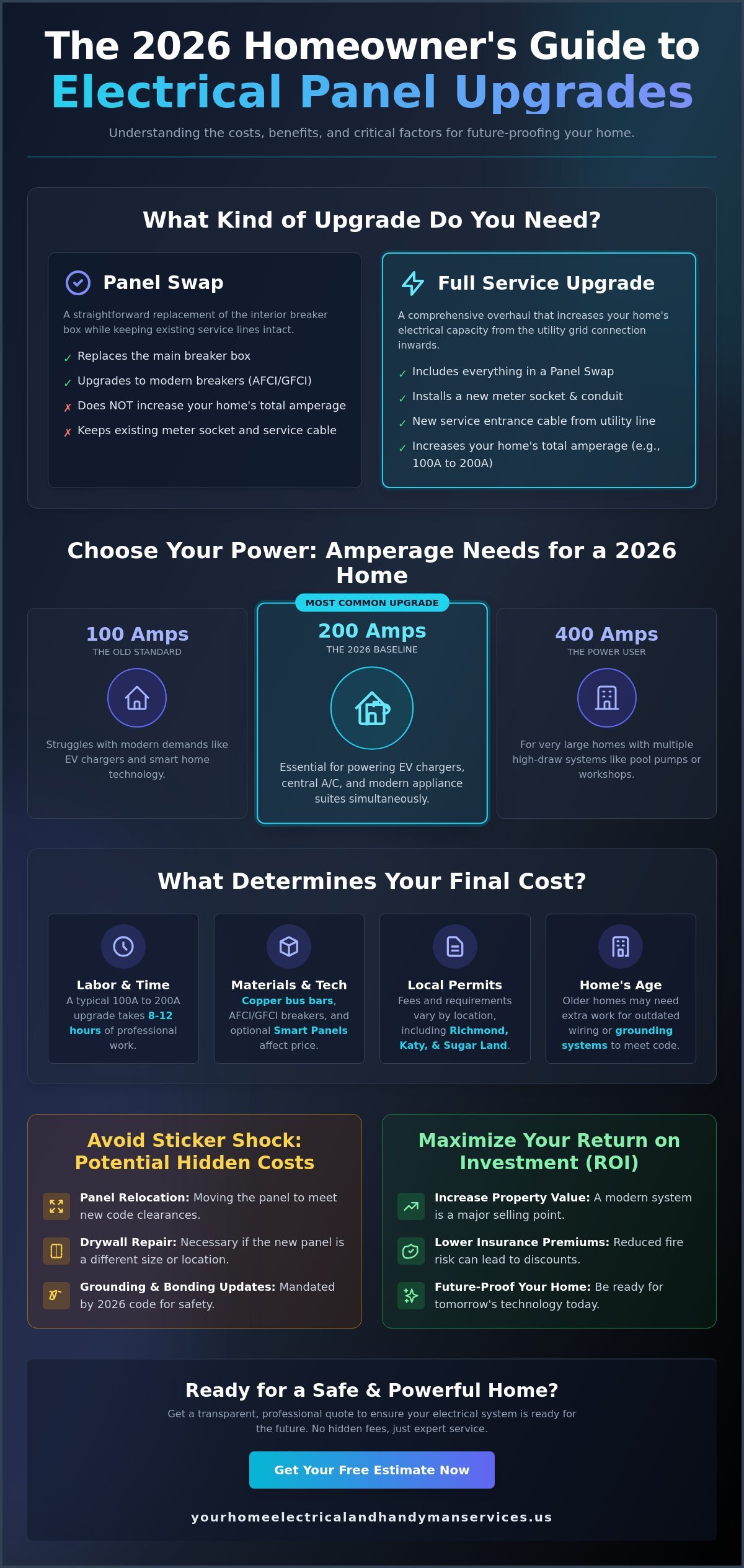
Understanding the cost to upgrade electrical panel starts with recognizing that your home’s electrical backbone is more than just a metal box. To get a technical foundation, it helps to understand What is an Electrical Panel? and how it safely distributes power throughout your property. In 2026, the complexity of your project depends heavily on whether you need a simple panel swap or a full service upgrade. A panel swap involves replacing the interior breaker box while keeping existing service lines intact. A full service upgrade is much more involved. It requires new conduit, a modern meter socket, and the service entrance cable that connects your home to the utility grid.
Equipment rates are a major factor in your final estimate. As of 2026, global market fluctuations in copper and steel continue to impact the price of high-capacity panels and wiring. Since these metals are essential for conductivity and structural integrity, material costs can shift based on current supply chain availability. The age of your home also plays a decisive role. Older properties often have outdated grounding systems or cloth-insulated wiring that isn’t compatible with modern breakers. If your existing wiring is brittle or lacks a dedicated ground, additional labor is required to bring the system up to current safety standards.
Amperage Needs for Modern Texas Homes
For many households in Richmond and the surrounding areas, 200-amp service has become the baseline requirement. This capacity is necessary to support high-draw items like heavy-duty central air conditioning, pool pumps, and modern kitchen suites without frequently tripping breakers. Before any work begins, a professional must perform a load calculation. A load calculation is a technical assessment that determines exactly how much power your home consumes at peak usage to ensure your new panel isn’t undersized for your lifestyle. While 100-amp panels were common in the past, they often struggle to keep up with the demands of 2026 appliances and smart home technology. Understanding the full benefits of a 200 amp panel upgrade Texas homeowners are choosing can help you decide if this capacity is the right fit for your household.
Material Quality: Standard vs. Smart Panels
The type of hardware you choose also influences your total investment. Traditional breaker boxes remain a reliable, cost-effective choice for many homeowners. However, smart energy-management panels are gaining popularity because they allow you to monitor and control electricity usage via a smartphone app. Regardless of the technology level, you should prioritize panels with high-quality copper bus bars. These components offer better conductivity and long-term durability than aluminum alternatives. Modern units also often feature integrated surge protection. This built-in defense is vital for shielding your expensive electronics and smart devices from unpredictable voltage spikes.
2026 Cost Comparison by Upgrade Type and Capacity
When planning your home budget, the cost to upgrade electrical panel is primarily driven by the capacity your household requires. While industry resources like Bob Vila provide a baseline for the Cost to Replace an Electrical Panel, 2026 projects often involve more than just a direct hardware swap. Modern safety regulations now require Arc-Fault Circuit Interrupter (AFCI) and Ground-Fault Circuit Interrupter (GFCI) breakers in most living areas. These specialized breakers are significantly more expensive than traditional ones, which naturally increases the total hardware investment for any full panel replacement.
Beyond the main service, many homeowners are opting for sub-panel installations. If you’re building a detached garage, a shed, or a large home addition, a sub-panel allows you to manage power locally without running dozens of individual wires back to the main box. This secondary installation adds to the project’s complexity but ensures your system remains organized and safe. It’s a practical way to manage the load for high-demand areas without cluttering your primary distribution board.
100-Amp to 200-Amp Service Upgrades
Moving from a 100-amp to a 200-amp service is the most frequent request for residential properties today. This upgrade is usually essential for a Level 2 charging station installation. Without this extra capacity, charging an electric vehicle while running your air conditioner can easily exceed the limits of an older 100-amp system. A standard residential swap typically requires 8 to 12 labor hours. This timeframe accounts for the careful labeling of circuits, the physical mounting of the new enclosure, and the technical cut-over from the utility provider’s lines.
Smart Panels and High-Capacity 400-Amp Systems
For larger estates in the Katy or Richmond area, a 400-amp system provides the necessary headroom for multiple AC units and heavy workshop machinery. We’re also seeing a rise in smart panels like Span or Schneider Pulse. These systems carry a price premium because they offer remote monitoring and energy-shedding capabilities. By allowing you to prioritize which circuits stay on during a power event, smart panels provide a level of control that traditional boxes simply can’t match. Choosing the right capacity now prevents expensive rework later. If you’re unsure which capacity fits your home, you can consult with a local professional to review your current load and future needs.
Local Factors Influencing Costs in Richmond, Katy, and Sugar Land
While national averages provide a starting point, the actual cost to upgrade electrical panel in Fort Bend County is shaped by our specific local market. In 2026, labor rates across the Greater Houston area reflect the high demand for skilled tradespeople. Because our region experiences extreme humidity and intense summer heat, equipment must meet strict durability standards. Outdoor panels must have a NEMA 3R rating to prevent corrosion and premature failure. These weather-resistant enclosures are essential in Texas, as they protect your home’s electrical heart from the moisture and salt-air influence that can degrade standard metal boxes over time.
Your proximity to local utility hubs also plays a role in the project’s logistics. Technicians in our area must account for the travel time and specific material availability in suburbs like Katy and Sugar Land. If your property is in an older, established neighborhood, the existing infrastructure might require more preparation before the new panel can be installed. This localized approach ensures that your system isn’t just new, but specifically built to withstand the environmental pressures of the Gulf Coast.
Permitting and Inspection Requirements
Ensuring your electrical panel upgrade Richmond TX is fully code-compliant is a non-negotiable step for safety and legal reasons. Each municipality has its own set of permit fees and inspection schedules. Richmond and Sugar Land often have different administrative costs for filing electrical permits, which typically range from $50 to $300 depending on the project’s complexity. It’s vital to remember that DIY panel work is prohibited in most of these jurisdictions. Attempting to bypass the permit process can void your homeowner’s insurance policy and lead to significant fines. Professional installation ensures the work passes the city inspector’s review the first time, preventing costly delays.
Utility Coordination in Greater Houston
The upgrade process requires close coordination with CenterPoint Energy for service disconnects and reconnects. Depending on the age of your neighborhood, you might face additional requirements for upgrading the service drop or the lateral lines that bring power from the street to your house. A common addition to the project scope is the replacement of the meter base. If your old meter base isn’t rated for 200 amps or more, it must be swapped to meet current utility standards. Hiring a professional familiar with CenterPoint’s specific technical requirements is the best way to avoid “red tags” that can leave your home without power longer than necessary.
Avoiding “Sticker Shock”: Hidden Costs to Watch For
Many homeowners focus solely on the hardware quote, but the true cost to upgrade electrical panel often includes necessary site preparation that isn’t immediately visible. It’s common to receive an initial estimate for a panel swap only to find that your home’s infrastructure requires additional attention to meet 2026 safety standards. These “hidden” expenses aren’t just upsells. They are essential requirements for passing city inspections and ensuring your property remains insurable. Understanding these variables upfront allows you to set a realistic budget and avoids the frustration of mid-project price changes.
One of the most frequent additions to a project is a grounding and bonding upgrade. The latest National Electrical Code (NEC) updates for 2026 emphasize expanded wiring protection and arc flash labeling. If your home was built more than twenty years ago, your current grounding system likely consists of a single rod or a connection to a cold water pipe that no longer meets modern conductivity requirements. To bring the system up to code, technicians often need to install dual copper-clad ground rods and verify the bonding of your gas and water lines. This technical work ensures that stray electricity has a safe path to the earth, protecting your appliances from surge damage.
You might also encounter costs related to circuit modernization. When you install a high-capacity panel, it is the perfect time to evaluate if your existing circuits can actually handle the increased load. In many cases, older circuits serving kitchens or bathrooms need to be split or re-wired to prevent the new breakers from tripping under modern appliance demands. This proactive approach prevents the “sticker shock” of having a brand-new panel that still struggles to power your daily life.
Panel Relocation and Structural Challenges
Moving an electrical panel is significantly more expensive than replacing one in its current spot. If your existing box is located in a closet, bathroom, or near a gas meter, it likely violates current NEC clearance rules. Relocating the system to an exterior wall or a more accessible area requires extending every single circuit in your home to the new location. This process is labor-intensive and becomes even more complex if your home has outdated aluminum wiring or knob-and-tube systems. Working in cramped attic spaces or tight crawlspaces to re-route these lines adds hours to the labor estimate, making the “where” of your panel just as important as the “what.”
Post-Installation Drywall and Paint
Once the electrical work is finished, you are often left with “electrician’s holes” in your walls. Electricians must cut into the drywall to mount the new enclosure and route the heavy service cables. Most electrical quotes do not include the finishing work required to make your walls look whole again. Utilizing a professional drywall repair Katy TX service is the most efficient way to handle this final phase. Proper texture matching is critical for a seamless finish, especially in homes with specific orange-peel or knockdown wall designs. Budgeting for this “handyman” phase ensures your home looks as good as it functions. If you want a complete, professional result without the stress of managing multiple contractors, request a comprehensive estimate that accounts for both the electrical and the finishing work.
Maximizing ROI: Why Quality Matters for Your Panel Upgrade
Is a panel upgrade just another maintenance bill? In 2026, savvy homeowners view the cost to upgrade electrical panel as a strategic investment that pays dividends during a home sale. A 200-amp system has become a non-negotiable requirement for many buyers in the Texas market. It provides immediate proof that the property is ready for modern life without the need for expensive, immediate retrofitting. By modernizing your infrastructure now, you avoid the stress and potential delays that occur when an outdated system is flagged during a pre-sale home inspection.
Beyond resale value, a professional upgrade can positively impact your ongoing expenses. Insurance companies often reward these updates with lower premiums because a new, code-compliant panel significantly reduces the risk of electrical fires. When you replace a 30-year-old box with a modern unit featuring integrated surge protection, you are actively protecting your home’s equity. Choosing the cheapest quote from an unlicensed source often leads to failed inspections or hidden safety hazards. Investing in a licensed professional ensures the job meets the rigorous 2026 NEC standards, giving you long-term peace of mind and verified safety.
Future-Proofing for EVs and Smart Homes
Your electrical panel is the gateway to every modern convenience you plan to add to your home. If you are considering an EV charger installation Sugar Land project, your panel’s capacity is the first thing a technician will check. Electric vehicles and smart home ecosystems demand a steady, high-volume flow of power that older 100-amp systems simply weren’t designed to provide. Smart panels are particularly valuable during our intense Texas summers. They allow you to monitor high-draw appliances like AC units in real-time, helping you manage energy consumption and prepare for future additions like solar arrays or backup battery systems. To explore how this investment pays off long-term, review the key 200 amp panel upgrade Texas homeowners are realizing in 2026, from improved safety to enhanced energy management.
Choosing the Right Local Partner
Selecting the right team for your electrician Richmond TX services makes the difference between a stressful construction project and a smooth home improvement. Your Home Electrical and Handyman Services LLC provides a unique advantage by bridging the gap between technical electrical work and aesthetic home repair. We handle both the high-voltage work and the final wall repairs. This dual-expertise approach means you don’t have to coordinate between multiple contractors to fix the drywall after the new panel is set. We prioritize thoroughness and customer care, ensuring your home is safe, functional, and looks professional from start to finish. If you’re ready to secure your home’s energy future, contact us today for a clear, professional assessment of your needs.
Secure Your Home’s Energy Future Today
Upgrading your electrical infrastructure is one of the most significant steps you can take to modernize your property for 2026 and beyond. By understanding how amperage choices and local permitting fees influence the cost to upgrade electrical panel, you can plan your investment with total clarity. Remember that a successful project involves more than just a new breaker box. It requires careful coordination with local utilities and a plan for the final wall repairs that follow technical work.
Our team has been serving Richmond, Katy, and Sugar Land since 2021. We provide licensed and insured technicians who bring specialized expertise in both electrical systems and handyman repairs. This unique combination ensures your home remains safe and looks polished once the job is complete. Don’t let an outdated system limit your home’s potential or safety. Get a Professional Quote for Your Panel Upgrade Today. Taking the time to choose a trusted local partner ensures your home is ready for the next decade of smart technology and energy demands. We look forward to helping you future-proof your property.
Frequently Asked Questions
Is a permit required to upgrade an electrical panel in Richmond, TX?
Yes, a permit is mandatory for any electrical panel project in Richmond. Local building codes require this to ensure that all work meets current safety standards and passes a formal city inspection. Obtaining a permit protects your home’s resale value and ensures your insurance policy remains valid. A professional team will handle the paperwork and coordinate the inspection process for you.
How long does a typical electrical panel upgrade take to complete?
Most residential panel upgrades take between 8 and 12 hours to complete. This timeframe includes the physical removal of the old unit, mounting the new enclosure, and the technical process of landing and labeling every circuit. The duration can vary based on the age of your home and how quickly the local utility company can perform the necessary service disconnect and reconnect.
Will my power be turned off during the panel replacement?
Yes, your power will be disconnected for the duration of the installation. For safety reasons, electricians cannot work on a live main service line. Your contractor will coordinate with your utility provider to cut the power before work begins and restore it once the new panel is safely installed and passes an initial safety check. You should plan for a full day without electricity.
Can I upgrade my electrical panel myself to save on labor costs?
No, you should never attempt a DIY panel upgrade. High-voltage electrical work is extremely dangerous and requires specialized training to prevent arc flashes and fires. Furthermore, local laws in the Greater Houston area require a licensed professional to perform this work. This requirement is standard in all major cities; for instance, finding a licensed electrician NYC is just as critical for homeowners in the Northeast to ensure their project is handled legally and safely. Attempting to bypass these regulations can lead to heavy fines, failed inspections, and the loss of your homeowner’s insurance coverage.
Does a new electrical panel lower my monthly energy bill?
A new panel does not directly reduce the cost of electricity, but it can improve your home’s overall efficiency. Modern panels eliminate energy loss caused by heat in old, loose, or corroded connections. If you opt for a smart panel, you can use integrated monitoring tools to identify which appliances are consuming the most power. This data helps you make informed decisions to lower your monthly energy consumption.
What is the difference between a panel change-out and a service upgrade?
A panel change-out is a direct replacement of the interior breaker box using your existing service lines. A service upgrade is a more comprehensive project that increases your home’s total capacity. This involves replacing the interior panel, the exterior meter base, and the service entrance cables. A service upgrade is usually necessary when you want to move from 100-amp to 200-amp capacity.
How do I know if my current panel is a fire hazard?
Warning signs of a hazardous panel include flickering lights, buzzing sounds, or a burning smell coming from the breakers. You should also check for physical heat on the panel door or visible scorch marks. If your home still uses panels from defunct brands like Federal Pacific or Zinsco, these are documented fire risks that should be replaced immediately by a professional team. To learn more about what to watch for, review the critical signs you need a new electrical panel before scheduling your replacement.
Can I add an EV charger without upgrading my 100-amp panel?
It depends on your home’s total electrical load, but most 100-amp panels are already near their limit with modern appliances. When you calculate the cost to upgrade electrical panel, it is often a necessary part of a charger installation. Upgrading to 200 amps ensures that your system can handle the high draw of a vehicle charger without tripping breakers when your air conditioner or oven is running. If you’re unsure whether your system is already showing signs I need a new electrical panel, a professional load assessment can help you determine the right course of action before investing in an EV charger.
2 Responses