

What if the most expensive part of your new electric vehicle isn’t the car itself, but the hidden electrical upgrades you didn’t see coming? If you’ve been searching for the cost to install EV charger in garage Rosenberg, you’ve likely found a mess of conflicting numbers and vague estimates. It’s frustrating to plan a budget when you aren’t sure if your older electrical panel can handle the load or what Fort Bend County actually requires for safety. You want the convenience of Level 2 charging at home, but you don’t want to risk a code violation or a tripped main breaker every time you plug in.
We understand that reliability matters more than a “low-ball” estimate that doubles once the work begins. This guide provides a professional breakdown of exactly what goes into a safe, code-compliant installation in our local community. We’ll cover everything from the mandatory $150 City of Rosenberg permit fee to the 30% federal tax credit and CenterPoint Energy rebates available in 2026. You’ll learn how to evaluate your home’s amperage capacity and how the distance between your panel and your garage impacts your final quote. By the end, you’ll have a clear roadmap for getting your Level 2 charger running quickly and safely.
Key Takeaways
- Identify how structural hurdles like finished garage ceilings or detached floor plans can influence your project’s labor costs.
- Compare the daily performance of Level 1 versus Level 2 charging to determine which option fits your driving habits and budget.
- Understand the specific steps needed to secure a Fort Bend County permit and ensure your home meets the latest electrical safety standards.
- Learn how to evaluate the total cost to install EV charger in garage Rosenberg by checking your panel’s available breaker space.
- Discover how local utility programs and federal incentives work together to make professional installation more affordable this year.
Key Factors Influencing EV Charger Installation Costs in Rosenberg
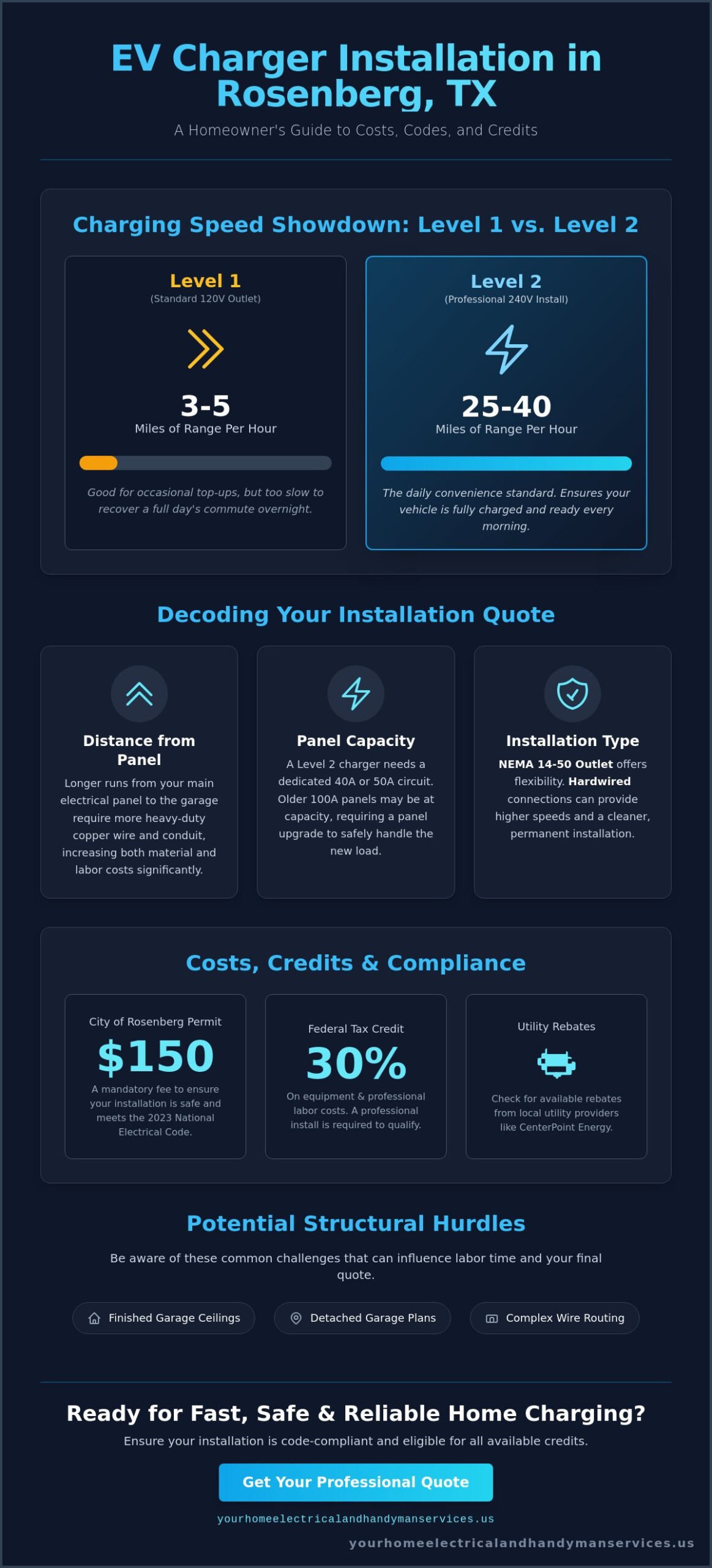
Every home in Rosenberg is unique, which means the total cost to install EV charger in garage Rosenberg varies based on several technical variables. The most significant factor is the physical distance between your home’s main electrical panel and the spot where you plan to mount your charger. Longer distances require more heavy-duty copper wiring and additional conduit, which increases both material expenses and labor time. If the panel is on the opposite side of the house from the garage, the routing becomes more complex and labor-intensive.
You also need to decide between a NEMA 14-50 outlet and a hardwired installation. An outlet offers flexibility if you ever need to move the charger, but a hardwired connection often allows for higher charging speeds and a cleaner look in your garage. In Rosenberg, you must also account for the $150 electrical permit fee for homes up to 2,500 square feet. This isn’t an optional cost; it ensures your installation meets the 2023 National Electrical Code and passes a safety inspection required for local compliance.
Panel Capacity and the Need for Upgrades
A standard Level 2 charger needs a dedicated 40-amp or 50-amp circuit to function properly. Many older homes in Fort Bend County were built with 100-amp panels that are already near their limit with existing appliances like air conditioners and electric dryers. Adding a high-draw EV charger to an overloaded system can lead to frequent breaker trips or safety hazards. If your panel lacks the necessary amperage or physical breaker space, you’ll likely need a professional electrical panel upgrade Richmond TX before the charger can be safely installed. This ensures your home’s infrastructure can handle the new load without compromising other circuits.
Hardware vs. Labor: Breaking Down the Quote
Your total investment is split between the physical equipment and the professional labor required to set it up. Choosing an electric vehicle charging station with smart features like Wi-Fi connectivity or scheduled charging usually costs more than a basic “plug-and-play” unit. Beyond the hardware, professional labor covers mounting the unit, running the appropriate gauge of wire, and conducting rigorous testing. When you calculate the cost to install EV charger in garage Rosenberg, remember that professional installation is the only way to guarantee your system is eligible for the 30% federal tax credit or CenterPoint Energy rebates. Cutting corners with unlicensed labor might seem cheaper initially, but it often leads to expensive repairs or failed inspections that prevent you from claiming these valuable incentives.
Level 1 vs. Level 2 Charging: Comparing Long-Term Value
When you first bring home an electric vehicle, you might be tempted to rely on the standard 120-volt “Level 1” cord that came with the car. While it’s technically free to use, it only provides about 3 to 5 miles of range per hour of charging. For many Rosenberg residents who commute daily to Houston or Sugar Land, this slow trickle isn’t enough to recover a full day’s drive overnight. Level 2 charging is the 240-volt residential standard for EVs. By upgrading, you increase your charging speed to 25 or 40 miles of range per hour, ensuring your vehicle is always ready for the morning rush. While the cost to install EV charger in garage Rosenberg involves an initial investment, the daily convenience and the boost to your home’s resale value often outweigh the upfront expense.
Investing in a dedicated home charging setup also makes you eligible for significant financial offsets. For example, the Federal tax credit for EV chargers can cover a substantial portion of your equipment and labor costs through June 2026. Beyond the tax benefits, having a professional Level 2 station is a major selling point for future homebuyers who likely already own or plan to purchase an EV. If you’re ready to make the switch, our team provides professional EV charger installation tailored to your specific garage layout.
Hardwired Stations vs. NEMA 14-50 Outlets
Choosing the right connection type is a major part of determining the cost to install EV charger in garage Rosenberg. A hardwired connection involves wiring the charging station directly into your electrical system, which allows for the highest possible charging speeds, often up to 48 or 50 amps. On the other hand, choosing a NEMA 14-50 outlet for your garage offers more flexibility. This high-powered outlet allows you to plug in your charger and easily take it with you if you move, or even use the outlet for other heavy-duty shop tools. Outlets generally require a GFCI breaker to meet modern safety codes, which can slightly increase the material cost compared to a standard hardwired breaker.
Speed and Efficiency Expectations
Switching to a 240-volt circuit fundamentally changes how you interact with your vehicle. Instead of waiting 20 or 30 hours for a full charge, a Level 2 system typically tops off a battery in just 4 to 8 hours. It’s also more efficient in extreme weather. When those Texas “Northers” blow through Fort Bend County, dropping temperatures can slow down the chemical reactions in your car’s battery. A Level 2 charger provides enough power to pre-condition the battery and the cabin without draining your range, ensuring you maintain maximum efficiency even during our brief winter cold snaps.
Garage-Specific Installation Challenges and Structural Costs
Beyond the electrical panel capacity discussed earlier, the physical structure of your garage plays a massive role in your final quote. Rosenberg homes often feature finished garages with drywall ceilings and walls. Running heavy-duty 6-gauge wire through these enclosed spaces is more complex than a simple surface mount. If your garage has exposed rafters, the labor is straightforward. However, if we need to “fish” wire through finished ceilings, the time and precision required will influence the total cost to install EV charger in garage Rosenberg.
Detached garages present an even greater challenge. If your parking area is separate from the main house, we must factor in the labor of trenching. This involves digging a path to bury conduit at a depth that meets local safety codes. While this adds to the initial work, it ensures your charging system is protected from the elements and yard maintenance equipment. Properly buried conduit is a non-negotiable safety standard for any detached structure in Fort Bend County.
Routing Wire Through Finished Walls
When the distance between your panel and the charger exceeds 50 feet, material costs for copper wiring and conduit rise quickly. In high-traffic garage areas, we prioritize the use of rigid conduit to protect the electrical lines from accidental bumps by car doors or bicycles. This professional routing prevents future electrical interference and keeps your home compliant with the safety standards found in the U.S. Department of Energy guide to home charging. Our goal is to find the most efficient path that minimizes structural impact while maintaining maximum power delivery.
Handyman Services for a Flawless Finish
Most electrical contractors will run your wires but leave your garage walls looking like Swiss cheese. They’ll tell you to “call a guy” to fix the holes they made. We take a different approach by combining electrical expertise with professional handyman skills. This synergy means we don’t just install the hardware; we also handle the drywall patching and texture matching ourselves. If you want your garage to look untouched after a major wire pull, you can learn more about the drywall repair Katy TX and Rosenberg homeowners rely on for a clean finish. This one-stop-shop model reduces the stress of managing multiple contractors and ensures the cost to install EV charger in garage Rosenberg remains transparent from start to finish.
Rosenberg Permits, Local Codes, and Utility Rebates
Understanding the local regulatory environment is a critical step in finalizing your budget. In Rosenberg, the electrical permit fee for a residential EV charger installation is $150 for homes up to 2,500 square feet. This fee covers the administrative processing and the mandatory safety inspection required by the city. Following the 2023 National Electrical Code isn’t just a suggestion; it’s a legal requirement that protects your property and ensures your homeowner’s insurance remains valid. An unpermitted installation can become a major liability during a future home sale or if an electrical issue ever leads to an insurance claim.
Local compliance also impacts the long-term safety of your home’s electrical system. A passed inspection proves that the cost to install EV charger in garage Rosenberg was an investment in quality rather than a shortcut. When your installation is officially signed off by a city inspector, you have documented proof that your home meets modern safety standards. This documentation is often required by insurance providers to maintain coverage for high-voltage home additions. Without it, you could face significant hurdles if you ever need to file a claim related to your home’s electrical system.
Navigating the Permit Process
Filing for permits can be a tedious process if you’ve never dealt with Fort Bend County’s building departments. When we handle your project, we take care of the application and the scheduling of the final inspection for you. This professional oversight ensures that your project remains on track and avoids common clerical errors that delay installation. A professional electrician knows exactly which forms to submit to the City of Rosenberg to ensure your 240-volt circuit is legally recognized. Skipping this step to save a few dollars today often leads to much higher costs when you’re forced to bring the system up to code during a home inspection later.
Utility Incentives and Tax Credits
The good news for Rosenberg homeowners is that several programs exist to offset your initial investment. CenterPoint Energy offers a rebate for residential customers that may cover up to 50% of the project cost for Level 2 chargers. This program is currently slated to run until December 31, 2026, though funds are limited and could be depleted sooner. Additionally, you can claim a federal tax credit of 30% for equipment and installation, up to a maximum of $1,000. It’s important to act quickly, as this specific credit is scheduled to expire on June 30, 2026. To qualify, you must keep detailed records of your EV charger installation quote and final invoices for your tax filings.
Beyond upfront rebates, you can save on long-term operating costs by looking into “Time of Use” programs. These plans allow you to charge your vehicle during off-peak hours when electricity rates are lower, typically late at night. By scheduling your charger to run after 11:00 PM, you can significantly reduce your monthly utility bill. If you want a safe installation that maximizes these local and federal savings, we can provide a professional EV charger installation that meets every local requirement and helps you secure your rebates.
Why Rosenberg Homeowners Trust Your Home Electrical
Choosing a professional to handle high-voltage upgrades in your home requires a high level of trust. We’ve built our reputation in the Richmond-Rosenberg area by providing reliable, licensed, and insured electrical services that prioritize your property’s safety. Our technicians don’t just “install a box” on your wall. We evaluate your entire system to ensure your 240-volt circuit operates without straining your existing infrastructure. Because we specialize in both electrical panel upgrades and smart home device setup, we provide a comprehensive solution that integrates your new charger into your home’s modern ecosystem.
One of the biggest frustrations homeowners face is “hidden garage fees” or unexpected surcharges for structural work. We eliminate this stress through transparent, flat-rate pricing. We believe you deserve a clear understanding of the cost to install EV charger in garage Rosenberg before the first wire is pulled. By combining our electrical mastery with professional handyman finishing skills, we handle everything from the initial breaker installation to the final drywall patching and repair. This means you don’t have to coordinate with multiple contractors to get your garage back in order after the job is done.
Local Expertise You Can Count On
Our commitment to the Rosenberg, Katy, and Sugar Land communities goes beyond simple service calls. We live and work in this area, which means we understand the specific home construction styles and local code requirements unique to Fort Bend County. We prioritize safety and long-term reliability over quick, cheap fixes that might fail a city inspection. During our personalized consultations, we help you find the right charger for your specific vehicle and driving habits. Whether you drive a high-performance sedan or a family SUV, we ensure your equipment is perfectly matched to your car’s onboard charging capacity.
Ready for a Faster Charge?
Getting your home ready for an electric vehicle shouldn’t be a complicated or overwhelming process. Our site assessment is designed to give you a definitive answer regarding your home’s readiness. We check your panel’s amperage, measure the distance for the wire run, and identify the most efficient path through your garage structure. This thorough approach allows us to provide a firm cost to install EV charger in garage Rosenberg that accounts for all local permits and technical requirements. If you’re tired of slow Level 1 charging and want the convenience of a professional Level 2 station, we’re ready to help. Request your EV charger installation quote today and take the first step toward a faster, safer home charging experience.
Secure Your Home Charging Future Today
Transitioning to an electric vehicle is a significant milestone for your household and your daily commute. You now understand that a safe, code-compliant installation requires balancing panel capacity, local Rosenberg permit requirements, and efficient wire routing. By prioritizing a Level 2 setup, you aren’t just saving hours of charging time each day; you’re investing in your property’s long-term value while taking advantage of 2026 tax credits and CenterPoint Energy rebates.
Determining the final cost to install EV charger in garage Rosenberg shouldn’t involve guesswork or hidden fees. Our team provides a seamless experience by combining technical electrical mastery with expert drywall repair to leave your garage in pristine condition. As licensed and insured Texas technicians with 5-star local reviews, we ensure your installation meets the highest safety standards from the initial breaker to the final inspection. We’re ready to help you drive into the future with a reliable, high-speed home charging station.
Get Your Professional EV Charger Installation Quote in Rosenberg. We look forward to powering your journey with confidence and professional care.
Frequently Asked Questions
How much does it typically cost to install an EV charger in Rosenberg?
The total investment depends on your garage’s distance from the electrical panel and the specific hardware you choose. Factors like the need for a panel upgrade or the complexity of routing wire through finished drywall also play a major role. Because every home’s infrastructure is different, the cost to install EV charger in garage Rosenberg is best determined through a professional site assessment that accounts for your home’s unique layout.
Do I need to upgrade my electrical panel to install a Tesla Wall Connector?
You may need an upgrade if your current electrical panel is rated at 100 amps or lacks physical breaker space. A Tesla Wall Connector requires a dedicated 60-amp circuit to achieve maximum charging speeds. If your panel is already supporting heavy loads like an HVAC system and electric dryer, a professional must calculate your remaining capacity to ensure the new charger doesn’t cause frequent breaker trips or safety hazards.
Is a permit required for an EV charger installation in Fort Bend County?
Yes, the City of Rosenberg requires a building permit for all residential EV charger installations. As of 2026, the electrical permit fee is $150 for homes up to 2,500 square feet. This process ensures your installation complies with the 2023 National Electrical Code. Obtaining this permit is a vital step for maintaining your homeowner’s insurance coverage and ensuring the system passes a safety inspection by a local official.
Can a handyman install an EV charger, or do I need an electrician?
You should always hire a licensed electrician for EV charging projects due to the high voltage and complex safety requirements involved. While a handyman can assist with structural tasks like drywall patching, only a licensed professional can pull the necessary permits and ensure the wiring meets strict electrical codes. Using unlicensed labor for high-draw appliances can void your equipment warranty and create significant fire risks in your garage.
How long does it take to install a Level 2 charger in a standard garage?
A standard installation typically takes between 3 and 6 hours to complete from start to finish. This timeline covers mounting the unit, running the conduit and wiring, and performing final safety tests. If your project requires an electrical panel upgrade or involves a long wire run to a detached garage, the process may take a full day. We strive to minimize disruption to your home while ensuring every connection is secure.
What is the difference between a NEMA 14-50 outlet and hardwiring a charger?
A NEMA 14-50 is a heavy-duty outlet that allows you to plug in a mobile charger, while hardwiring connects the station directly to your home’s electrical wiring. Hardwired connections are generally more reliable and can support higher charging speeds, often up to 48 amps. Outlets provide more flexibility if you plan to move the charger in the future, but they require a GFCI breaker which adds to the material requirements.
Are there any rebates available for Rosenberg residents installing EV chargers?
Yes, Rosenberg homeowners can take advantage of significant local and federal incentives in 2026. CenterPoint Energy offers a rebate program that can cover up to 50% of the project cost for eligible residential customers. Additionally, a federal tax credit of 30% is available for both hardware and installation costs through June 30, 2026. These programs make the cost to install EV charger in garage Rosenberg much more affordable for early adopters.
Will installing an EV charger increase my home’s value in Texas?
Installing a dedicated Level 2 charging station is a smart way to increase your property’s appeal in the modern Texas real estate market. As electric vehicle adoption grows in Fort Bend County, homebuyers are increasingly looking for properties that are already “EV ready.” Having a professionally installed, code-compliant station in your garage positions your home as a future-proofed property, which can be a decisive factor for buyers who already own an electric vehicle.