

With more than 463,000 registered electric vehicles in Texas as of early 2026, the demand for at-home charging has shifted from a luxury amenity to a standard tenant requirement. You’ve likely seen the growing number of EVs in your parking lot and felt the pressure to adapt. Planning an EV charger installation for apartment building Texas projects often feels overwhelming when you consider the potential for high infrastructure costs and the lack of clear “Right to Charge” mandates in the state.
It’s natural to worry about how these upgrades will affect your property’s electrical load or lead to complex billing disputes between residents. We’re here to help you navigate these technical and financial hurdles with confidence. This guide offers a practical roadmap for property managers, covering everything from TDLR registration requirements to cost-recovery strategies. You’ll learn how to secure remaining federal tax credits before the June 30, 2026, deadline and find a reliable local partner to ensure your building remains a top choice for modern renters.
Key Takeaways
- Understand how the rapidly growing EV market in the Houston-Sugar Land metro area impacts your property’s long-term value and tenant retention.
- Learn how to evaluate your existing electrical service and implement load management software to avoid expensive transformer upgrades.
- Compare shared and assigned charging models to find the most efficient strategy for EV charger installation for apartment building Texas properties.
- Identify critical financial incentives, including the 2026 Federal 30C tax credit and local utility rebates from providers like CenterPoint Energy.
- Discover why a combined approach of expert electrical work and professional drywall repair ensures a clean, durable installation for your multi-unit complex.
Understanding the EV Charging Landscape for Texas Multi-Unit Dwellings
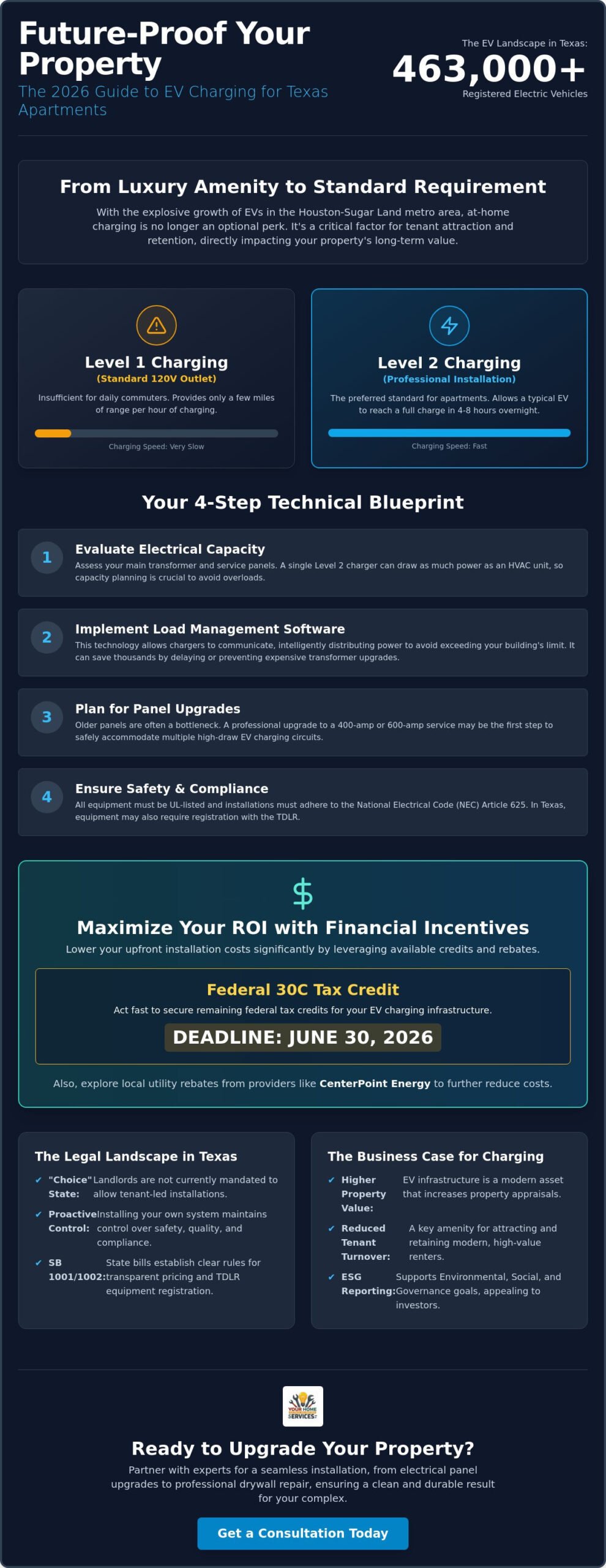
In the context of Texas Multi-Unit Dwellings (MUDs), EV charging refers to the specialized infrastructure needed to serve multiple residents within a single property. The EV charging landscape across the Richmond-Katy-Sugar Land corridor is evolving rapidly as more drivers transition away from internal combustion engines. While Texas currently averages about 4.0 charging stations for every 100 registered EVs, the vast majority of these are public. For property managers, providing on-site EV charger installation for apartment building Texas services bridges the gap between public infrastructure and the convenience of charging where a tenant lives.
Most residents find that Level 1 charging, which uses a standard 120V outlet, is insufficient for daily commuting because it only provides a few miles of range per hour. A professional Level 2 installation is the preferred standard for MUDs. It allows a typical EV to reach a full charge in roughly 4 to 8 hours, making it a viable amenity for tenants who leave for work each morning. Offering this speed is a significant differentiator for complexes located in high-traffic suburbs like Rosenberg.
The Legal Reality: Texas Senate Bills and Tenant Rights
Texas is currently a “choice” state for landlords, meaning there are no laws forcing you to allow tenant-led installations. However, Senate Bill 1001 and 1002 establish clear rules for those who do offer charging, focusing on transparent pricing and equipment registration with the Texas Department of Licensing and Regulation (TDLR). By taking a proactive approach to EV charger installation for apartment building Texas, you maintain control over the safety and quality of the electrical work rather than reacting to unmanaged tenant requests that could jeopardize your building’s insurance or code compliance.
Ensuring safety and compliance is vital to avoid liability; in cases where negligence leads to on-site accidents, The Todd Law Group, PLLC provides legal expertise for individuals dealing with personal injury claims in Texas.
The Business Case for Apartment EV Charging in 2026
In high-growth areas like Rosenberg and Richmond, EV chargers are becoming a powerful tool for tenant retention. Modern renters often prioritize properties with sustainable amenities, and providing a reliable place to plug in can significantly reduce turnover. Beyond resident satisfaction, these upgrades contribute to a higher overall property appraisal. Commercial owners also find that documented EV infrastructure supports Environmental, Social, and Governance (ESG) reporting, which is increasingly relevant for institutional investors and lenders who prioritize modern, future-proofed assets.
Evaluating Electrical Capacity and Infrastructure Requirements
Older apartment complexes in Texas face a significant hurdle: their electrical infrastructure wasn’t designed for the high-power demands of 2026. Before beginning an EV charger installation for apartment building Texas project, you must determine if your main transformer and service panels can support the additional draw. A single Level 2 charger can pull as much power as a large HVAC unit. When you multiply that by ten or twenty residents, the risk of a transformer overload becomes a serious concern that could lead to costly downtime.
Load management software is a key tool for modern property managers. These systems allow chargers to “talk” to each other, distributing power intelligently so the building’s total limit isn’t exceeded during peak hours. This technology often saves thousands of dollars by delaying the need for a massive utility-side transformer upgrade. Safety is equally vital. All equipment must be UL-listed, and the installation must strictly follow the National Electrical Code (NEC) Article 625. Strategic plans for the Texas Electric Vehicle Charging Infrastructure emphasize that grid readiness and safety compliance are the foundation of a reliable charging network.
The Critical Role of Electrical Panel Upgrades
The main service panel is often the bottleneck for multi-unit projects. Many older dwellings operate on panels that are already near their maximum capacity. To safely add high-draw circuits, a Professional Electrical Panel Upgrade is usually the first step. Our Richmond-based technicians specialize in evaluating breaker capacity and determining if your property needs a 400-amp or 600-amp service to accommodate future growth. If you’re planning for long-term resident satisfaction, a dedicated panel upgrade for EV chargers ensures that vehicle charging doesn’t interfere with essential building services like elevators or security lighting.
Trenching and Wiring Logistics for Large Parking Lots
Connecting the panel to the parking stalls involves complex logistics. In Texas, the distance from the electrical room to the farthest parking spot can be hundreds of feet. You’ll need to choose between asphalt cutting, which is often faster but requires visible patching, or directional boring, which preserves your lot’s appearance by going under the surface. Additionally, you’ll need to decide between wall-mounted units for parking garages or pedestal-mounted stations for open lots. If you’re unsure about your building’s current capacity, you can request a professional site assessment to avoid expensive surprises during the installation phase.
Choosing the Right Charging Model: Shared vs. Assigned
Deciding where to place your equipment is just as important as the wiring itself. For a successful EV charger installation for apartment building Texas project, you must choose between a centralized community hub or individual chargers in assigned stalls. This choice dictates your upfront costs and your long-term management strategy. It also impacts how your residents interact with the technology on a daily basis. You want a system that’s easy to use but doesn’t create new administrative headaches for your leasing office.
Managing electricity billing is the next hurdle. You can charge a flat monthly fee for access or use smart chargers that bill per kilowatt-hour (kWh). Most modern systems utilize RFID cards or mobile apps to track usage automatically. This removes the administrative burden from your staff. To keep costs down, you might use load sharing, which is a method of distributing a fixed amount of power across multiple vehicles on a single circuit. This approach prevents you from needing a massive panel upgrade for every single stall while still meeting resident needs.
When calculating your return on investment, don’t forget that many of these costs can be offset. The Federal Alternative Fuel Vehicle Refueling Property Credit provides significant tax relief for commercial properties that install charging stations. Taking advantage of these credits makes the transition to a modern property much more affordable for owners in the Houston area.
The Shared Amenity Model (The “Gas Station” Approach)
A centralized hub works well for smaller complexes in Sugar Land where parking is limited. It’s often cheaper to install four chargers in a row than to run wires to forty different spots. This model functions like an on-site station. However, you’ll need a clear policy for “loitering.” Some property managers implement idle fees that start once a car is fully charged to encourage residents to move. This model also creates a direct revenue stream through electricity markups.
Assigned Parking Installations (The “Home Garage” Experience)
Assigned stalls offer a premium experience that high-end tenants love. It’s the ultimate convenience. You’ll need to handle the wiring for specific spots, which often requires more extensive trenching across the parking lot. To protect yourself, include a “Right to Charge” lease addendum. This document should clearly state that the tenant is responsible for damage to the charging cord, while the landlord maintains the core infrastructure. This ensures your EV charger installation for apartment building Texas remains a property asset rather than a liability.
Texas Incentives and the Installation Process
Timing is everything when it comes to financing large-scale infrastructure projects. The most significant financial driver for an EV charger installation for apartment building Texas project in 2026 is the Federal 30C tax credit. This credit provides up to 30% of the cost for hardware and installation, but there is a firm deadline. Equipment must be placed in service by June 30, 2026, to qualify for current incentives. For property managers in Richmond and Rosenberg, starting the planning phase early in the year is the only way to ensure you don’t miss out on these federal offsets.
Beyond federal support, local utility programs offer additional relief. CenterPoint Energy, which services the Katy and Sugar Land areas, frequently updates its commercial rebate programs for “make-ready” infrastructure. These incentives often cover the costs of the conduit and wiring that connect your electrical room to the charging stations. Navigating the permitting process in Fort Bend County requires precise documentation. You’ll need to submit detailed electrical plans that show how the new load impacts the existing grid. Structuring a clear request for proposal (RFP) for a local contractor ensures you get a bid that includes these permitting fees and final city inspections.
Step-by-Step Installation Roadmap
A successful project moves through four distinct phases to ensure safety and code compliance. Following this roadmap helps you avoid delays in the Fort Bend County permitting office:
- Step 1: Site Load Analysis. A licensed professional evaluates your building’s current draw to confirm you can support Level 2 charging without exceeding transformer limits.
- Step 2: Hardware and Software Selection. You’ll choose chargers that meet TDLR standards and a billing platform that integrates with your property management software.
- Step 3: Secure Permits and Utility Approvals. We handle the filing with local jurisdictions in Richmond or Katy to ensure the project meets all municipal codes.
- Step 4: Installation and Final Inspection. Once the physical work is complete, a final inspection is required to certify the system for resident use.
Navigating Texas Utility Requirements
Commercial electricity rates in Texas often include demand charges, which are fees based on your property’s highest point of power usage. If several tenants charge their vehicles simultaneously during peak hours, your utility bill could see a sharp increase. This is where professional smart home device setup logic becomes essential for your charging network. Networked chargers must be configured to communicate via a central gateway, allowing the system to throttle power during peak times. This keeps your operating costs predictable while still providing a full charge to residents by morning. If you’re ready to modernize your property, you can schedule a site load analysis today to get a clear picture of your building’s capacity.
Why Partner with Your Home Electrical and Handyman Services?
Choosing a partner for an EV charger installation for apartment building Texas project requires more than just technical skill. It requires a team that understands the specific infrastructure of Richmond, Katy, Sugar Land, and Rosenberg. Your Home Electrical and Handyman Services LLC positions itself as your trusted expert guide, balancing high-level electrical knowledge with the practical needs of property management. Our technicians are fully licensed and insured, ensuring every installation meets the strict 2026 Texas commercial and residential codes. We don’t believe in hidden fees or complex hourly billing. Instead, we provide flat-rate transparency and project-based quotes so you can manage your capital expenditure budget with total certainty.
What sets us apart is our integrated “Handyman + Electrician” team. Most electrical contractors focus solely on the wiring and the breakers. They often leave behind damaged walls, unpatched holes, or exposed conduit that detracts from your property’s aesthetic value. Your Home Electrical and Handyman Services LLC takes a different approach. Our team manages the entire scope of work, from the initial site load analysis to the final aesthetic restoration. This saves you the headache of hiring multiple vendors to clean up after the electrical work is finished.
- Localized Expertise: We know the specific permitting requirements for Fort Bend County and the local utility standards in Richmond and Rosenberg.
- Budget Certainty: Our project-based quotes mean the price we say is the price you pay, helping you avoid the “scope creep” common in large infrastructure projects.
- Comprehensive Service: We handle the electrical panel upgrades, the charger mounting, and the structural repairs in-house.
- Reliability: We prioritize long-term durability and safety over flashy, temporary solutions, ensuring your investment remains an asset for years.
More Than Just Wiring: A Complete Property Solution
Running new conduit through an existing multi-unit dwelling often requires cutting into walls or ceilings. We specialize in professional drywall repair in Katy and the surrounding metro areas. This ensures that your hallways and common areas look flawless once the new circuits are in place. We also focus on the aesthetic integration of exterior pedestals. We make sure the hardware matches your building’s design and stands up to the intense Texas heat. Our goal is to provide a seamless addition to your property that looks like it was part of the original construction.
Ready to Electrify Your Texas Property?
Starting your EV charger installation for apartment building Texas project begins with a comprehensive site assessment. When you contact our Richmond office, we’ll help you evaluate your current infrastructure and resident needs. To make the process as efficient as possible, please have your main electrical panel location and the total number of units ready for our team. We’ll walk you through the logistics of trenching, load management, and billing software to create a custom roadmap for your building. Our seasoned professionals are ready to help you modernize your property and attract the next generation of Texas renters.
Prepare Your Building for the Electric Future
The transition to electric mobility is no longer a distant trend; it’s a current reality for Texas property managers. By addressing your building’s electrical capacity and choosing a scalable charging model now, you secure a competitive advantage that attracts high-value tenants. Remember that federal tax incentives like the 30C credit won’t last forever. Acting before the June 2026 deadline ensures you maximize your return on investment while modernizing your infrastructure.
Our team has served the Richmond, Katy, and Sugar Land communities since 2021. As licensed Texas electricians, we understand the technical and legal requirements for a successful EV charger installation for apartment building Texas project. We provide a complete solution that covers both complex electrical panel upgrades and professional drywall restoration. We leave your property in better condition than we found it; for owners looking to maximize curb appeal after construction, a thorough exterior cleaning by Poseidon Power Washing LLC can ensure your new infrastructure truly shines.
Don’t let technical confusion or infrastructure fears hold your property back. We’re ready to help you navigate every step of the process with transparency and expertise. Request a Multi-Unit EV Installation Quote and take the first step toward a more sustainable and profitable property today.
Frequently Asked Questions
Do Texas laws require landlords to allow EV charger installations?
Texas does not currently have “Right to Charge” laws that mandate landlords allow tenant installations. While several other states have passed such legislation, Texas law focuses more on the registration of commercial charging equipment with the TDLR and ensuring transparent pricing for users. Landlords maintain full control over whether to permit these upgrades on their property and how the infrastructure is managed.
What is the average cost to install a Level 2 charger in an apartment building?
The total cost for a multi-unit project varies significantly based on your building’s existing electrical capacity and the distance from the power source to the parking stalls. Factors like trenching through asphalt or requiring a transformer upgrade will influence the final budget. We provide detailed, project-based quotes after a site assessment to ensure you have an accurate figure for your specific property’s needs.
Can an older apartment building in Richmond handle multiple EV chargers?
Most older complexes in Richmond weren’t built for the high-power draw of multiple vehicles, but they can be adapted. By using load management software, you can distribute available power intelligently without necessarily triggering a massive utility transformer upgrade. A site load analysis is the essential first step to determine your building’s current limits and safety requirements.
How do I bill tenants for the electricity used by EV chargers?
Property managers typically use smart charging stations that integrate with billing software via mobile apps or RFID cards. This allows you to automate the process, billing residents directly for their kilowatt-hour usage or charging a flat monthly access fee. These systems remove the administrative burden from your leasing staff and ensure accurate cost recovery for the property.
Are there tax credits for Texas businesses installing EV charging stations in 2026?
Yes, the Federal Alternative Fuel Vehicle Refueling Property Credit (Section 30C) provides a tax credit of up to 30% for commercial installations. However, this equipment must be placed in service by June 30, 2026, to qualify for the current incentive. Planning your EV charger installation for apartment building Texas project early in the year is vital to secure these significant federal savings.
How long does a typical multi-unit EV charger installation take?
A standard multi-unit project usually takes between four to eight weeks from the initial site assessment to the final inspection. The physical installation of the hardware often only takes a few days. The majority of the timeline is dedicated to securing local permits and coordinating with utility providers like CenterPoint Energy for any necessary grid connections.
Do I need to upgrade my electrical panel for an apartment EV charger?
An electrical panel upgrade is often necessary if your current system is already operating near capacity. Level 2 chargers require 240V circuits, which can quickly overwhelm an older 200-amp or 400-amp main service. We evaluate your breaker capacity during the site visit to determine if an upgrade is required to ensure the EV charger installation for apartment building Texas project remains safe and reliable.
Is a permit required for EV charger installation in Fort Bend County?
Yes, Fort Bend County requires electrical permits for all EV charging infrastructure to ensure compliance with the National Electrical Code. This process involves a professional plan review and a final on-site inspection by a county official. Working with a licensed professional ensures that all paperwork is filed correctly and that the installation meets all local safety and building standards.