

You wake up, grab your coffee, and head to the garage only to find your car battery is exactly where you left it the night before. Instead of a full charge, you’re greeted by a blinking red light on the wall. It’s a frustrating start to any morning, especially when you have a long Texas commute ahead. Most homeowners immediately worry about expensive repairs or faulty wiring, but many issues are actually simple communication errors or environmental trips.
We understand that a reliable charge is essential for your daily routine. If you’re currently troubleshooting home EV charger problems, you don’t have to feel overwhelmed by technical manuals. This guide explains how to identify common faults safely and resolve them without a service call. We will walk through the most frequent causes of charging interruptions, from GFCI trips to vehicle handshakes, so you can decide if it’s a quick fix or if it’s time to bring in an expert to look at your electrical panel.
Key Takeaways
- Learn how to interpret status lights to distinguish between a simple scheduling mode and a critical hardware fault.
- Understand how extreme Texas temperatures cause thermal throttling and how to shield your charger from direct sunlight.
- Save time by troubleshooting home EV charger issues like “soft trips” where the breaker appears on but has actually disengaged.
- Identify the specific physical warning signs, such as scorched plastic or burning smells, that indicate a fault requires a professional electrician.
- Resolve common software “handshake” failures and connection errors that often prevent a successful charging session.
Common Reasons Your Home EV Charger Isn’t Charging
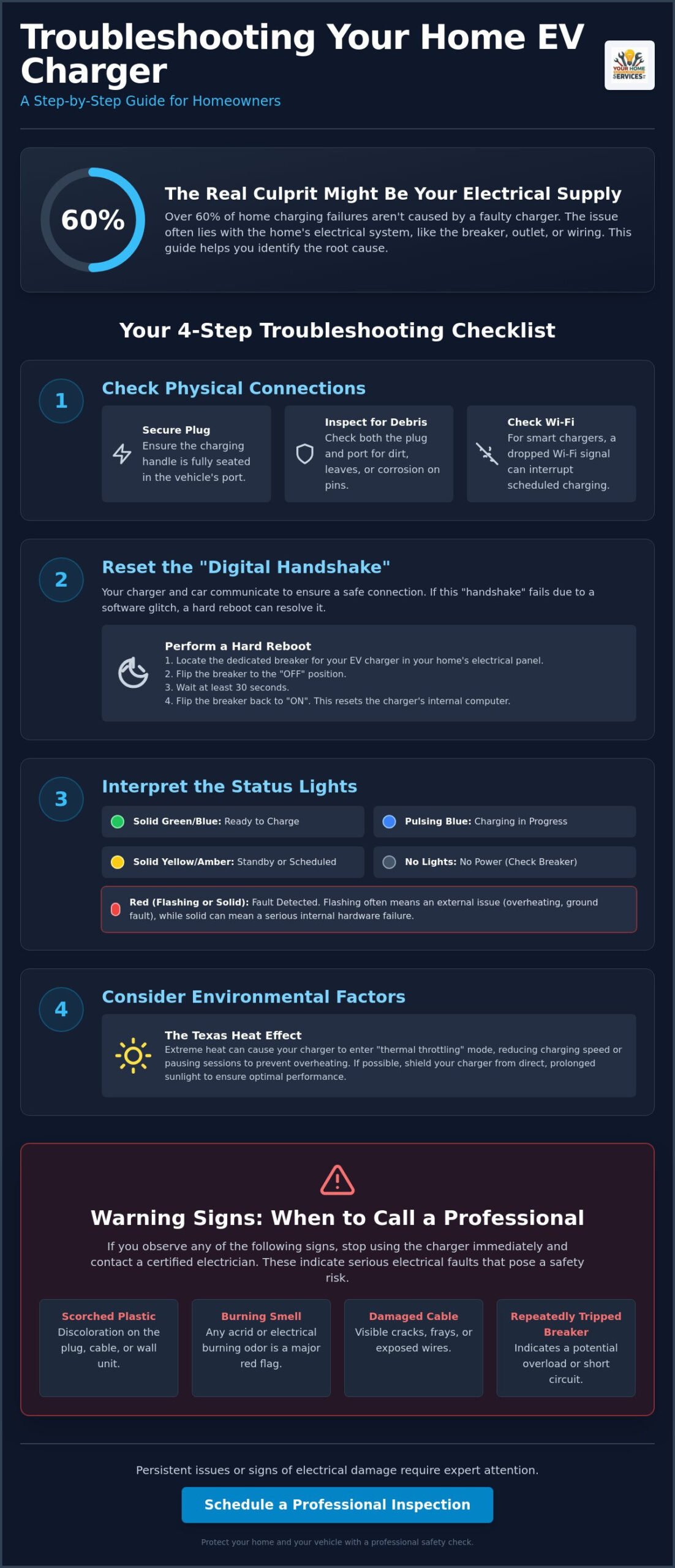
Finding your electric vehicle with an empty battery when you’re ready to leave for work is more than an inconvenience. It’s a disruption to your entire day. While it might seem like the charger has simply failed, the reality is often less severe. When you begin troubleshooting home EV charger issues, it helps to remember that these systems are sophisticated computers as much as they are electrical appliances. Over 60% of home charging failures actually stem from the electrical supply, such as the breaker or wiring, rather than the internal components of the unit itself.
Before you assume the worst, check the most basic connections. A loose plug or a bit of dust in the port can prevent the system from engaging. If the charger is a smart Level 2 model, a dropped Wi-Fi signal might prevent it from following its programmed schedule. These small hurdles are common, but they are easily addressed once you know what to look for in your EV charging station setup.
The “Handshake” and Communication Errors
Your car and the charging unit must perform a digital “handshake” before any power flows. This communication ensures that the connection is secure and the battery is ready to receive a charge. If this handshake fails, the charger will remain in standby mode or show an error light. Software timeouts are a frequent culprit, often caused by a glitch in the vehicle’s onboard computer or the charger’s firmware.
To resolve a communication hang-up, try a hard reboot. This isn’t just unplugging the car. You should locate the dedicated breaker in your electrical panel, switch it to the “off” position, wait at least 30 seconds, and then flip it back on. This resets the internal logic of the charger and often clears temporary software bugs that prevent the handshake from completing.
Physical Obstructions and Cable Wear
The physical connection is the most vulnerable part of your system because it’s handled every day. Inspect the charging handle for bent pins or signs of corrosion. In the humid Texas climate, even a small amount of oxidation on the J1772 or Type 2 plug pins can increase resistance and trigger a safety shutdown. Use a flashlight to peer into the vehicle’s port to ensure no debris, like a small leaf or a pebble, is preventing the plug from seating fully.
Cable integrity is equally vital. If you notice cracks in the cable jacket or if the handle feels excessively hot during use, the unit may be detecting a ground fault. Safety is the priority here. You should never attempt to bypass these issues with an extension cord. Standard household extension cords are not designed to handle the continuous, high-amperage draw required for Level 2 charging. Using one creates a significant fire hazard and will likely cause your charger to shut down immediately to protect your home’s electrical system.
Interpreting Status Lights and Error Codes
When your car isn’t receiving power, the first thing you should look at is the display on the charging unit itself. Most manufacturers use a series of LED lights to communicate the system’s health. These lights act as a diagnostic shorthand, telling you whether the unit is waiting for a scheduled time or if it has encountered a critical hardware failure. Understanding these signals is a vital part of troubleshooting home EV charger issues before you decide to call for professional help.
If you see a solid or flashing red light, the charger has detected a fault. A solid red light often indicates an internal hardware failure that may require a unit replacement. However, a flashing red light usually points to an external issue, such as a ground fault or an overheating connector. For those who need more detailed guidance, the Joint Office of Energy and Transportation provides technical assistance for EV charging infrastructure to help homeowners understand these complex safety standards.
The Universal Language of EV Charger LEDs
While every brand is slightly different, most follow a standard color logic. Green or blue lights typically mean the unit is powered and ready. A pulsing blue light usually indicates that charging is actively in progress. If you see an amber or yellow light, don’t panic. This often means the charger is in a “standby” or “scheduled” mode, waiting for off-peak hours to begin the session. Check your vehicle’s dashboard or the charger’s app to see if a timer is active.
What if the unit has no lights at all? This usually means the charger isn’t receiving any electricity. Before assuming the charger is broken, check your home’s main electrical panel. A tripped breaker is the most common cause of a completely dark unit. If your breaker trips repeatedly when you plug in your car, it could be a sign that you need a professional electrical panel upgrade to safely support the high demand of a Level 2 charger.
Using the App for Advanced Diagnostics
Modern chargers like the Tesla Wall Connector or JuiceBox units offer much more information through their mobile apps than they do through simple LED lights. For instance, a Tesla Wall Connector might flash red three times to signal an over-temperature condition. The app will confirm this and may even provide a specific error code that you can reference in the owner’s manual.
Your app is also the best tool for checking connectivity. Smart chargers require a stable Wi-Fi connection to follow schedules and receive firmware updates. If your charger appears “offline” in the app, it may have lost its handshake with your router. Resetting your router or installing a Wi-Fi extender in the garage often solves these “phantom” charging failures. Always check for pending firmware updates in the app settings, as manufacturers frequently release software patches that resolve known communication bugs with newer vehicle models.
Checking Your Homes Electrical Infrastructure
If your charger is dark or won’t initiate a session, the problem likely isn’t the unit itself. It’s often the power delivery system. Your electrical panel is the heart of your home’s energy distribution, and a Level 2 charger is one of the most demanding appliances you’ll ever own. When troubleshooting home EV charger issues, your first stop should be the main service panel to identify the dedicated breaker for your charging station. This breaker should be clearly labeled, typically as a double-pole 40-amp or 50-amp switch.
One common point of confusion for homeowners is the “soft trip.” This happens when a breaker disengages internally due to a fault but doesn’t fully flip to the “off” position. It might still look like it’s “on,” but it isn’t conducting electricity. To fix this, you must firmly flip the breaker to the “off” position until it clicks, then flip it back to “on.” If the breaker feels spongy or won’t stay in the “on” position, it’s a sign of a hardware failure within the panel that requires immediate professional attention.
Is Your Panel Overloaded?
Many homes in Katy and Richmond were built before high-speed EV charging was a standard consideration. Electrical systems follow an “80% rule,” meaning a circuit shouldn’t carry more than 80% of its rated capacity for continuous loads like EV charging. If you’re running your HVAC system, an electric dryer, and your car all at once, you might exceed your total Home Electrical Capacity for EV Charging. This leads to frequent interruptions that can eventually damage your charger’s sensitive electronics.
Look for physical warning signs at your panel. If you notice a faint buzzing sound or if the breaker feels hot to the touch, your system is struggling under the load. In these cases, a 200 amp panel upgrade for Texas homes is often the most reliable solution. Upgrading ensures your home can handle the simultaneous demand of modern life without constant tripping or fire risks.
GFCI and Grounding Issues
EV chargers are incredibly sensitive to the quality of your home’s grounding. If your home has older wiring, particularly in some of Richmond’s established neighborhoods, the ground connection might be insufficient. This often triggers a “Ground Fault” error on the charger. Troubleshooting home EV charger grounding issues is complex because the charger is constantly monitoring for leakage current to prevent electric shocks. If the soil around your home’s ground rod has dried out significantly during a Texas drought, it can even affect your charger’s ability to verify a safe ground.
You might also encounter “nuisance tripping” if your charger has built-in GFCI protection and it’s connected to a breaker that also has GFCI protection. These two safety systems can sometimes conflict, causing the breaker to trip even when no actual fault exists. A professional inspection can determine if your grounding rod needs replacement or if your breaker configuration is causing these unnecessary interruptions.
Texas Heat and Environmental Troubleshooting
Texas summers in Katy and Sugar Land regularly see temperatures climb well above 100°F. This extreme environment places immense stress on electrical components that are already generating their own heat during operation. If you find yourself troubleshooting home EV charger issues like unexpectedly slow charging in the mid-afternoon, the culprit is likely the intense Texas sun rather than a mechanical failure. High ambient temperatures make it difficult for the charger to dissipate heat, leading to a protective state known as thermal throttling.
Living in the Gulf Coast region also means dealing with high humidity. Moisture and salt in the air can gradually affect electrical connections, especially for units mounted outdoors. While most modern chargers are built to withstand the elements, they aren’t invincible. Understanding how the climate impacts your equipment helps you maintain a reliable charge all year long.
Thermal Throttling Explained
Thermal throttling is a built-in safety mechanism designed to protect your investment. When the internal temperature of the unit rises too high, the charger automatically reduces the amount of electricity it delivers to your vehicle. This reduction lowers the heat generated by the electrical flow, preventing the delicate circuit boards from sustaining permanent damage. Internal sensors will shut down the unit if temperatures exceed safe operating limits.
To avoid these interruptions, try to schedule your charging sessions after 9:00 PM. Not only is the air cooler, but the reduced demand on the local power grid often results in more stable voltage. If you must charge during the day, ensure the charging cable is fully uncoiled. A coiled cable can trap heat and trigger a temperature fault much faster than one that is spread out on the cool garage floor.
Weatherproofing and Maintenance
Humidity is a silent contributor to charging failures for homeowners in Richmond. High moisture levels can lead to subtle corrosion on the charging pins. This oxidation increases electrical resistance, which in turn generates even more heat during a session. Regularly inspect your charger’s handle for debris, dust, or any signs of green or white powdery buildup. A quick cleaning with a dry, soft cloth can often restore a low-resistance connection.
Additionally, check the NEMA enclosure for signs of insect intrusion. Small pests like ants are frequently attracted to the warmth and electromagnetic fields of electrical boxes, which can lead to short circuits or blocked ventilation ports. If your unit is mounted on an exterior wall, consider installing a small shade structure or a carport. Reducing direct sunlight exposure can lower the unit’s operating temperature by 15°F or more. If your charger keeps overheating despite your best efforts, it might be time for a professional EV charger installation assessment to ensure proper ventilation and placement.
When to Call a Professional Electrician in Richmond
While many charging hiccups result from minor software glitches or the intense Texas heat, certain symptoms indicate a serious electrical hazard. Safety is the absolute priority when dealing with high-voltage equipment. If your initial efforts at troubleshooting home EV charger issues don’t yield a stable connection, you must recognize the signs that the problem has moved beyond a simple DIY fix. Continuing to use a faulty system can lead to permanent hardware damage or, in extreme cases, an electrical fire.
Physical warning signs are the most urgent. If you catch the faint scent of ozone, notice scorched plastic on the plug, or see visible smoke coming from the unit, you should immediately flip the breaker to “off” and stop using the charger. These are clear indicators of an electrical short or a loose connection that is generating dangerous levels of heat. Similarly, if the unit’s housing is cracked or water has managed to bypass the seals of an outdoor-mounted charger, professional intervention is necessary to prevent a short circuit.
Repeated breaker trips are another red flag. If you’ve performed a reset and the breaker trips again the moment the charging session begins, the circuit is likely overloaded or there’s a fault in the hardwired connection. Persistent “Ground Fault” errors that remain even after you’ve cleaned the charging pins often point to a breakdown in the home’s grounding system. These issues require specialized diagnostic tools that only a licensed electrician can provide.
The Safety Red Line
There is a firm boundary between user maintenance and professional repair. You should never attempt to open the charger’s internal casing or modify the wiring of a 240V circuit. These systems carry enough current to be lethal if handled incorrectly. A single mistake during a DIY wiring repair can compromise your home’s entire electrical system and void your equipment’s warranty. This is why hiring a licensed professional for EV charger installation in Sugar Land is so critical for your home’s long-term safety. A professional ensures that every component meets the latest National Electrical Code standards.
What to Tell Your Electrician
When you call for assistance, providing specific details can help the technician diagnose the problem more efficiently. Before the visit, document any error codes displayed in your app or the specific flashing patterns of the LED lights. Note the exact time of day when the failures occur. For example, if the fault only happens during the peak afternoon heat, it confirms an environmental issue. You should also keep track of which other high-load appliances, such as your HVAC or pool pump, were running when the system failed. This information helps the expert determine if you need a simple repair or a more robust electrical panel upgrade to support your vehicle’s power needs.
Restoring Your Reliable Home Charging Experience
Maintaining a dependable EV charger is essential for your daily routine. Most interruptions are solvable once you understand the basic logic of status lights and the specific impact of the Texas climate on your equipment. By following these steps for troubleshooting home EV charger issues, you can often clear simple communication errors or resolve environmental throttling without unnecessary stress. However, your safety is the most important factor. If a reset doesn’t fix the problem or if you notice any physical warning signs at your panel, it’s time to rely on a professional.
Our team of licensed and insured Texas electricians has been serving Richmond, Katy, and Sugar Land since 2021. We are specialists in Level 2 Tesla and universal charger repairs, ensuring your home’s electrical infrastructure is both safe and efficient. Don’t let a faulty connection leave you with an empty battery or compromise your property’s electrical integrity. We have the tools and expertise to diagnose complex faults and provide lasting solutions.
Schedule a Professional EV Charger Diagnostic in Richmond or Katy today to ensure your charging station is ready for the road ahead. We’re here to help you keep your vehicle powered and your home safe.
Frequently Asked Questions
Why is my EV charger flashing a red light?
A flashing red light indicates that the unit has detected a fault, such as a ground fault or an over-temperature condition. While a solid red light often suggests a permanent internal failure, a flashing light is usually a protective response to something happening in your home’s wiring or the environment. When you’re troubleshooting home EV charger error codes, the number of flashes often corresponds to a specific issue listed in your owner’s manual.
Can I reset my home EV charger by flipping the breaker?
Yes, flipping the breaker is an effective way to perform a hard reboot of your system. If the unit’s internal computer has frozen or a software handshake error occurs, cutting the power for 30 seconds can clear the glitch. This is often the first step in troubleshooting home EV charger connectivity issues before you decide to call for professional assistance.
Why does my EV charge slower when it is hot outside?
Your charger slows down in high heat to prevent its internal circuit boards from sustaining heat damage. This process, known as thermal throttling, is very common during 100°F days in Texas. The unit reduces the amperage it pulls from the grid to lower the internal temperature, which protects the hardware but results in a longer charging time for your vehicle.
Is it safe to use my EV charger if the cable is slightly warm?
A slight increase in temperature is normal because electricity naturally generates heat as it flows through the copper wiring. However, the cable should never feel painful to touch or emit a burning plastic smell. If the handle or cable feels excessively hot, it could indicate high resistance from corroded pins or a loose internal connection that needs immediate professional inspection.
What should I do if my charging cable is stuck in the car?
Most electric vehicles have a manual override release located in the trunk or behind a small panel near the charging port. If the electronic lock fails to disengage, consult your car’s owner’s manual to find this emergency pull cord. You should avoid using force to yank the cable out, as this can damage the expensive charging port on your vehicle.
How much does it cost to repair a home EV charging station?
The cost of a repair depends on whether the issue is with the charging unit itself or your home’s electrical infrastructure. Many chargers are covered by a manufacturer warranty for three to five years, which may cover a replacement unit if the hardware fails. If the problem is in your home’s wiring or the breaker, a licensed electrician will need to provide a specific estimate after a diagnostic visit.
Can a faulty EV charger damage my car’s battery?
It’s highly unlikely for a charger to damage your battery because the car’s onboard computer controls the actual charging process. The wall unit acts as a smart switch that provides power only when the vehicle requests it. However, a severe electrical surge through the charger could potentially damage the car’s sensitive onboard charger or other electronic components.
For owners who want to verify their vehicle’s health after experiencing charging issues, specialized services such as EVdiagnostika.si provide licensed, independent testing for electric and hybrid batteries to ensure everything is functioning correctly.
While this guide focuses on Texas EV infrastructure, the principles of battery care extend to all forms of electric mobility; you can learn more about Etech Motion to see how these electrical standards are applied in the world of advanced electric powerchairs.
Why does my car say “Charging Paused” on my phone app?
A “Charging Paused” notification usually means the system is following a pre-set schedule or has reached the battery’s programmed charge limit. It can also happen if the charger detects a temporary instability in the local power grid. You should check your vehicle’s dashboard settings and the charger’s mobile app to ensure a timer isn’t accidentally preventing the session from continuing.