
What if you could wake up every morning to a fully charged vehicle without ever worrying about the safety of your home’s electrical panel? Many homeowners quickly realize that standard wall outlets are far too slow for a modern lifestyle, making a professional EV charger installation Sugar Land project a top priority for 2026. It’s frustrating to see a “days remaining” message on your dashboard, and it’s even more stressful to worry about whether improper wiring could lead to a fire. You want a setup that’s fast, reliable, and professionally finished without messy conduit runs or holes left in your drywall.
We understand that you need a solution that balances technical performance with professional assurance. This guide covers everything you need to know about getting your home ready, from navigating the latest 2024 ICC codes to securing your local permits. You’ll learn how to assess your current electrical capacity and how to claim the 30% federal tax credit. We provide a clear, step by step look at how to achieve a clean, Level 2 installation that passes every inspection and gets you back on the road faster.
Key Takeaways
- Discover why Level 2 charging is the essential standard for modern drivers, providing significantly faster speeds than a traditional 120V outlet.
- Learn how to evaluate your home’s electrical panel and load capacity to ensure a safe, reliable power supply for your new equipment.
- Compare hardwired and plug-in charging stations to find the right balance between maximum power delivery and future versatility.
- Understand the specific permitting and local code requirements for an EV charger installation Sugar Land project to guarantee a successful inspection.
- Find out how to achieve a professional finish that includes both expert electrical wiring and seamless drywall repair for a clean look.
Why Level 2 EV Charger Installation is Essential for Sugar Land Drivers
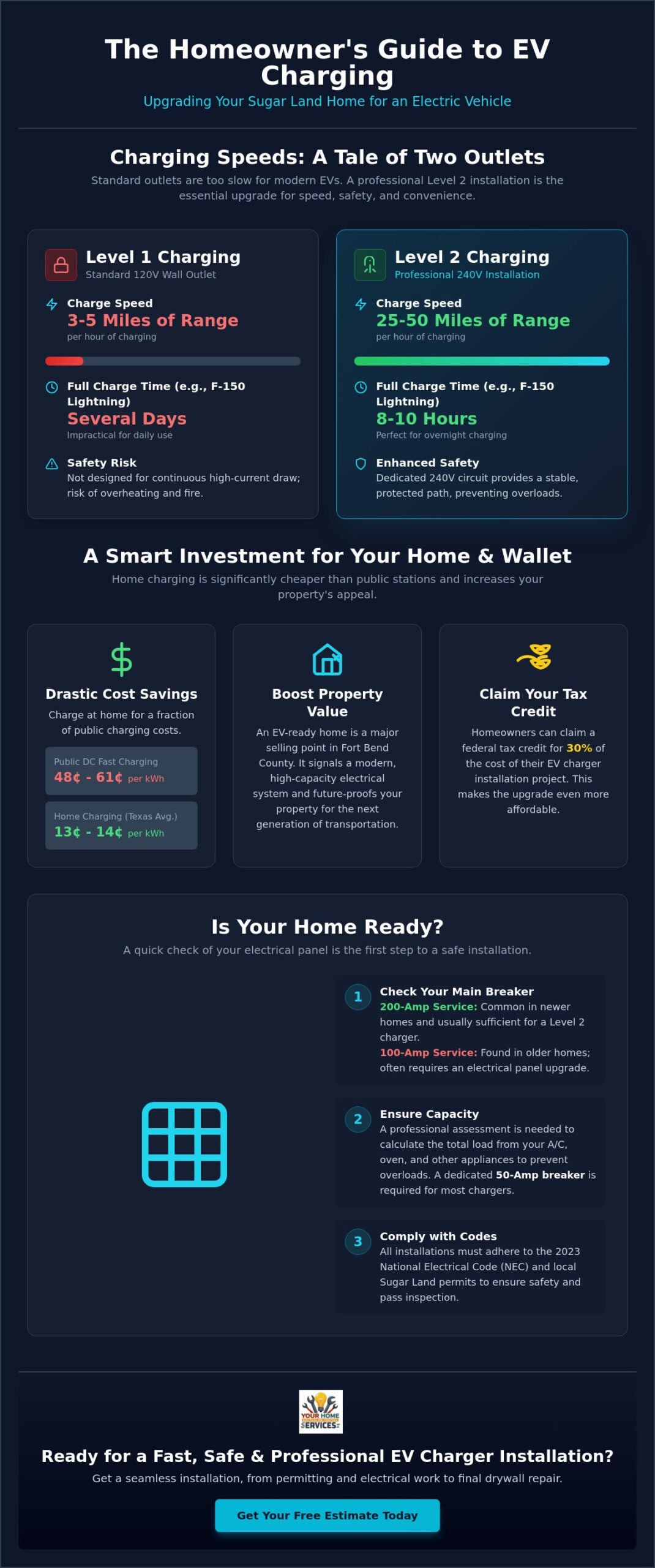
Many new EV owners in Sugar Land start by plugging into a standard wall outlet. They quickly find that 120V Level 1 charging is like filling a swimming pool with a garden hose. For a modern vehicle, this trickle method might only add 3 to 5 miles of range per hour. If you have a long commute into Houston or a busy weekend planned, you simply won’t have enough charge. A professional EV charger installation Sugar Land project upgrades your garage to Level 2, which utilizes 240V power to deliver 25 to 50 miles of range per hour.
This setup turns your home into a high-performance electric vehicle charging station. Beyond speed, home charging is much more affordable than relying on public infrastructure. While public DC fast chargers in the area can cost between 48 and 61 cents per kWh, home charging rates in Texas are often as low as 13 to 14 cents per kWh according to recent utility data. You can save hundreds of dollars annually by fueling your car while you sleep.
Safety is another major factor that homeowners must consider. Standard household outlets aren’t designed for the continuous, high-current draw required to charge a car for 10 hours straight. A dedicated 240V circuit reduces the risk of overheating and electrical fires. It provides a stable, protected path for electricity that won’t trip your breakers or strain your existing lighting circuits.
Level 1 vs. Level 2: The Real-World Difference
Consider popular models like the Tesla Model Y or the Ford F-150 Lightning. On a standard outlet, a full charge for a Lightning could take several days. With a Level 2 station, you can go from empty to full in just 8 to 10 hours. Trickle charging also tends to be less efficient for battery health. Because the car’s cooling and management systems must run the entire time it is plugged in, a shorter, more powerful charge session actually wastes less energy. You’ll wake up every morning with a full tank, ready for your daily routine without searching for a public plug—and to keep that new car shine, many owners turn to D3 Auto Care LLC for professional automotive protection.
Boosting Your Property Value in Fort Bend County
Homebuyers in Fort Bend County are increasingly looking for EV-ready properties. Installing a charging station now is a smart investment in your home’s future marketability. It shows that the electrical system is modern and capable of handling high-demand appliances. Whether you choose a hardwired unit or a pre-wired NEMA 14-50 outlet, you’re future-proofing your property for the next generation of transportation. A professional EV charger installation Sugar Land provides a visible, high-tech upgrade that sets your home apart in a competitive real estate market, especially when considering the long-term benefits of solar integration from leaders like G-Solar & Electrical.
Technical Requirements: Assessing Your Home’s Electrical Capacity
Before you schedule an EV charger installation Sugar Land, you must determine if your home can physically handle the extra demand. Most Level 2 chargers operate at 32 to 48 amps, which requires a dedicated 50-amp double-pole breaker. This isn’t just about having an empty slot in the breaker box; it’s about the total electrical load your service can manage. When assessing your home’s electrical capacity, we look at the concurrent draw of your air conditioning, pool pumps, and electric ovens to ensure the new charger won’t overload the system.
The 2023 National Electrical Code (NEC) remains the standard for these installations in Sugar Land. These regulations exist to prevent overheating during the hours of continuous high-current draw that EV charging requires. If your current system is already operating near its limit, you will likely need an electrical panel upgrade for EV charger in Sugar Land before it’s safe to add a new circuit. Taking this step ensures your home remains protected while providing the fast charging speeds you expect.
Does Your Panel Have Room?
You can identify your service level by looking at the main breaker at the top of your panel. A 200-amp service is common in many newer Sugar Land developments and typically provides enough headroom for a Level 2 charger. However, older homes with 100-amp service often face challenges. If you notice flickering lights when your dryer starts or if your breakers trip frequently, your box is likely at its limit. For those living in older neighborhoods, reviewing a professional electrical panel upgrade Richmond TX guide can help you understand the scope of work required to modernize your home’s infrastructure.
Wiring and Conduit: Aesthetics vs. Function
For a standard 50-amp continuous load, we typically use 6 AWG copper wire. This heavy-gauge wiring is necessary to handle the heat generated during an eight-hour charging session. You have two main options for the installation: surface-mounted conduit or in-wall wiring. While running wires behind the drywall looks the most professional, it may involve more labor and patching. Professional-grade conduit is required for garage safety in Texas to protect high-voltage wiring from accidental physical damage. If you want to ensure your setup is both safe and visually appealing, Your Home Electrical and Handyman Services LLC can help you design a layout that fits your garage’s specific needs.
Choosing the Right Equipment: Hardwired vs. Plug-In Stations
Deciding between a hardwired unit and a plug-in station is one of the most important steps in your EV charger installation Sugar Land process. Hardwired stations connect directly to your home’s electrical system without a traditional plug and outlet. This direct connection allows for higher power delivery, often reaching 48 to 80 amps, which provides the fastest possible Level 2 charging speeds. Because there’s no exposed plug, these units offer superior weather resistance. They’re the preferred choice for driveway installations where the equipment is exposed to the Texas humidity and rain.
Plug-in options typically use a heavy-duty outlet. While these are usually limited to 40 amps of continuous draw to stay within safety margins, they offer unmatched versatility. If your charger ever needs a repair or an upgrade, you can simply unplug it and swap it out yourself without calling an electrician back to the house. When you’re making these equipment choices, it’s also vital to account for permits and local codes to ensure your garage remains compliant with current 2026 safety standards.
You also need to choose between “smart” and “dumb” chargers. Smart chargers connect to your home WiFi, allowing you to monitor energy usage and schedule charging sessions through a mobile app. This is helpful if your specific electricity plan offers lower rates during overnight hours. “Dumb” chargers are simpler and often more affordable. They start charging as soon as you plug them in. Finally, ensure your station matches your vehicle’s port. While the J1772 standard has been common for years, the industry is rapidly shifting toward the North American Charging Standard (NACS) used by Tesla and adopted by most major manufacturers for their 2026 lineups.
The NEMA 14-50 Outlet Advantage
Many Sugar Land homeowners prefer a NEMA 14-50 outlet installation because it provides a multi-purpose power source. This is the same type of outlet used for large RVs or heavy shop equipment, adding utility to your garage beyond just vehicle charging. Installing an outlet is often more cost-effective than a dedicated hardwired station. However, you must ensure the outlet is industrial-grade. Cheaper residential outlets can’t always handle the heat of a high-draw EV load for several hours at a time.
Top Charger Brands for 2026
The Tesla Wall Connector remains the gold standard for NACS-equipped vehicles, offering a sleek design and high reliability. For non-Tesla owners or those who want a universal solution, the ChargePoint Home Flex and Emporia are excellent choices. These brands offer robust apps and flexible amperage settings to match your home’s capacity. Choosing a UL-listed charger is non-negotiable because using uncertified equipment can lead to the denial of insurance claims in the event of an electrical fire. Stick with reputable, tested brands to protect your property and your vehicle.
The Sugar Land Installation Journey: Permits and Local Codes
A successful EV charger installation Sugar Land project follows a methodical process to ensure your home remains safe and compliant with local laws. This journey isn’t just about the physical wiring; it involves a structured set of steps that protect your property value and your family. We break down the process into four critical phases:
- Step 1: Initial Assessment: We conduct a thorough site survey of your garage or driveway. This includes calculating your current electrical load to ensure your panel can handle the new demand without overloading.
- Step 2: Permitting: We secure all necessary electrical permits from the City of Sugar Land Building and Development Services department.
- Step 3: Professional Installation: Our team installs the dedicated 240V circuit, heavy-duty conduit, and your chosen charging unit according to the manufacturer’s specifications.
- Step 4: Final Inspection: A city official visits your home to verify that the work meets all safety codes, providing you with the final sign-off for your records.
Navigating Sugar Land Building Permits
The City of Sugar Land requires a permit for any new 240V circuit addition. This is a mandatory safety measure, not a suggestion. Effective January 21, 2026, the city adopted the 2024 International Code Council (ICC) Codes, while the 2023 National Electrical Code (NEC) remains the governing standard for electrical work. We handle all the paperwork and coordination with the city to save you time and frustration. Skipping this step is risky. Unpermitted work can lead to insurance claim denials if a fire occurs, and it often creates major headaches when you eventually try to sell your home.
Neighborhood Specifics: From First Colony to Riverstone
Each neighborhood in our community presents unique challenges for an EV charger installation Sugar Land. Homes in established areas like First Colony often have older 100-amp or 125-amp electrical panels that require modernization to support a Level 2 charger. In contrast, newer developments like Riverstone typically feature 200-amp service, making the process more straightforward. You also need to consider your Homeowners Association (HOA). Many local HOAs have specific deed restrictions regarding where you can mount an outdoor charger or how conduit must be hidden. If you choose a driveway installation, we use weather-rated enclosures to protect the equipment from the intense Texas humidity and seasonal storms. For a seamless experience that respects your neighborhood’s standards, you can trust our team for professional EV charger installation services.
Why Your Home Electrical and Handyman Services LLC is the Best Choice
Choosing a partner for your EV charger installation Sugar Land project means finding a team that understands both the technical and the aesthetic needs of your home. Many large electrical contractors specialize in running wires but often leave the homeowner with the task of patching holes and repainting the garage. Your Home Electrical and Handyman Services LLC takes a different approach. By combining licensed electrical expertise with professional handyman skills, we provide a complete solution from the first load calculation to the final coat of paint.
Our “No-Mess” Guarantee is a core part of our service identity. We understand that running a new 240V circuit often requires cutting into the drywall to route heavy-gauge wiring safely. Instead of leaving you with a messy cleanup, we handle the entire restoration process ourselves. This local focus extends across the Sugar Land, Katy, and Richmond grids, where we have built a reputation for transparent, flat-rate pricing on standard installations. You’ll know exactly what to expect before the work begins.
The Turnkey Advantage: Electrical + Handyman
Homeowners who value their property’s appearance prefer our turnkey model. We provide a specialized drywall repair Sugar Land service that ensures a seamless finish once the electrical work is complete. You won’t have to manage multiple contractors or wait weeks for a separate painter to show up. Having a single point of contact with Your Home Electrical and Handyman Services LLC simplifies the project and ensures the final result looks like the charger was always part of your home’s original design.
Ready for a Faster Charge?
Getting started is a straightforward process. You can request a detailed EV charger installation quote to understand the scope of your specific project. To make your consultation as efficient as possible, it helps to have a few items ready. Please provide clear photos of your electrical panel, your vehicle’s make and model, and your desired location in the garage or driveway. Schedule your professional installation today and start every day with a full battery and total peace of mind.
Secure Your Home’s Electric Future Today
Investing in a dedicated home charging station is about more than just convenience; it’s about ensuring your home’s electrical system is safe, efficient, and ready for the road ahead. By upgrading to a Level 2 system, you eliminate the frustration of slow charging while significantly increasing your property’s long-term value. Whether you need a load assessment for an older panel or a clean garage finish, a professional EV charger installation Sugar Land project provides the reliability you need to support your daily commute.
Our team of licensed and insured Texas electricians handles the complex technical requirements and the city permitting process for you. We are proud of our 5-star local Sugar Land reviews and our commitment to a “no-mess” experience, which includes professional drywall repair for a seamless finish. You don’t have to settle for exposed wires or unfinished walls. Get Your Professional EV Charger Installation Quote Today and enjoy the peace of mind that comes with a job done right. We look forward to helping you make the most of your electric vehicle journey.
Frequently Asked Questions
How much does it cost to install an EV charger in Sugar Land?
The total cost depends on the distance between your electrical panel and the charger location, as well as any necessary infrastructure upgrades. While hardware prices vary by brand, labor and materials are calculated based on the complexity of the wiring run and local permitting requirements. We provide transparent, flat-rate pricing for standard installations to ensure you have a clear understanding of the project before we begin.
Do I really need a permit for a home EV charger installation?
Yes, the City of Sugar Land requires a building permit for all new 240V circuit additions. This ensures that the work meets the 2023 National Electrical Code (NEC) and the 2024 International Code Council (ICC) standards adopted in early 2026. Our team handles the entire permitting process for you, including coordination with the building department and the final safety inspection for your peace of mind.
How long does the professional installation process take?
A standard EV charger installation Sugar Land typically takes between four and six hours to complete. This timeframe includes mounting the unit, running the conduit, and testing the circuit for safety. If your project requires an electrical panel upgrade or extensive drywall restoration, the process may extend into a full day. We work efficiently to minimize disruption to your household routine and get you back on the road quickly.
Can I install a Level 2 charger myself if I have some electrical experience?
We strongly discourage DIY installations due to the high voltage and continuous current draw required for Level 2 charging. Improper wiring can lead to electrical fires, equipment damage, or voided vehicle warranties. Additionally, the City of Sugar Land requires a licensed professional to pull the necessary permits and sign off on the work to ensure it passes official safety inspections and remains code-compliant.
Will an EV charger require me to upgrade my entire electrical panel?
Not every home requires a full panel upgrade, but it depends on your current electrical load. We perform a detailed load calculation to see if your existing service can handle a 50-amp breaker alongside your AC and other heavy appliances. If your panel is 100-amp or already at capacity, we can perform a professional Electrical Panel Upgrade to ensure your home remains safe and can support the new demand.
Can an EV charger be installed outside if I don’t have a garage?
Yes, we can install chargers outdoors if you don’t have a garage or prefer a driveway setup. We use weather-rated enclosures and industrial-grade conduit to protect the equipment from the intense Texas humidity and rain. For outdoor installations, we often recommend hardwired units because they offer superior protection against the elements compared to plug-in models that rely on an external outlet.
What is the difference between a hardwired charger and a NEMA 14-50 outlet?
Hardwired chargers connect directly to your electrical system, allowing for faster charging speeds and better weather resistance. A NEMA 14-50 outlet allows you to plug in a portable charger, offering versatility if you need to replace the unit yourself later. While the outlet is a popular choice, hardwired units are generally considered the more robust and permanent solution for high-performance home charging in 2026.
Does Your Home Electrical and Handyman Services LLC handle the drywall repair after the install?
Yes, Your Home Electrical and Handyman Services LLC includes professional drywall repair as a standard part of our turnkey service. Most electrical companies leave homeowners to deal with the holes and mess left behind after running new wires through the walls. Our team restores your garage or interior walls to their original condition, providing a seamless finish that makes the EV charger installation Sugar Land look like it was built with the home.