

The era of DIY electric vehicle charging is officially over in Texas. With the state’s adoption of the 2026 National Electrical Code on September 1, 2026, every NEMA 14-50 outlet installation must now be performed by a qualified professional. This change is a vital safety measure to prevent electrical fires that can occur when standard household outlets are pushed to their limits by high-amperage continuous loads.
You likely want the convenience of fast home charging without worrying if your electrical panel can handle the stress or if you’ve purchased a low-quality receptacle that might melt. We’ll show you why the NEMA 14-50 remains the gold standard for versatility while explaining how to ensure your setup meets the latest Texas safety codes. We will also explore the critical difference between industrial-grade components and standard outlets, the impact of new GFCI requirements, and whether a hardwired charger might actually be your most cost-effective option.
Key Takeaways
- Understand why the NEMA 14-50 is the gold standard for home charging and how its 4-prong design provides reliable 240-volt power.
- Learn about the “80% rule” for continuous loads and why 6-gauge copper wiring is essential for safe heat management in your garage.
- Compare the flexibility of a plug-in outlet with the faster charging speeds and lower installation costs of a hardwired charger.
- Follow the professional steps for a NEMA 14-50 outlet installation, from performing a panel load calculation to choosing the right conduit.
- Discover how to protect your property from fire risks caused by extreme Texas heat and high-amperage electrical resistance.
What is a NEMA 14-50 Outlet and Why is it the EV Standard?
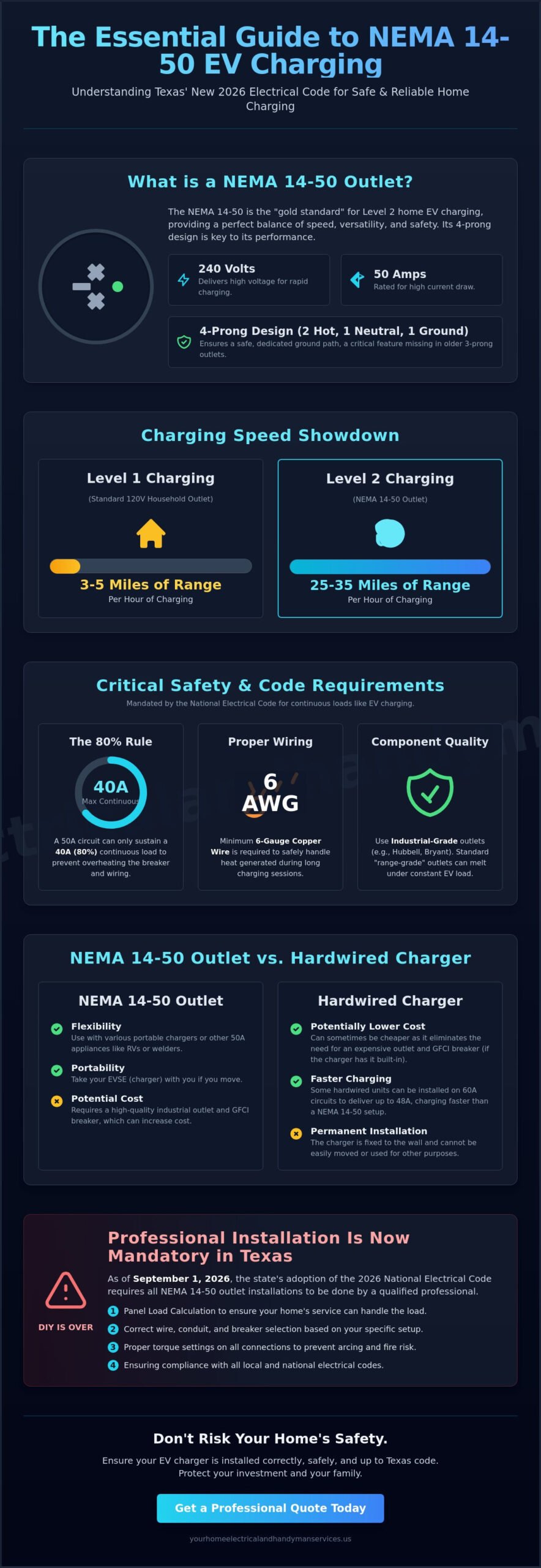
A NEMA 14-50 outlet is a heavy-duty, 4-prong receptacle designed to handle 240 volts of electricity. It’s often recognized as the “gold standard” for home charging because it offers a perfect balance of speed and versatility. The name itself reveals its technical specifications. The “14” refers to the specific blade configuration and grounding requirements as defined by the NEMA connector standard; while the “50” indicates its 50-amp maximum rating. This high-capacity design allows it to support the heavy electrical draw required by modern vehicles like the Tesla Model 3, Ford Mustang Mach-E, and various Level 2 portable chargers.
Homeowners often prefer a NEMA 14-50 outlet installation over older configurations like the NEMA 10-30 or 6-50. Older 10-30 outlets, commonly used for dryers, lack a dedicated ground wire, which is a significant safety concern for EV charging. The 6-50 configuration lacks a neutral wire, limiting its use for other appliances. By choosing the 14-50, you’re installing a future-proof solution that works with almost every major EV brand’s mobile connector or plug-in station.
The Difference Between Level 1 and Level 2 Charging
Level 1 charging uses a standard 120-volt household outlet. It’s incredibly slow, typically adding only 3 to 5 miles of range per hour. For many Richmond commuters, this isn’t enough to recover a full day of driving overnight. In contrast, a Level 2 setup using a NEMA 14-50 outlet provides roughly 25 to 35 miles of range per hour. This speed ensures your vehicle is ready for the morning commute even if you arrive home with a nearly empty battery. The outlet provides the power, while your Electric Vehicle Supply Equipment (EVSE) manages the safe transfer of energy to the car’s internal charger.
Common Use Cases Beyond Electric Vehicles
The utility of a NEMA 14-50 outlet installation extends beyond your car. These outlets are the standard power source for larger RVs and trailers. If you have guests visiting in a motorhome, a 14-50 outlet allows them to run their AC and appliances without straining your home’s system. Additionally, high-powered workshop tools like professional-grade welders or large air compressors often require this exact 50-amp circuit. However, you should never attempt to share a single outlet between an EV and a dryer using a splitter. Dryers typically run on 30-amp circuits; attempting to pull EV-level power through those wires creates a severe fire hazard in your home.
Technical Requirements: Amps, Volts, and Wire Gauges
A safe NEMA 14-50 outlet installation depends on understanding how electricity behaves under a continuous load. Unlike a kitchen range that cycles on and off, an electric vehicle pulls high current for several hours at a time. The National Electrical Code (NEC) mandates the 80% rule for these scenarios. This means that while your circuit is rated for 50 amps, it can only safely deliver 40 amps of continuous power. Pushing a circuit beyond this 80% threshold risks overheating the breaker and the internal wiring of your home.
Wiring choice is equally critical for heat management. You must use 6-gauge copper wiring to handle the 40-amp continuous draw safely. While some sources suggest 8-gauge wire for very short runs, it lacks the thermal mass required to prevent heat buildup during an eight-hour charging session. Your installation requires a 4-wire configuration: two hot wires, one neutral, and one ground. Every connection must be secured with a torque wrench to the manufacturer’s specific inch-pound settings. Loose terminal screws are a primary cause of electrical arcing, which can quickly lead to a garage fire.
Why Outlet Quality Matters: Residential vs. Industrial Grade
Many homeowners are tempted to buy a $10 outlet from a big-box hardware store. These are “range-grade” receptacles designed for stoves that only pull full power for short bursts. Using these for EV charging often leads to thermal runaway, where the outlet eventually melts because it cannot dissipate constant heat. For a reliable setup, we recommend industrial-grade brands like Hubbell or Bryant. These are built with heavier internal brass components that withstand high-duty cycles. The superior contact pressure within an industrial-grade outlet is the most critical factor in preventing terminal failure and melting.
Evaluating Your Electrical Panel Capacity
Before adding a heavy 50-amp load, you must determine if your home’s electrical service can support it. Most modern homes have 200-amp service, which usually accommodates an EV charger without issue. However, older homes with 100-amp service often require a Professional Electrical Panel Upgrade Richmond TX to avoid overloading the main breaker. A professional load calculation is the only way to ensure your total household demand, including air conditioning and appliances, won’t exceed your panel’s safety limits. If you’re just Getting Started with Home EV Charging, having an expert assess your system is the best way to prevent future outages. If you suspect your panel is nearing its limit, our team can perform a detailed electrical panel inspection to ensure your home remains safe and code-compliant.
NEMA 14-50 Outlet vs. Hardwired EV Chargers
Choosing between a plug-in setup and a hardwired station is a pivotal decision for your home charging strategy. A NEMA 14-50 outlet installation offers significant flexibility for homeowners who might move or want to switch charger brands in the future. If you decide to upgrade your charging hardware, you simply unplug the old unit and swap in the new one. However, this convenience comes with a specific performance cap. Because of the 80% safety rule, an outlet on a 50-amp circuit is limited to 40 amps of continuous output. Hardwired chargers, when installed on a 60-amp circuit, can deliver 48 amps or more, providing a noticeable boost in charging speed for large-battery vehicles.
The cost profile for these two options has changed significantly due to updated safety standards. Current National Electrical Code (NEC) requirements mandate the use of a GFCI breaker for all garage-based NEMA 14-50 outlets. These specialized breakers typically cost between $150 and $200. Interestingly, many hardwired chargers have internal ground-fault protection, which often allows them to be installed with a standard, less expensive breaker. Research indicates that hardwiring can actually be $400 to $500 cheaper overall because it eliminates the need for both the expensive GFCI breaker and the industrial-grade receptacle itself.
Aesthetics also play a role in your garage’s appearance. A hardwired installation provides a much cleaner, more integrated look. The electrical conduit feeds directly into the unit, removing the need for a visible plug and a heavy cord hanging from the wall. This permanent setup feels like a high-end appliance rather than a temporary utility hookup, which can be a selling point for modern Texas homes.
When to Choose an Outlet
A NEMA 14-50 outlet installation is the right path if you rely on the mobile connector that came with your vehicle. It’s also the superior choice for multi-use garages. If you frequently use heavy-duty workshop tools or own an RV, a single high-capacity outlet can serve multiple roles. If your charger ever fails, the “plug-and-play” nature of an outlet ensures you won’t need to wait for an electrician to swap out the hardware.
When Hardwiring is the Superior Choice
Hardwiring is the only recommended option for outdoor installations where protecting a large 240-volt plug from rain and humidity is difficult. It’s also the best way to future-proof your home if you drive a vehicle with a massive battery pack, such as a Ford F-150 Lightning, which benefits greatly from the extra 8 amps of power. For a faster, more streamlined charging experience, a Level 2 Charging Station Installation is often the most efficient long-term investment for your property.
The Installation Process and Safety Standards in Texas
A NEMA 14-50 outlet installation in Texas requires more than just basic electrical knowledge. The extreme humidity and summer heat in cities like Richmond and Sugar Land increase electrical resistance. This makes precise installation a necessity for long-term safety. A professional installation follows a structured five-step process to ensure your system remains reliable under heavy use. It begins with a comprehensive load calculation. This ensures your current panel can handle the 50-amp surge without compromising other household systems like your air conditioning.
Next, the electrician runs 6/3 SOOW or THHN wire through appropriate conduit, such as EMT or PVC. Using conduit is essential in Texas. It protects the heavy-gauge wires from mechanical stresses and the high ambient temperatures found in local garages. The third step involves installing a dedicated 50-amp double-pole breaker. This is followed by mounting the industrial-grade NEMA 14-50 receptacle into a heavy-duty box. We use specialized boxes that provide better heat dissipation than standard plastic versions. Finally, the system is verified with a multimeter to check voltage levels and ground integrity before the first charge.
NEC 2026 Codes: The GFCI Requirement
The Texas Department of Licensing and Regulation (TDLR) has officially adopted the 2026 National Electrical Code, effective September 1, 2026. This code mandates that all 240-volt garage outlets must have GFCI protection. While this prevents shocks, it can sometimes cause “nuisance tripping.” This happens when the GFCI breaker and the car’s internal safety computer conflict while monitoring for ground faults. A professional electrician knows how to select specific breaker brands that minimize these interruptions while staying fully compliant with the law. This expertise prevents your car from stopping its charge in the middle of the night.
Permitting and Inspections in Fort Bend County
In Fort Bend County, obtaining an electrical permit is a requirement for any new 240V circuit. Cities like Katy and Rosenberg require these permits to ensure that all work meets local safety standards. Skipping this step can lead to significant headaches when you try to sell your home. Unpermitted electrical work is a major red flag for home inspectors and can lower your property value. Additionally, your homeowner’s insurance may deny claims related to electrical fires if the installation was not permitted and inspected by a professional. Our team handles all the paperwork and coordinates with local inspectors so you don’t have to. If you are ready to start, you can schedule your EV charger installation today to ensure your home is safe and up to code.
Why Professional Installation is Vital for Your Richmond Home
Texas garages are notoriously harsh environments for electrical components. During a typical Richmond summer, temperatures inside a closed garage can easily exceed 100 degrees Fahrenheit. This ambient heat increases electrical resistance within your wiring. When you combine high outside temperatures with the heat generated by a 40-amp continuous load, the margin for error disappears. A NEMA 14-50 outlet installation that isn’t perfectly executed can quickly lead to component degradation or even a house fire. Professional electricians understand these local variables and select materials that are rated for these extreme thermal conditions.
The greatest danger in high-amperage circuits is a loose connection. When electricity flows through a loose terminal, it creates an arc, which generates intense heat. This heat causes the metal to expand and contract, further loosening the connection in a dangerous cycle. We use professional-grade torque tools to meet exact manufacturer specifications for every screw and terminal. This precision ensures a “set it and forget it” installation that remains secure for years. For residents in Richmond, Katy, and Sugar Land, having this level of technical accuracy provides the peace of mind that your home and vehicle are protected from avoidable electrical failures.
Beyond the Plug: A Whole-Home Safety Approach
We don’t view an EV charger as an isolated project. During every NEMA 14-50 outlet installation, our team performs a courtesy check of your entire electrical panel. We look for signs of overheating, corrosion, or aging breakers that might fail under the new demand of your electric vehicle. This proactive strategy prevents future outages and ensures your home’s infrastructure is healthy. Choosing a licensed and insured technician over an unlicensed handyman is a critical safety decision. Handymen often lack the specialized load calculation software and high-torque equipment required for safe 240-volt work. If you’re also located in the greater Houston area, working with a trusted EV charger installer Cypress residents rely on ensures your installation meets 2026 NEC standards with the same level of precision and code compliance. We take pride in our role as your “Trusted Expert Guide,” prioritizing long-term reliability over quick, non-compliant fixes.
Ready for a Faster Charge?
Upgrading to a Level 2 home setup is a transformative experience for any EV owner. It replaces the anxiety of a low battery with the confidence of a full charge every single morning. Beyond the daily convenience, a professionally installed high-capacity outlet adds measurable value to your property as more Texas drivers make the switch to electric. You gain speed, safety, and a future-proof garage setup in one visit. If you’re ready to stop relying on slow wall plugs and public charging stations, we’re here to help. Schedule your NEMA 14-50 installation today and experience the standard of professional electrical service your home deserves.
Secure Your Home’s Charging Future
Transitioning to an electric vehicle is a significant step toward a more efficient lifestyle in Fort Bend County. You now understand that using industrial-grade components and adhering to the 2026 NEC GFCI requirements are non-negotiable for long-term safety. A proper NEMA 14-50 outlet installation doesn’t just provide speed; it manages the intense Texas heat while ensuring your home’s electrical panel remains balanced and protected. By choosing a dedicated circuit and high-quality hardware, you’re investing in a setup that will reliably power your vehicle for years.
Since 2021, we’ve helped residents in Richmond, Katy, and Sugar Land navigate these technical upgrades with confidence. Our licensed and insured Texas technicians prioritize stability and code compliance, using only industrial-grade components that outperform standard big-box store alternatives. Don’t leave your property’s safety to chance with a DIY approach or an unpermitted install. Request a Professional EV Charger Installation Quote today to secure your home’s infrastructure. We are ready to help you enjoy the convenience of fast, worry-free charging every morning.
Frequently Asked Questions
Can I use my existing 30-amp dryer outlet for EV charging?
No, you shouldn’t use a standard 30-amp dryer outlet for electric vehicle charging. Dryer outlets are designed for intermittent use and lower amperage; while a NEMA 14-50 requires a dedicated 50-amp circuit to handle the continuous high-power draw. Attempting to charge an EV on a dryer circuit can lead to overheating and potential fire hazards in your home’s wiring.
How long does it take to install a NEMA 14-50 outlet?
A standard NEMA 14-50 outlet installation typically takes between two and four hours to complete. The exact timeframe depends on the distance between your electrical panel and the garage wall; as well as the complexity of running the necessary conduit. If your panel requires an upgrade to handle the new load, the process may take longer to ensure everything is code-compliant.
Does a NEMA 14-50 outlet require a GFCI breaker?
Yes, the 2026 National Electrical Code requires GFCI protection for all 240-volt receptacles installed in garages. This safety standard is designed to prevent electrical shocks in environments where moisture might be present. While these breakers are more expensive than standard ones, they’re a mandatory safety feature for any modern home charging setup in Texas.
What is the best brand of NEMA 14-50 outlet for Tesla charging?
Industrial-grade brands like Hubbell or Bryant are the most reliable choices for Tesla and other EV charging needs. These manufacturers use heavy-duty brass components that provide superior contact pressure compared to $10 residential-grade outlets. Investing in a high-quality receptacle prevents the terminal melting issues often seen with cheaper big-box store alternatives.
Can I install a NEMA 14-50 outlet myself?
No, the 2026 NEC mandates that electric vehicle supply equipment must be installed by qualified persons, which effectively requires a licensed electrician. DIY installations are dangerous because they often lack the precise torque settings and load calculations needed for high-amperage circuits. Additionally, unpermitted work can void your homeowner’s insurance and vehicle warranty.
Will a NEMA 14-50 outlet increase my home’s value in Katy, TX?
Yes, adding a professional NEMA 14-50 outlet installation is a smart way to boost your property’s appeal in the Katy and Sugar Land markets. As electric vehicle adoption grows, buyers increasingly view home charging as a standard and desirable upgrade. It positions your home as a modern, move-in-ready option for the significant number of Texas drivers switching to electric power.
What wire gauge is needed for a 50-amp EV circuit?
You must use 6-gauge copper wire for a 50-amp EV charging circuit. This specific thickness is required to safely manage the heat generated by a 40-amp continuous load over several hours. Using thinner wire, such as 8-gauge, increases electrical resistance and creates a significant risk of the insulation melting during long overnight charging sessions.
Is a NEMA 14-50 outlet waterproof for outdoor use?
A NEMA 14-50 outlet is not inherently waterproof and shouldn’t be exposed directly to the elements. If you need an outdoor charging solution, the outlet must be housed in a NEMA 3R weatherproof “in-use” cover. However, hardwiring your charger is generally the more durable and moisture-resistant choice for any installation located outside the garage.
One Response