

What if your new electric vehicle is only as fast as the wiring behind your garage wall? Most homeowners feel a mix of excitement and hesitation when they think about a level 2 charging station installation. It is natural to worry about the potential for electrical fires or wonder if your current electrical panel is simply too old to support the demand of a modern EV. You want the convenience of fast charging, but you need the peace of mind that comes with a professional, code-compliant setup.
We understand that the technical details can feel overwhelming, especially with the 2026 National Electrical Code updates shifting the industry toward mandatory hardwired installations. This guide shows you exactly how to plan and prepare for your upgrade so your home stays safe and your car stays charged. We will walk through the critical differences between NEMA 14-50 plugs and hardwired units, explain how to assess your power load, and help you navigate local permit requirements in areas like Richmond, Katy, and Sugar Land. By the end, you will have a clear roadmap to ensure your home is ready for the future of transportation.
Key Takeaways
- Understand how upgrading to 240V power can increase your charging speed up to 40 miles per hour compared to standard household outlets.
- Learn how to assess your electrical panel’s capacity and determine if you need a service upgrade to support a high-demand circuit.
- Compare the long-term safety of hardwired connections versus NEMA 14-50 plugs to choose the right level 2 charging station installation for your specific garage layout.
- Discover the essential steps for securing local permits in Richmond, Katy, or Sugar Land to ensure your installation meets 2026 safety standards.
- Identify critical environmental factors, such as extreme Texas heat and humidity, that influence where and how you should mount your charging equipment.
What is a Level 2 Charging Station Installation?
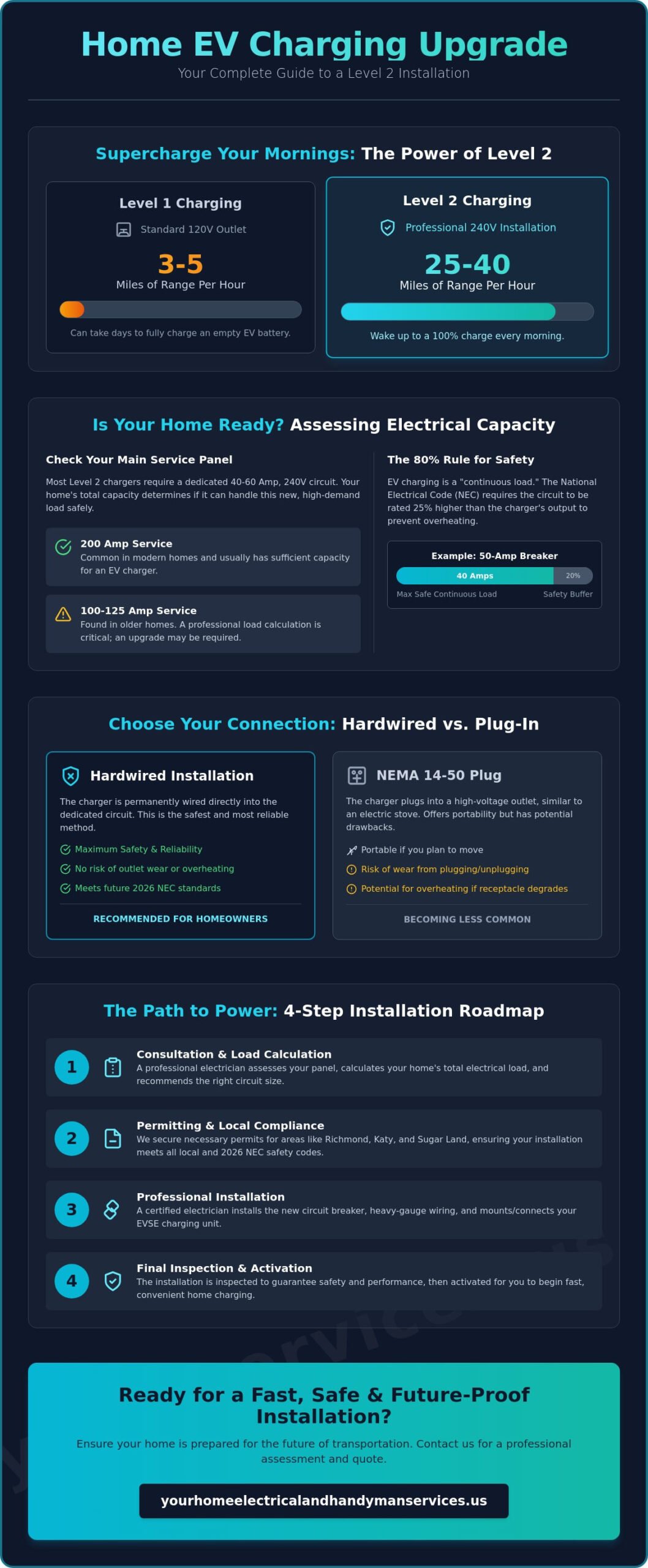
A level 2 charging station installation transforms your home from a simple residence into a high-speed fueling hub. While most electric vehicles come with a basic cord that plugs into a standard 120V wall outlet, this is known as Level 1 charging. It’s often too slow for modern driving needs. A Level 2 setup uses 240V AC power, which is the same voltage required by heavy-duty appliances like clothes dryers or electric ovens. This increased voltage allows for a much faster transfer of energy to your vehicle’s battery, making it the standard for homeowners who want reliability and speed.
The Difference Between Level 1 and Level 2
The primary difference lies in the voltage and the resulting charging speed. Level 1 charging typically adds only 3 to 5 miles of range per hour. If you have a long commute, it could take days to reach a full charge from empty. In contrast, a Level 2 system delivers between 25 and 40 miles of range per hour. This means you can arrive home with a low battery and wake up to a 100% charge every single morning. Beyond convenience, Level 2 systems offer better heat management. They complete the charging cycle faster, which can actually be more efficient for the battery’s internal cooling systems compared to the prolonged, low-voltage trickle of a Level 1 connection.
Key Components of a Home Charging Setup
A professional installation consists of several critical parts that work together to move power safely. The most visible piece is the electric vehicle supply equipment (EVSE), which is the wall-mounted unit that communicates with your car. This unit is not just a glorified extension cord; it’s a smart device that ensures the connection is safe and the power flow is stable before charging begins.
Behind the drywall, the system requires a dedicated double-pole circuit breaker in your electrical panel. This breaker is designed to handle the high-amperage load without interfering with your lights or kitchen appliances. Because a level 2 charging station installation involves sustained power draws for several hours, it requires heavy-gauge wiring. These thicker wires are essential to prevent overheating and to meet the updated 2026 safety standards for residential properties.
2026 EV Technical Requirements
As we move through 2026, many new EV models feature larger battery packs and more advanced onboard chargers. These vehicles often require higher amperage to reach their optimal charging curves. Installing a high-capacity Level 2 system ensures your home is ready for these newer models, providing the “juice” they need to maintain long-term battery health and peak performance. It’s a foundational upgrade that ensures your property remains compatible with the next generation of electric transportation.
Assessing Your Home’s Electrical Capacity for Level 2
Before you purchase a wall unit or schedule your level 2 charging station installation, you need to look at your home’s electrical heart: the main service panel. Most modern homes feature a 200 Amp service, which usually provides plenty of headroom for high-demand appliances. However, many older properties in the Richmond and Sugar Land areas still operate on 100 Amp or 125 Amp services. If your panel is already supporting a central AC system, an electric range, and a pool pump, adding a 50-Amp EV circuit might push the system beyond its safe limits.
Electrical safety standards require us to follow the “20% Rule” for continuous loads. Because an EV charger draws a heavy amount of power for several hours at a time, the National Electrical Code (NEC) classifies it as a continuous load. This means you cannot use 100% of a breaker’s capacity. For example, if you want to charge at 40 Amps, you must install a 50-Amp breaker. This buffer prevents the breaker from overheating during those long overnight sessions. If you notice flickering lights or a warm panel door, it might be time for an electrical panel upgrade Richmond TX to ensure your infrastructure can handle the new demand.
Performing a Load Calculation
A professional load calculation is the only way to be certain your home is safe. This process involves totaling the amperage of your existing fixed appliances and comparing it to your main service rating. Charging at home is highly convenient, but it shouldn’t come at the cost of tripping your main breaker every time the air conditioner kicks on. We look for “spare” capacity. If your calculation shows you are already near 80% of your total capacity during peak summer months, adding a level 2 charging station installation without adjustments is a significant fire risk.
When a Panel Upgrade is Non-Negotiable
Sometimes, a simple addition isn’t possible. If your panel is a Zinsco or Federal Pacific brand, these are known safety hazards in older Texas homes and should be replaced regardless of your EV plans. Additionally, your panel might be physically “full.” If there are no open slots for a new double-pole breaker, you cannot safely tap into another circuit. Upgrading to a 200 Amp service is often the best way to future-proof your home, especially if you plan to add a second electric vehicle later. If you are unsure about your current setup, getting an expert home electrical review can provide the clarity you need before you invest in hardware.
Choosing Your Setup: Hardwired vs. NEMA 14-50 Plug
Deciding between a hardwired connection and a NEMA 14-50 outlet is a pivotal choice during your level 2 charging station installation. Both options deliver the 240V power your vehicle needs, but they serve different long-term goals. Hardwiring is widely considered the gold standard for safety and performance in 2026. A NEMA 14-50 plug, on the other hand, offers flexibility for homeowners who may need to move their charging unit or replace it without calling an electrician back to the house.
The 2026 National Electrical Code (NEC) has introduced stricter requirements that affect this decision. If you choose a plug-in charger, you must install a Ground-Fault Circuit Interrupter (GFCI) breaker at the main electrical panel. While this is a safety feature, it can lead to “nuisance tripping.” This happens because many modern chargers have their own internal GFCI sensors. These two safety systems can occasionally conflict, causing your car to stop charging in the middle of the night. Hardwired units don’t require that external GFCI breaker, which typically results in a more reliable and stable connection.
The Hardwired Advantage
If you drive a high-performance EV like a Tesla or a Rivian, hardwiring is often the only way to achieve maximum charging speeds. Most NEMA 14-50 outlets are limited to a 40-Amp output. A hardwired level 2 charging station installation can support 48 Amps or even higher, depending on your home’s capacity. This extra power allows you to add range much faster. Beyond speed, hardwiring offers a cleaner aesthetic. There are no bulky industrial outlets or visible plugs on your wall. It also provides superior weatherproofing. By eliminating the plug-and-socket connection, you remove a potential point of failure where moisture or dust could enter the system.
The NEMA 14-50 ‘RV Plug’ Option
The NEMA 14-50, often nicknamed the “RV plug,” is a popular choice for its versatility. It allows you to unplug the charging unit for service or take it with you if you sell your home. However, the quality of the outlet itself is non-negotiable. Standard “big box” store outlets are often designed for appliances like kitchen ranges that cycle on and off. EV charging is a continuous, heavy draw that lasts for hours. Residential-grade outlets can melt or fail under this sustained thermal stress. We always recommend industrial-grade outlets, such as those from Hubbell or Bryant, which are specifically built to handle the high-heat environment of a multi-hour charging session. For a deeper look at component selection and the latest code requirements, our NEMA 14-50 outlet installation guide for 2026 covers everything you need to know before purchasing hardware.
From a cost perspective, hardwired installations are often slightly more affordable in terms of materials. You save on the cost of the industrial outlet and the specialized GFCI breaker. However, the labor involved is similar for both configurations because the heavy-gauge wiring must still be run from the panel to your garage or driveway. Choosing the right path depends on whether you value maximum speed and reliability or the ability to swap hardware easily in the future.
How to Plan and Execute Your Level 2 Installation
A successful level 2 charging station installation requires a methodical approach to ensure both convenience and safety. The process begins with selecting the optimal location. You want the unit placed near your vehicle’s charge port to avoid tension on the cable, typically within 20 feet. It is also vital to keep the area clear of obstructions like storage shelves or garage door tracks. Once the location is confirmed, the technical execution begins. This involves installing a dedicated conduit and heavy-duty wiring that runs from your electrical panel to the charging point. Every connection must be torque-tested to meet manufacturer specifications, followed by a full commissioning test under load to verify that the system operates without overheating.
Permitting and Code Compliance in Texas
In local jurisdictions like Richmond, Katy, and Sugar Land, securing an electrical permit is a non-negotiable step. Fort Bend County authorities require these permits to ensure that every level 2 charging station installation meets current safety codes. If you skip this process, you risk having home insurance claims denied in the event of an electrical fire. Professional installers also prioritize proper grounding and bonding. This is especially important in our region, where frequent lightning and thunderstorms can cause power surges that might damage your vehicle’s sensitive battery management system.
The Installation Day Walkthrough
You can expect a standard installation to take approximately 3 to 5 hours. On the day of the project, your professional will arrive with specialized equipment, including voltmeters, conduit benders, and torque wrenches. A major focus during the walkthrough is the verification of the “Continuous Load” rating. Because EV charging pulls high amperage for hours at a time, every component from the breaker to the wiring must be rated for sustained use. While a handyman is a great choice for furniture assembly or TV wall mounting, high-voltage EVSE work requires a licensed electrical expert to handle the complexities of the National Electrical Code safely. If you are located in the greater Houston area, working with a trusted EV charger installer Cypress homeowners rely on can ensure your project meets all 2026 code requirements from start to finish.
Precision is key during the final stages. After mounting the unit, the professional will check for stable voltage levels and ensure the communication handshake between the charger and your car is seamless. This thorough testing phase gives you the confidence that your home infrastructure is ready for daily use. If you are ready to upgrade your home’s charging capabilities, you can book your professional EV charger installation to ensure a code-compliant and reliable setup.
Local Considerations for Richmond, Katy, and Sugar Land
Living on the Texas Gulf Coast presents unique challenges for any electrical project, and a level 2 charging station installation is no exception. Our local climate is a major factor that many national guides overlook. In cities like Richmond and Katy, garage temperatures frequently climb above 100°F during the summer months. This extreme ambient heat affects how electricity moves through your home’s wiring. When copper wires get hot, their resistance increases, which can lead to overheating if the system isn’t designed correctly. We account for this by “derating” the wires, which often means using a thicker gauge than what might be required in a cooler climate to ensure the circuit remains stable during a long afternoon charging session.
Beyond the heat, our regional humidity and heavy rain require specialized hardware for outdoor setups. If you plan to mount your charger on a driveway or near a carport, the equipment must handle intense Gulf Coast downpours. We also prioritize local financial incentives that help offset your project costs. For instance, the Federal Alternative Fuel Vehicle Refueling Property Credit currently covers 30% of the cost of a level 2 charging station installation and labor, up to a maximum of $1,000. This credit is set to expire on June 30, 2026. Additionally, CenterPoint Energy offers a residential rebate program that may cover up to 50% of your project costs through the end of 2026, provided funds are still available.
Protecting Your Investment from Texas Weather
Texas leads the nation in lightning strikes, which makes surge protection a vital consideration for EV owners. Your vehicle’s battery is a highly sensitive and expensive component. We strongly recommend a whole-home surge protector to shield your car from the power spikes common during our frequent thunderstorms. For chargers mounted outdoors, we use UV-rated conduit to prevent the Texas sun from making the piping brittle over time. We also ensure that any exterior wall penetrations are professionally sealed with industrial-grade silicone. This keeps moisture and local pests from entering your home through the new electrical run.
Why Professional Local Installation Matters
Every subdivision in Sugar Land and Richmond has its own specific build style and electrical quirks. A local expert understands the common panel configurations found in these neighborhoods and knows exactly how to navigate the local permitting process. For example, Richmond residents must process applications through the MyGovernmentOnline portal, while Sugar Land uses the Citizen Self Service Portal. We handle these administrative hurdles to ensure your installation is fully documented and legal. Choosing a dedicated local team prevents the “solar cowboy” mistakes often seen when out-of-town contractors cut corners on grounding or permit filings. You gain the peace of mind that comes from a licensed and insured team that stands by their work right here in your community.
Ready to Power Your Future with Confidence
Your transition to electric driving should be as seamless as the vehicle itself. A professional level 2 charging station installation is more than a simple convenience. It is a critical infrastructure upgrade that requires precision and local expertise. By prioritizing a code-compliant setup and choosing the right hardware for your specific needs, you protect your home’s electrical system and ensure your battery remains healthy for years to come.
Since 2021, our team has provided reliable service to homeowners throughout Richmond, Katy, and Sugar Land. Our licensed and insured Texas technicians possess deep expertise in installing and configuring units from top brands like Tesla, ChargePoint, and JuiceBox. We understand the unique demands of the Texas climate and the specific requirements of local building codes. You don’t have to navigate the complexities of load calculations or permit filings alone. When you are ready to upgrade your home, Request a Professional EV Charger Installation Quote to get started. Start every morning with a full battery and the peace of mind that your property is in safe, capable hands.
Frequently Asked Questions
Can I install a Level 2 charger myself if I’m handy with electricity?
No, you should not attempt a DIY installation. The 2026 National Electrical Code updates now require most new installations to be hardwired by a qualified professional to ensure safety and compliance. A professional level 2 charging station installation involves torque-testing connections and verifying GFCI trip thresholds to prevent fire hazards. Attempting this yourself can lead to severe safety risks and may result in your homeowner’s insurance policy being voided.
How much does a typical Level 2 charging station installation cost in 2026?
The total investment depends on several specific factors unique to your property. Key variables include the distance between your electrical panel and the charging location, whether your home requires an electrical panel upgrade, and the type of hardware you select. You should also account for local permit fees in cities like Sugar Land or Katy. Many homeowners offset these costs by taking advantage of the 30% federal tax credit before it expires in June 2026.
Do I need to upgrade my electrical panel for a Tesla Wall Connector?
It depends on your current electrical service and existing household demand. A Tesla Wall Connector can draw up to 48 amps, which requires a dedicated 60-amp breaker. If your home has a 100-amp panel that is already powering an air conditioner and electric range, an upgrade to a 200-amp service is usually necessary. A professional load calculation will determine if your current panel can safely handle the additional continuous load without tripping the main breaker.
What is the difference between a 40-amp and a 50-amp circuit for an EV?
The primary difference is the charging speed and the maximum continuous power the circuit can handle. Following the 80% rule for continuous loads, a 40-amp circuit supports 32 amps of actual charging. A 50-amp circuit supports 40 amps of charging, which provides more miles of range per hour. Choosing the higher amperage circuit is often the best way to future-proof your home for vehicles with larger battery capacities that require faster refueling.
Does a Level 2 charger work with all electric vehicle brands?
Yes, Level 2 chargers are designed to be compatible with all major electric vehicle brands. Most modern units use standardized plugs or come with adapters to ensure they work with everything from a Tesla to a Ford or Rivian. As long as the unit provides 240V power, it will effectively charge any battery electric vehicle or plug-in hybrid currently on the market. This universal compatibility makes a home charger a versatile long-term investment.
How long does it take an electrician to install a home charging station?
A standard level 2 charging station installation typically takes between 3 and 5 hours to complete. This includes the time needed to mount the equipment, run the conduit, and perform final safety testing under load. If your home requires more complex work, such as a long wiring run through a crawlspace or a full electrical panel upgrade, the project may take a full day. A professional will always verify that the handshaking protocol between the charger and car is functioning correctly before finishing.
Will installing an EV charger increase my home’s property value?
Real estate trends in the Richmond and Katy areas suggest that EV-ready homes are increasingly attractive to buyers. As more drivers switch to electric transportation, having a professional charging setup already in place is seen as a high-value infrastructure upgrade. It eliminates a major hurdle for the next homeowner, making your property stand out in a competitive market. It is a functional improvement that adds modern appeal and demonstrates that the home’s electrical system is up to current standards.
What happens if I install a charger without a permit in Katy or Richmond?
Installing a charger without a permit can lead to significant legal and financial problems. Local authorities in Katy and Richmond require permits to ensure the work follows 2026 safety codes. If unpermitted electrical work causes a fire, your insurance company may refuse to pay for the damages. Furthermore, you may face fines from the city or be forced to remove and reinstall the equipment correctly when you try to sell your home and an inspector discovers the missing permit.
4 Responses