

Is your current charging setup actually holding your vehicle back while creating unnecessary risks for your home? Many homeowners assume a standard plug-in is enough, but as we move through 2026, the demand for faster, safer power is changing the game. Choosing a professional hardwired EV charger installation Sugar Land ensures you’re not just keeping up with technology; you’re also protecting your property from the common hazards of DIY or substandard setups. It’s the most robust way to future-proof your garage for high-output vehicles.
We understand the stress that comes with modernizing your home’s electrical system. It’s natural to worry about panel capacity or the potential for messy drywall damage in a finished garage. This guide will show you exactly how to achieve a clean, professional-looking setup that meets the 2023 National Electrical Code and 2024 ICC standards. You’ll learn how to secure the fastest Level 2 speeds while ensuring your installation remains eligible for federal tax credits before the June 30 deadline. We’re here to provide the clarity and technical expertise you need for total peace of mind.
Key Takeaways
- Understand why a permanent hardwired connection is essential to meet the 48-80 amp power demands of modern 2026 vehicle batteries.
- Learn the critical technical requirements for a safe setup, including why specific copper wire gauges are necessary for high-capacity charging.
- Discover how a hardwired EV charger installation Sugar Land can simplify your electrical panel needs and potentially lower equipment costs.
- Navigate the local permitting and inspection process to ensure your home remains compliant with the latest Sugar Land building codes.
- See how professional finishing techniques eliminate the eyesore of messy drywall cuts for a clean, integrated garage aesthetic.
Hardwired EV Charger Installation in Sugar Land: Why It Matters in 2026
A hardwired EV charger isn’t just another appliance; it’s a permanent extension of your home’s electrical infrastructure. Unlike portable units that plug into a wall, a hardwired setup involves a direct, continuous connection from your circuit breaker to the electric vehicle charging station. This eliminates the need for a traditional outlet entirely. As we move through 2026, this method has become the preferred choice for Sugar Land homeowners who prioritize safety and long-term reliability. By removing the plug and socket interface, you eliminate a common point of failure where heat can build up during high-current charging sessions.
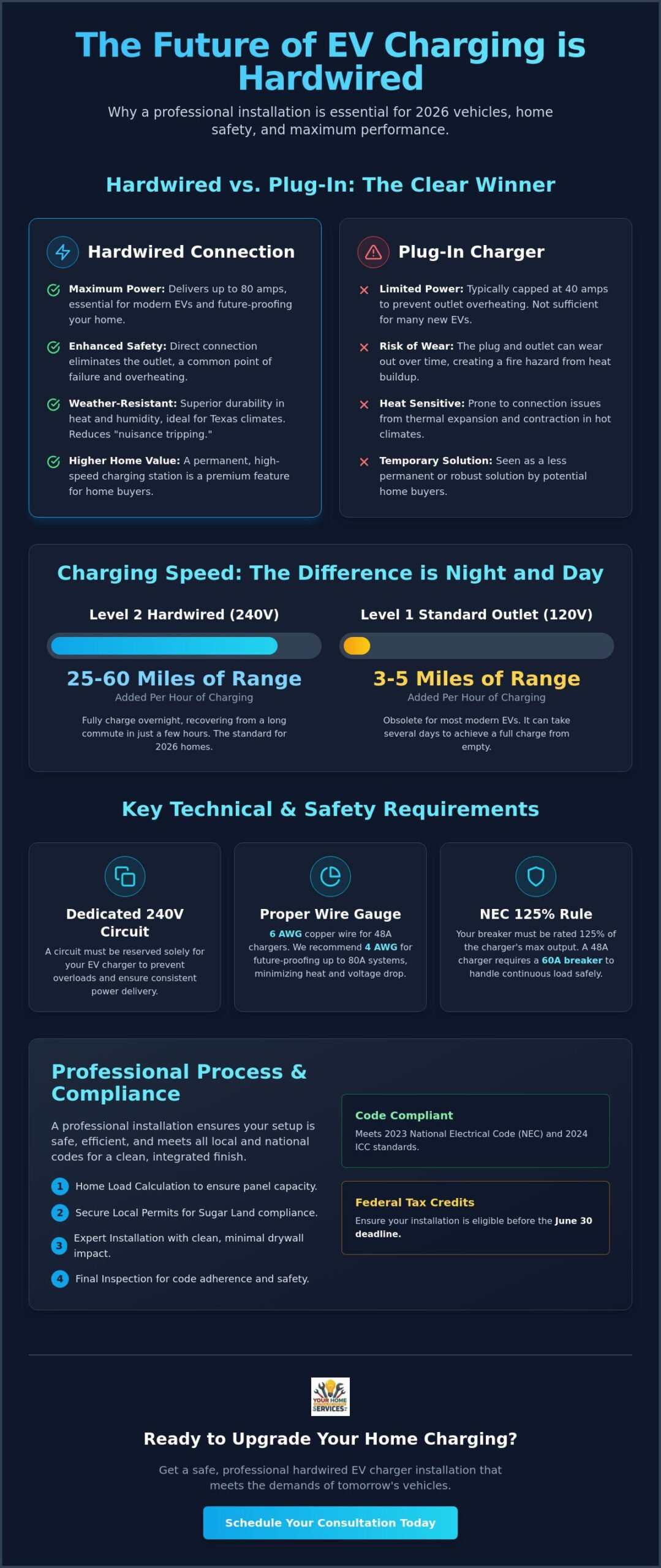
The shift toward larger battery capacities in 2026 vehicles means that older charging methods are struggling to keep up. Most plug-in chargers are limited to 40 amps to prevent overheating the outlet. However, a professional hardwired EV charger installation Sugar Land allows your system to handle 48 to 80 amps safely. This higher capacity is essential for modern electric trucks and SUVs that require more power to reach a full charge overnight. Beyond the technical specs, a permanent installation significantly boosts your home’s resale value. Buyers in the Sugar Land market now view a dedicated, high-speed charging station as a premium feature, similar to a modern kitchen upgrade or a smart home integration.
Level 1 vs. Level 2: The Speed Gap
The standard 120V Level 1 outlet is officially obsolete for the average driver. With modern EV ranges often exceeding 300 miles, a basic wall plug only adds about 3 to 5 miles of range per hour. In contrast, a hardwired Level 2 setup can provide 25 to 60 miles of range for every hour it’s connected. This means you can fully recover a long commute in just a few hours rather than waiting days. Level 2 charging is the standard for 2026 residential builds. It provides the quick turnaround time that busy families in our community depend on daily.
The “Hardwired Advantage” for Texas Climates
Texas summers present unique challenges for electrical components. The extreme heat causes materials to expand and contract, which can loosen the tension in a standard NEMA 14-50 outlet over time. A hardwired connection uses heavy-duty lugs and direct wiring that better manage this thermal expansion. This stability reduces the risk of “nuisance tripping,” which often happens when GFCI-protected outlets react to minor fluctuations in the grid. For Sugar Land homes with carports or outdoor setups, weather-rated hardwired units offer superior durability against humidity and heat compared to their plug-in counterparts. This ensures your hardwired EV charger installation Sugar Land remains a dependable asset for years to come.
Technical Requirements for a Professional Hardwired Setup
A safe home charging environment requires more than just a mounting bracket and a drill. A successful hardwired EV charger installation Sugar Land begins with a dedicated 240V circuit. This circuit must be reserved solely for your EVSE (Electric Vehicle Supply Equipment) to prevent overloads on other household branches. When reviewing the technical requirements for a professional hardwired setup, wire gauge stands out as a critical safety factor. For a 48-amp charger, 6 AWG copper wire is the standard. We often recommend 4 AWG copper for longer runs or to future-proof for 80-amp systems to minimize voltage drop and heat buildup.
The National Electrical Code (NEC) mandates the “125% rule” for continuous loads like EV charging. This means your circuit breaker must be rated for 125% of the charger’s maximum output. If your vehicle draws 48 amps, you’ll need a 60-amp breaker. This buffer prevents the breaker from tripping during the hours of sustained heat generated while your car sits in the garage. Modern units also feature Wi-Fi integration, which fits perfectly into a broader smart home device setup Houston. These systems allow you to schedule charging during off-peak hours, helping you save on utility costs while monitoring your energy consumption through a smartphone app.
Load Calculations: Can Your Panel Handle It?
Before adding a 60-amp breaker, a professional must perform a whole-home load calculation. We analyze your HVAC, pool pumps, and electric ranges to see if your existing service can handle the extra demand. Many newer homes in our area have 200-amp panels, which are usually sufficient. If your home still uses an older 100-amp or 150-amp service, you might need an electrical panel upgrade for EV charger in Sugar Land. Some smart chargers can mitigate this by “throttling” power when other large appliances are running, but a panel upgrade is the most reliable long-term solution.
Conduit and Routing Strategies
The physical path of the wire is just as important as the wire itself. In a finished garage, we often use surface-mounted EMT conduit for a rugged, industrial look that protects the wiring from physical damage. If you prefer a hidden look, we can run wiring behind the drywall, though this requires precision and professional patching. We always look for the most efficient route from your panel to the garage. Keeping the setup clean and unobtrusive is a priority for every project we handle. If you’re unsure about your current capacity, we can help you assess your home’s electrical health before you purchase your equipment.
Hardwired vs. Plug-In: Choosing the Right Solution
Deciding between a hardwired unit and a plug-in model often depends on your long-term goals for your property. A plug-in charger using a standard NEMA 14-50 outlet is capped at a maximum of 40 amps. While this is sufficient for some, a professional hardwired EV charger installation Sugar Land allows you to access 48 to 80 amps. This extra headroom is vital for the larger battery packs found in newer electric trucks and luxury sedans. If you plan to stay in your home for the next decade, hardwiring is the “one and done” solution that ensures you won’t need to revisit your garage electrical setup as vehicle technology evolves.
Many homeowners are surprised to learn that hardwiring can actually be more cost-effective during the initial setup. According to the EPA guide to home EV charging, safety is the primary concern for residential systems. The 2023 National Electrical Code (NEC) requires expensive GFCI (Ground Fault Circuit Interrupter) breakers for all 240V outlets in a garage. These breakers can add significant cost to the project. Hardwired units usually have this protection built directly into the device, allowing for a standard breaker and a more streamlined installation. While plug-in outlets offer portability for renters, they add an extra layer of complexity and cost for permanent residents.
Reliability and Maintenance
High-load EV charging is a rigorous task for any electrical component. Standard outlets are not always designed to handle 8 to 10 hours of continuous high-amperage draw every single night. Over time, the physical connection between a plug and an outlet can loosen, leading to resistance and potential melting. Hardwired units provide a “plug and forget” convenience with fewer mechanical points of failure. Maintenance for a hardwired system is minimal, typically requiring only a periodic visual inspection of the charging cable and connector over its 10-year lifespan.
Which One Fits Your Garage?
Space and aesthetics play a major role in your final decision. Hardwired chargers often have a smaller footprint because they don’t require the bulky plug and extra heavy-duty cord needed for an outlet connection. This creates a “clean garage” look where the wiring is either hidden behind the wall or neatly tucked into a slim conduit. Hardwiring is the NEC-preferred method for outdoor installs. If your charging station will be located on a driveway or under a carport, the permanent connection offers superior protection against the humidity and temperature swings common in the Sugar Land area.
The Step-by-Step Installation Process in Sugar Land
The journey to a faster charge begins with a detailed on-site assessment. We don’t just look at where your car sits; we evaluate your entire electrical system to ensure a seamless hardwired EV charger installation Sugar Land. During this visit, we determine the most efficient path for the new circuit and confirm that your current panel can handle the sustained 48-amp or 80-amp draw. This planning phase is where we identify the best location for the charger to minimize cable clutter and maximize convenience for your specific vehicle’s port location.
Permits and Local Regulations
In Sugar Land, any new 240V circuit requires a city permit. This isn’t just red tape. It’s a critical safety measure that ensures your installation meets the 2023 National Electrical Code. We handle the entire application process through the city’s online portal, saving you the headache of navigating local bureaucracy. When the city inspector arrives for the final sign-off, they verify the wire gauge, breaker sizing, and grounding. Having this official record is crucial for maintaining your home insurance validity. If an issue ever occurred, an unpermitted high-voltage circuit could lead to a denied claim, so we never skip this step.
Next comes the rough-in phase. We run the conduit and pull the heavy-gauge copper wire discussed in previous sections. This is the most labor-intensive part of the day, requiring precision to ensure the wiring is secure and protected. After the wiring is in place, we make the final connections to the charger unit and the breaker panel. We don’t just flip the switch and leave. We commission the device, ensuring it syncs with your vehicle’s app and handles the full charging load without overheating. This final testing phase provides the peace of mind that your hardwired EV charger installation Sugar Land is operating at peak efficiency.
Professional Drywall Restoration
Running new lines through a finished garage often requires small access holes in the ceiling or walls. Most electrical companies leave these holes for the homeowner to deal with later, which can be a major source of stress. Our team takes a different approach by integrating drywall repair Katy TX techniques into every project. We patch, texture, and paint the affected areas so the installation looks like it was part of the original home build. This attention to detail ensures your garage remains a clean, professional-looking space rather than a construction zone. If you’re ready to upgrade your garage with a setup that looks as good as it performs, you can book your installation assessment today to get started.
Why Choose Your Home Electrical and Handyman Services?
Choosing a partner for your hardwired EV charger installation Sugar Land means finding a team that understands both the complex electrical requirements and the aesthetic value of your home. Most electrical companies stop their work once the breaker is flipped, leaving you with unsightly holes in your garage walls or messy conduit runs. We bridge that gap by combining licensed technical expertise with high-end handyman finishing. Our team ensures that your new high-speed charging system is safe, functional, and visually integrated into your space. We treat every property with the same care we’d give our own homes, providing a “Stable Expert” experience from start to finish.
Our roots are firmly planted in the local community. We live and work in Richmond, Katy, and Sugar Land, which gives us a personal stake in the quality of our service. Unlike large national franchises that prioritize volume, we focus on precision and long-term reliability. Whether you need a simple charger mount or a comprehensive electrical panel upgrade Richmond TX to support your new vehicle, we manage the entire project. This end-to-end approach eliminates the need for you to coordinate between multiple contractors, saving you time and reducing the stress of home improvements.
The Trusted Expert Guide
Integrity is the foundation of our business. Since our founding in 2021, we’ve operated with a commitment to clear communication and honest, no-hyperbole advice. We hold a local Texas operating license and stay current on all regional building codes to protect your investment. One of the ways we alleviate homeowner anxiety is through our flat-rate approach. You won’t have to worry about the stress of hourly billing surprises or hidden fees after the work begins. We provide straightforward, declarative answers to your technical questions so you can make informed decisions about your home’s infrastructure.
Beyond the Charger
Your garage is often the hub of your home’s modern technology. While a hardwired EV charger installation Sugar Land is a significant upgrade, it’s often just the beginning. We can assist with a variety of other enhancements, such as professional lighting installation services to brighten your workspace or smart home device setups that allow you to monitor your entire property from your phone. Our goal is to be your long-term partner for maintaining a safe and efficient home. Ready for a safer, faster charging experience in your garage? Contact us for your Sugar Land EV charger quote today!
Secure Your High-Speed Home Charging Future
Investing in a permanent charging solution is the most effective way to ensure your home stays ahead of evolving vehicle technology. By choosing a hardwired EV charger installation Sugar Land, you gain access to the maximum power levels modern batteries require while eliminating the common safety risks associated with standard wall outlets. You’ve seen how the right wire gauge and a dedicated circuit provide the reliability needed for daily commutes, and how professional finishing keeps your garage looking its best.
Our team of Licensed and Insured Texas Technicians is ready to handle the technical complexities of your project. We are specialists in 200-amp panel upgrades and provide expert drywall restoration included with every install. This means you won’t have to worry about the mess or the math; we take care of everything from permitting to the final paint touch-up.
Schedule Your Professional EV Charger Installation in Sugar Land
Take the first step toward a faster, safer charge. We look forward to helping you modernize your Sugar Land home with a setup that’s built to last.
Frequently Asked Questions
Do I need a permit for a hardwired EV charger in Sugar Land?
Yes, the City of Sugar Land requires a building permit for any new 240V circuit installation. This process ensures that your home’s electrical system can safely handle the additional load and that the work meets the 2023 National Electrical Code. We handle all the necessary paperwork and coordination with city inspectors through their online portal to ensure your installation is fully legal and documented.
Can I install a 48-amp charger on a 50-amp breaker?
No, you cannot safely run a 48-amp charger on a 50-amp breaker. Electrical codes require a circuit breaker to be rated for 125% of a continuous load, which includes EV charging. For a vehicle drawing 48 amps, you must have a 60-amp breaker installed. Using an undersized breaker will cause it to overheat and trip frequently, which can damage your electrical components over time.
How much does a professional hardwired EV charger installation cost in 2026?
The final cost for your project depends on your home’s unique layout, the distance between your panel and the garage, and your current electrical capacity. We provide a transparent, flat-rate quote after a thorough on-site assessment to ensure there are no surprises. This approach helps you plan your hardwired EV charger installation Sugar Land with confidence, knowing exactly what the investment will be for your specific property.
Will a hardwired EV charger work with any electric car?
Yes, most hardwired chargers are designed to be universal and will work with any modern electric vehicle. Most units use the standard J1772 or NACS connectors that are compatible with nearly all cars on the market today. If your vehicle has a proprietary port, you can use a manufacturer-approved adapter to connect to the station. These chargers are a smart way to add long-term value to your home.
How long does the installation process usually take?
A standard installation is typically completed in three to six hours. This timeframe includes mounting the charger, running the conduit, and performing the final safety tests to ensure everything is working correctly. If your project involves complex wiring through finished walls or requires an electrical panel upgrade, it might take a full day. We always aim to minimize disruption to your schedule while maintaining our high standards of quality.
Is it better to hardwire a Tesla Wall Connector or use a NEMA 14-50 plug?
Hardwiring is the superior option for a Tesla Wall Connector because it allows for faster charging speeds and a more reliable connection. A hardwired setup can deliver up to 48 amps of power, whereas a plug-in NEMA 14-50 outlet is limited to 40 amps. By hardwiring the unit, you also eliminate the mechanical connection of a plug, which reduces the risk of heat buildup and wear over years of daily use.
What happens if my electrical panel is full?
If your panel has no physical space left, we can often use tandem breakers or install a small sub-panel to create the room needed for your charger. However, we also have to perform a load calculation to see if your total electrical service can handle the new demand. If your home is already at its limit, we may recommend a service upgrade to a 200-amp panel to ensure your home remains safe and efficient.
Does a hardwired charger require a GFCI breaker?
No, a hardwired charger generally doesn’t require a GFCI breaker because the ground-fault protection is built directly into the charging unit. This is a major benefit of a hardwired EV charger installation Sugar Land, as it can save you money on specialized breakers that are often prone to nuisance tripping. Plug-in chargers, by contrast, are legally required to have GFCI protection at the outlet per the latest electrical codes.