

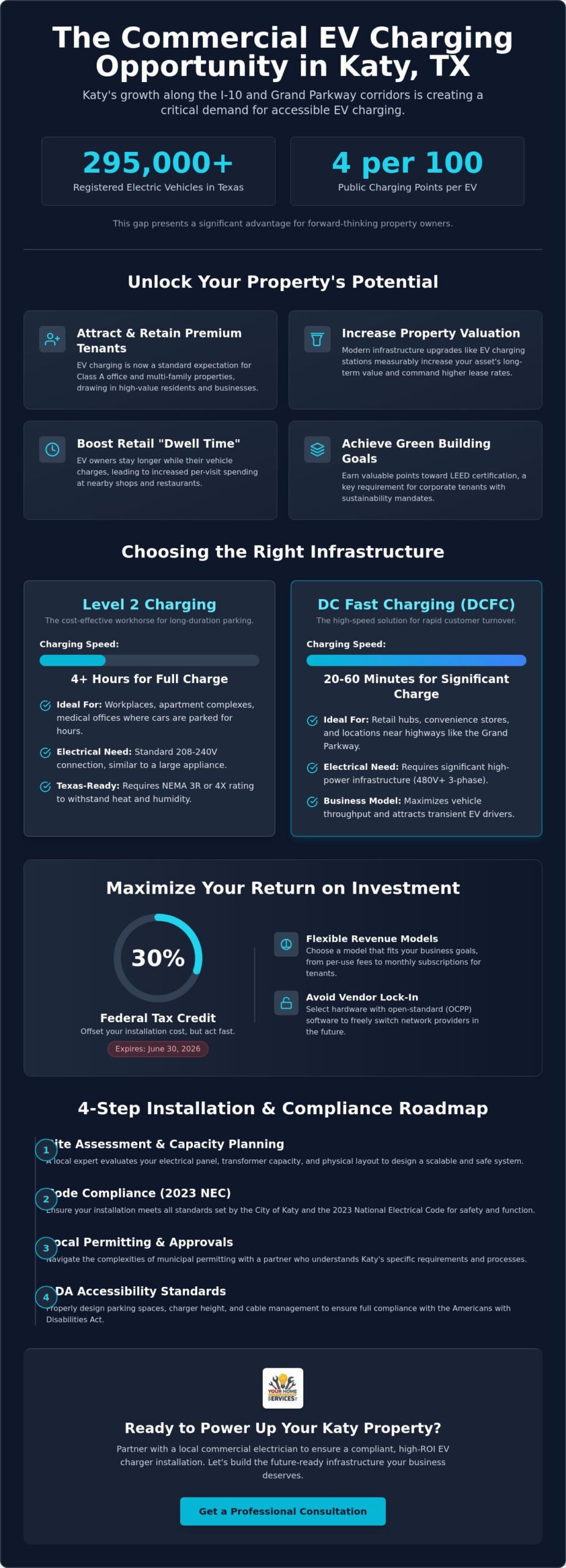
With nearly 295,000 electric vehicles now registered in Texas and only four public charging points available for every 100 cars, the demand for accessible power has reached a critical tipping point. If you own a property in Katy, you’ve likely realized that providing a place to plug in is no longer a luxury; it’s a competitive requirement. However, the technical side of a commercial EV charger installation in Katy often brings up valid concerns about electrical panel capacity and complex local permitting.
We understand that you want to attract high-value tenants and increase your property valuation without risking an overloaded system or failing a city inspection. This guide simplifies the process by showing you how to build a scalable, high-ROI charging infrastructure. You’ll learn how to navigate the City of Katy’s 2023 National Electrical Code standards and how to take advantage of the 30% federal tax credit before it expires on June 30, 2026. We’ll also compare Level 2 and DC Fast Charging options to help you choose the right fit for your specific business goals.
Key Takeaways
- Understand how Katy’s expansion along the I-10 and Grand Parkway corridors makes EV charging a vital asset for attracting high-income customers.
- Compare the benefits of Level 2 and DC Fast Charging to select the most efficient infrastructure for your commercial EV charger installation in Katy.
- Learn how to maximize your return on investment by leveraging federal tax credits and selecting a revenue model that fits your business goals.
- Navigate the complexities of site assessments, ADA accessibility standards, and local permitting to ensure your property remains compliant and functional.
- Identify why local technical expertise is essential for managing transformer capacity and the unique installation requirements found in the Katy area.
The Strategic Advantage of Commercial EV Charging in Katy
Katy’s commercial landscape is transforming rapidly as development pushes further west along the I-10 corridor and expands north and south via the Grand Parkway. As more professionals move into master-planned communities like Cinco Ranch and Cane Island, the demand for accessible power follows them to their workplaces and shopping centers. For local property owners, a commercial EV charger installation in Katy represents more than an environmental gesture. It is a calculated business move that aligns with the specific growth patterns of the West Houston area.
An electric vehicle charging station serves as a silent but powerful signal to the community. It tells high-income customers and tech-forward professionals that your facility is equipped for the future. Beyond the immediate draw of EV drivers, these installations play a significant role for office building owners aiming for LEED certification. By providing dedicated charging spots, you earn points toward green building ratings that are increasingly required by corporate tenants with strict sustainability mandates. Perhaps most importantly, installing this infrastructure now is a matter of practical foresight. Running conduit and preparing your electrical capacity during current renovations or builds saves thousands of dollars in future concrete cutting and trenching costs.
Attracting and Retaining Premium Tenants
In the competitive Katy real estate market, EV charging has quickly moved from a “nice-to-have” luxury to a standard expectation for premium office and multi-family developments. For retail centers near LaCenterra or the Katy Mills area, the benefit is even more direct. EV owners tend to stay longer at locations where they can top off their batteries. This increased “dwell time” often translates into higher per-visit spending at nearby restaurants and shops. By positioning your business as a technology leader, you don’t just attract customers; you build a loyal base of users who prioritize your location over competitors who lack modern amenities.
Increasing Commercial Property Valuation
A property’s value is tied directly to its utility and its ability to generate revenue. Adding a commercial EV charger installation in Katy upgrades your site’s physical infrastructure, which can have a measurable impact on long-term asset value. Industry data suggests that EV-equipped commercial properties often command higher lease rates because they cater to a more affluent demographic and meet modern corporate requirements. We’re seeing a clear transition where these stations are becoming as essential as high-speed internet or ample parking. Investing in high-quality electrical upgrades today ensures your property remains a Class A asset as the Texas EV fleet continues its rapid expansion through 2026 and beyond.
Maintaining this Class A status requires more than just technical upgrades; it also demands meticulous facility care. For property managers who value a pristine environment, That’s Cleaning offers professional commercial services that ensure every corner of your property reflects a premium standard of excellence.
Choosing the Right Infrastructure: Level 2 vs. DC Fast Charging
Selecting the right hardware for your property depends entirely on how long your visitors stay parked. For a commercial EV charger installation in Katy, you generally choose between two primary technologies: Level 2 charging and DC Fast Charging (DCFC). While Federal tax credits for EV chargers help offset the initial purchase of either system, the choice you make dictates your building’s long-term electrical demand and operational costs. It’s vital to select hardware that uses open-standard (OCPP) software. This prevents “vendor lock-in,” allowing you to switch network providers in the future without replacing the physical charging stations.
Level 2 Charging for Long-Duration Parking
Level 2 stations are the workhorses of the EV world. These units require a 208-240V electrical connection, similar to a large commercial appliance. They’re the most cost-effective way to scale charging for Katy workplaces, apartment complexes, and medical offices where cars remain stationary for four or more hours. When selecting hardware, we prioritize durability. In our region, chargers must feature NEMA 3R or 4X ratings to withstand the intense Texas heat and humidity. These ratings ensure the internal electronics stay protected, providing a reliable service life for your tenants and employees.
DC Fast Charging (DCFC) for Rapid Turnover
If your business model relies on high-volume turnover, such as a convenience store or a retail hub near the Grand Parkway, DC Fast Charging is the appropriate choice. These systems provide a significant charge in 20 to 60 minutes. However, they require high-voltage 480V three-phase power and often necessitate a dedicated transformer from CenterPoint Energy. It’s also important to account for utility demand charges. DCFC units pull a massive amount of power instantly, which can spike your monthly utility bill if not managed correctly through smart load-balancing software.
Before committing to a specific model, you must assess your existing electrical capacity. Many older commercial buildings in Katy weren’t designed to support multiple high-draw charging ports simultaneously. If you’re unsure whether your current service can handle the load, a professional electrical panel upgrade evaluation is the best first step to ensure your infrastructure remains stable. By implementing smart load management, you can often install more charging ports than your raw capacity would normally allow, as the system intelligently distributes power based on real-time demand.
Calculating ROI: Incentives and Revenue Models for Katy Businesses
A commercial EV charger installation in Katy isn’t just a utility expense; it’s a strategic asset with a measurable return on investment. By 2026, the financial landscape for these projects has become much clearer for property owners. You can significantly lower your upfront costs by utilizing the Federal 30C Tax Credit. This credit covers 30% of the total installation cost, up to a maximum of $100,000 per charger. To qualify for the full 30%, your project must meet specific prevailing wage and apprenticeship requirements. If those aren’t met, the credit remains at 6%. It’s important to act quickly, as this specific federal incentive is set to expire on June 30, 2026.
Federal and Local Financial Incentives
Beyond federal help, Texas businesses can look toward state-level programs and utility rebates. The Texas Commission on Environmental Quality (TCEQ) has allocated $109.2 million for equipment replacement grants, which are available on a first-come, first-served basis until August 31, 2026. Locally, CenterPoint Energy provides energy efficiency rebates for businesses in the Katy area. While they don’t currently offer a standalone EV charger program, these installations often qualify under their “Custom Projects” category. These programs are funded through the end of 2026 and can provide up to $300,000 per project, which dramatically shortens your payback period.
Revenue Generation and Billing Software
Once your hardware is in place, you need to decide how to recoup your remaining investment. Some Katy retail centers use a “loss leader” model, offering free charging to keep customers on-site longer. Others prefer a direct revenue model where users pay per kilowatt-hour. Modern billing software allows you to set different rates for employees versus guests. This flexibility is a core part of any guide for businesses on EV charger installation because it directly impacts your daily cash flow. You can also use this data to identify peak usage times and adjust your pricing to encourage off-peak charging.
Operational costs can eat into your profits if you aren’t careful. High-voltage chargers can trigger significant “demand charges” from the utility if multiple cars plug in at once during peak hours. Smart load management software prevents this by staggering power delivery. It ensures your building’s total draw stays below certain thresholds. This technology allows you to maximize your commercial EV charger installation in Katy without needing expensive infrastructure overhauls. By scheduling charging for late-night hours when energy rates are lower, you keep your overhead manageable while providing a premium service to your tenants and customers.
The Installation Process: Site Assessment and Permitting in Katy
Executing a commercial EV charger installation in Katy involves more than just bolting a unit to a wall. It requires a methodical approach that starts with a professional site assessment. During this phase, we evaluate your property’s transformer capacity and existing panel load to ensure the system remains stable under peak demand. If you’re planning for multiple ports or high-voltage DC fast chargers, your building might need a 480V three-phase service. Once capacity is confirmed, we design a layout that maximizes parking efficiency while meeting strict Texas accessibility standards.
Navigating the local regulatory environment is often the most complex part of the project. The City of Katy follows the 2023 National Electrical Code, and all permit applications must be processed through the city’s online Civic Access Site. Whether your property is within the city limits or falls under Fort Bend County’s jurisdiction, having a professional handle the paperwork ensures your project isn’t delayed by technical errors. After permits are secured, the physical work begins with trenching, conduit placement, and mounting the hardware. The process concludes with a final inspection and software commissioning to ensure your network connectivity is active and secure.
Electrical Capacity and Panel Upgrades
Many older commercial buildings in the West Houston area weren’t built with the surplus power needed for modern charging hubs. If your current system is already near its limit, you’ll likely need a professional electrical panel upgrade to support the new load safely. We often utilize sub-panels to manage multi-charger clusters, which allows for better organization and easier maintenance. For large-scale deployments, evaluating your primary service entrance early in the process prevents costly mid-project redesigns.
Compliance and Accessibility
Compliance isn’t optional for Katy business owners. Texas law requires that a specific percentage of your EV spots be ADA-accessible, which includes wider stalls and clear access aisles for van-accessible parking. Proper signage and pavement striping are also required by local ordinances to prevent non-EV drivers from blocking the stalls. Finally, we ensure every installation meets fire code standards, including the placement of emergency shut-offs and proper ventilation for indoor charging areas.
If you’re ready to modernize your property and provide a reliable power source for your tenants, our team can provide a comprehensive EV charger installation quote that covers every step from initial permitting to final commissioning.
Partnering with a Local Katy Commercial Electrician
Local expertise is the foundation of a successful commercial EV charger installation in Katy. Our region’s specific electrical grid configurations and even our soil conditions play a role in how infrastructure is deployed. For example, Katy’s clay-heavy soil requires specific techniques for safe and durable trenching when running high-voltage lines to parking islands. A team that understands these local variables can prevent common pitfalls that lead to project delays or future equipment failure. We prioritize clarity and professional standards in every step, ensuring your property is in capable hands.
Working with a licensed and insured team is non-negotiable for high-voltage commercial projects. These installations involve significant power loads that must be balanced correctly to protect your property’s primary electrical system. Beyond the chargers themselves, we look at the bigger picture of your facility’s energy footprint. This often includes a seamless integration with your existing lighting installation services and smart building controls. By unifying these systems, you can manage your parking lot illumination and EV power distribution from a single interface, optimizing energy efficiency across the board.
Customized Infrastructure Solutions
Every commercial property has a unique layout, and a one-size-fits-all approach usually leads to unnecessary expenses. We focus on tailoring charger placement to minimize the amount of trenching and concrete work required, which can be the most expensive part of the process. Our designs are intentionally scalable. We help you install the core infrastructure now so that adding more ports in the future is a simple hardware mount rather than a full construction project. We also handle the direct coordination with CenterPoint Energy for any necessary meter or transformer upgrades, taking the administrative burden off your plate.
Reliable Local Support
Choosing a Richmond-based team to serve your Katy business means you have support right around the corner. While national installers might leave you waiting days for a service call, our proximity allows for rapid response when you need troubleshooting or hardware repairs. Keeping your chargers “online” is essential for maintaining customer trust and ensuring a steady return on your investment. If a unit goes down, it impacts your tenants’ daily routines and your property’s reputation. We provide the steady, dependable maintenance required to keep your infrastructure running at peak performance. Our goal is to be a stable partner for your business as you transition into a more electrified future.
Ready to upgrade your property? Get a commercial EV charger installation quote today.
Future-Proof Your Katy Business Today
Implementing a commercial EV charger installation in Katy is a strategic investment that prepares your property for the rapid growth of the Texas electric vehicle fleet. By acting before the federal tax credit expires on June 30, 2026, you can significantly offset your costs while positioning your business as a leader in modern amenities. You’ve learned how the right infrastructure choice, from scalable Level 2 ports to rapid DC fast chargers, can drive tenant retention and increase your overall asset valuation. Navigating the City of Katy’s permitting and ADA requirements is straightforward when you have the right technical partner.
Our team of licensed and insured Texas technicians brings specific expertise in commercial panel upgrades and high-voltage systems. As a local Richmond-based business serving Katy and Sugar Land, we understand the unique demands of the regional electrical grid. We’re here to ensure your installation is safe, compliant, and ready to serve your customers for years to come. Don’t let your property fall behind as the corridor along I-10 and the Grand Parkway continues to evolve. Schedule Your Commercial EV Site Assessment in Katy Today and take the first step toward a more connected and profitable facility.
Frequently Asked Questions
How much does commercial EV charger installation cost in Katy?
Total project costs depend on your choice of hardware and the distance from your electrical panel to the parking spots. Level 2 stations are generally more budget friendly for workplaces, while DC Fast Chargers involve higher equipment costs and more complex electrical work. Trenching through concrete or upgrading your transformer will also influence the final investment for your property.
Will my current commercial electrical panel support EV charging?
Your current panel might support a single charger, but most commercial facilities require an upgrade to handle multiple units. EV chargers are continuous-load devices that pull significant power for hours at a time. We perform a detailed load calculation to determine if your existing service can handle the added demand without risking a system overload or safety hazard.
Do I need a special permit for commercial EV chargers in Fort Bend County?
Yes, a building permit is mandatory for any commercial EV charger installation in Katy or surrounding Fort Bend County areas. The City of Katy requires all installations to comply with the 2023 National Electrical Code. You must submit plans through the city’s online portal and pass a final inspection before the stations can be opened for public or tenant use.
What is the difference between Level 2 and DC Fast Charging for businesses?
Level 2 chargers operate on 208-240V power and are ideal for locations where cars stay parked for several hours, such as offices or apartments. DC Fast Charging provides a much quicker charge but requires a 480V three-phase electrical service. While DCFC is more expensive to install, it’s the better choice for high-turnover retail locations near major highways.
Are there tax credits available for Katy businesses installing EV chargers in 2026?
Katy business owners can utilize the federal 30C tax credit to offset up to 30% of their installation costs. This credit is capped at $100,000 per charger and remains available until June 30, 2026. To receive the full 30% credit, you must meet specific prevailing wage and apprenticeship requirements during the commercial EV charger installation in Katy.
How many EV charging spots should my commercial property have?
A good starting point is to designate 5% to 10% of your parking spaces for EV charging. This allows you to meet current demand while leaving room for future expansion as more drivers switch to electric vehicles. You should also check local zoning ordinances, as some new developments in the West Houston area now have minimum EV-ready requirements.
What are the ADA requirements for commercial EV charging stations in Texas?
Texas law requires that EV charging stations be accessible to people with disabilities. This means you must provide at least one van-accessible spot with a wider stall and a clear access aisle. The charging cables and user interfaces must also be positioned at a height that’s reachable for someone in a wheelchair to ensure full compliance with accessibility standards.
Can I charge my customers for using the EV stations?
You can definitely monetize your charging stations by using integrated payment and billing software. This allows you to set custom rates based on energy usage or the amount of time a vehicle is plugged in. Many owners use these fees to cover their electricity costs or to generate a new stream of revenue for the property.