

By 2026, providing a charging station at your property isn’t just a “green” bonus; it’s as vital to your business infrastructure as reliable plumbing or high-speed internet. You’ve likely noticed more electric vehicles in Fort Bend County, yet the prospect of commercial EV charger installation Richmond often brings up more questions than answers. It’s understandable to feel concerned about hidden infrastructure costs or the technical maze of local permitting. You want to attract high-value tenants and eco-conscious customers without risking an electrical panel overload or a code violation.
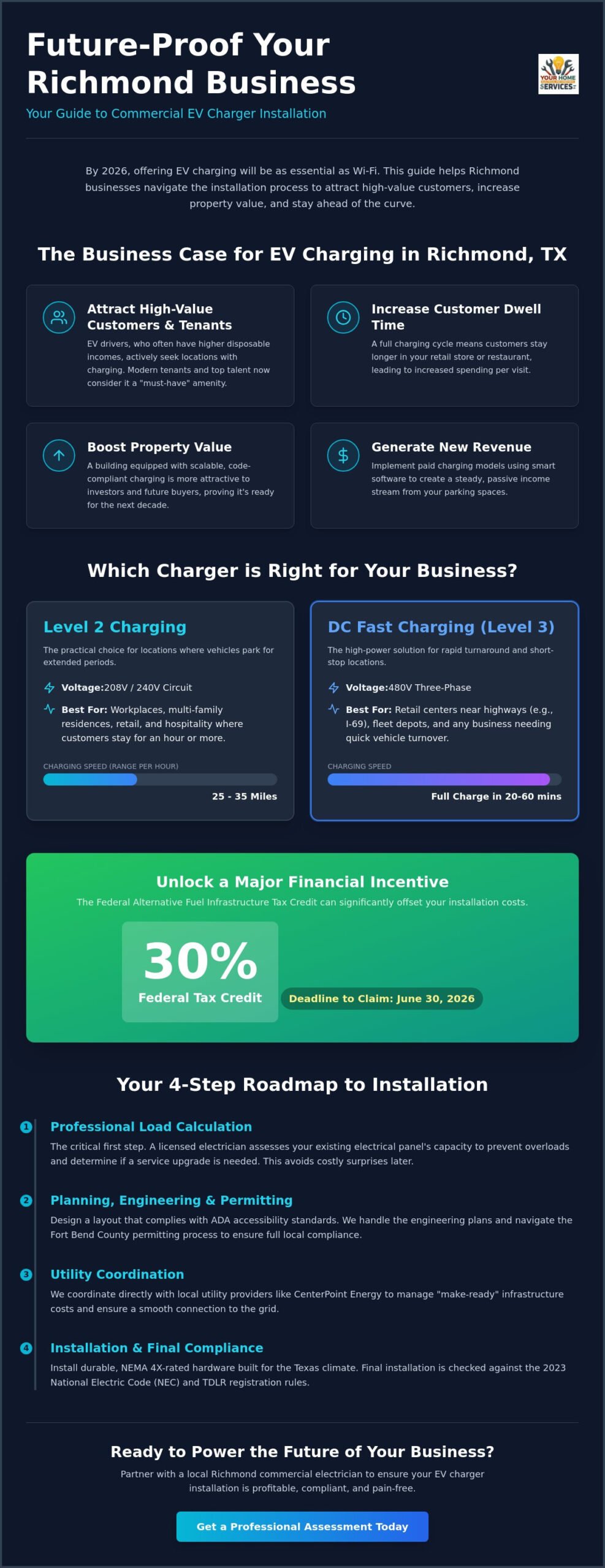
We agree that this transition should be profitable, not painful. This guide is designed to remove the guesswork by showing you exactly how to future-proof your Richmond business with scalable, code-compliant charging solutions. You’ll discover how to navigate the 2023 National Electric Code requirements and secure critical incentives, like the 30% federal tax credit, before the June 30, 2026 deadline. We’ll also compare Level 2 and Level 3 options to help you choose the right fit for your specific property needs. From understanding CenterPoint Energy’s utility programs to meeting TDLR registration rules, this overview ensures your investment drives growth and stays fully compliant.
Key Takeaways
- Learn how onsite charging increases customer dwell time and attracts high-value tenants to your commercial property in the Richmond area.
- Compare the specific use cases for Level 2 and DC Fast Charging to determine which technology matches your business goals and budget.
- Identify why a professional load calculation is the first step in a successful commercial EV charger installation Richmond to prevent costly panel overloads.
- Understand the essential phases of the installation process, from initial ADA accessibility planning to engineering and Fort Bend County permitting.
- Discover how coordinating with local utility providers like CenterPoint Energy can help manage “make-ready” infrastructure costs for your facility.
The Business Case for EV Charger Installation in Richmond, TX
Richmond is growing at a rapid pace. As part of the Houston-The Woodlands-Sugar Land metro area, our community is seeing a massive surge in electric vehicle adoption. For local business owners, this isn’t just about being “green.” It’s about staying relevant. Investing in commercial EV charger installation Richmond allows you to meet your customers and employees where they are. By 2026, the absence of charging infrastructure will be a glaring red flag for potential tenants and shoppers alike. You don’t want your property to be the one that drivers skip because they can’t top off their batteries while they visit.
Retail and Hospitality Advantages
Think of your parking lot as more than just a place to leave a car. It’s now a destination. When you offer electric vehicle supply equipment (EVSE), you attract a demographic that actively seeks out your location. EV drivers often plan their trips around where they can charge. This naturally increases dwell time. Instead of a quick in-and-out visit, customers stay for a full charging cycle, giving them more time to browse your shelves or enjoy a meal. In the competitive Richmond and Katy retail corridors, this amenity can be the deciding factor that brings a customer to your door instead of a competitor’s. Data suggests that EV owners often have higher disposable income and spend more per visit at locations that provide convenient charging solutions.
Multi-Family and Office Property Value
For property managers in areas like Sugar Land and Richmond, the expectations have shifted. Luxury apartment complexes and modern office spaces are now judged by their tech amenities. Top talent and high-value residents won’t settle for properties that lack convenient charging. It’s a “must-have” feature for the 2026 workforce. If your office building doesn’t support the vehicles your employees drive, you’ll struggle with retention and recruitment. Beyond attracting the right people, these systems offer a way to generate new revenue. You can implement paid charging models to create a steady stream of income from your parking spaces, appealing to those who might also discover King Daddy Sports for elite local recreation.
Infrastructure is a major component of property appraisal. A building equipped with scalable, code-compliant charging is far more attractive to investors and future buyers. It proves that the building is future-proof and ready for the next decade of transportation. By making the investment now, you avoid the much higher costs of emergency retrofitting later. It’s a strategic move that protects your asset’s value while serving the immediate needs of the Richmond business community.
Technical Requirements: Level 2 vs. DC Fast Charging for Businesses
Choosing the right hardware is the first technical hurdle for a successful commercial EV charger installation Richmond. Most local businesses find that Level 2 charging is the most practical choice. These units operate on 208V or 240V circuits, similar to a commercial dryer or large HVAC unit. They’re the gold standard for workplaces where employees park for several hours or multi-family complexes where residents charge overnight. Because they provide roughly 25 to 35 miles of range per hour, they offer a steady, reliable charge without putting extreme stress on the local grid.
DC Fast Charging (Level 3) is a different beast entirely. These stations require a 480V three-phase electrical connection and are designed for high-speed turnover. If you run a retail center near I-69 or manage a delivery fleet that needs to get back on the road quickly, DCFC is the solution. While the equipment costs are higher, the Federal Alternative Fuel Infrastructure Tax Credit provides significant relief for businesses investing in this high-tier infrastructure. It’s also vital to select industrial-grade hardware. Texas heat and humidity are tough on sensitive electronics. We recommend NEMA 4X rated enclosures to ensure your stations survive the Gulf Coast climate for years to come.
The Role of Commercial Load Management
Smart charging software is essential for modern commercial properties. It allows you to set “peak-shaving” rules that prevent your building from hitting expensive demand surcharges from your utility provider. Instead of a full service upgrade, you can use load-sharing technology to distribute power across multiple stations. This means if four cars are plugged in, the system automatically balances the output so you never exceed your building’s safe capacity. Integrating these chargers with your existing building management system (BMS) provides a single dashboard to monitor energy use and hardware health. If your current system feels outdated, a professional electrical panel upgrade may be necessary to support this new technology.
Fleet Electrification Basics
Transitioning a fleet to electric requires precise power calculations. You must determine the total kilowatt-hours needed based on your vehicles’ daily mileage and battery sizes. Sequential charging works well for overnight depots, where vehicles are charged one after another to keep the total power draw low. Simultaneous charging is faster but requires a much larger transformer. Load balancing is the automated process of distributing available electrical capacity across multiple charging ports to ensure no single circuit exceeds its safe limit. This ensures your vans are ready by morning without tripping breakers or damaging the battery systems.
Assessing Your Property: Is Your Richmond Electrical Panel Ready?
Before any hardware arrives at your site, we have to look at the heart of your building’s power system. Many older commercial buildings in Richmond weren’t designed to handle the continuous, high-amperage draw that multiple vehicles require. A commercial EV charger installation Richmond project often reveals that an existing system is already operating near its limit. Adding even a few Level 2 chargers could push your facility into a “tripped breaker” nightmare, potentially shutting down your HVAC or critical lighting at the worst possible time. This is why a dedicated sub-panel or a full service upgrade is frequently the most responsible path forward for local businesses.
Your readiness starts with understanding your current capacity. This isn’t just about looking at the labels on your breakers. It involves a deep dive into how your building uses energy throughout the day. Often, a foundational electrical panel upgrade Richmond TX is required to ensure the system can handle the new demand without compromising your existing operations. We look for hidden infrastructure needs like aging wiring or insufficient grounding that could cause safety issues once the chargers are active.
The Load Calculation Process
A licensed electrician must perform a professional load calculation before a city permit can be issued. For commercial properties, this often involves a 30-day load study. We use data loggers to track your peak energy usage in real-time. We have to account for every high-draw item in your building, including industrial HVAC units, commercial kitchen equipment, and heavy machinery. By identifying these peaks, we can determine exactly how much “room” is left for EV charging. This precision prevents you from over-investing in upgrades you don’t need or under-powering your new stations.
When to Upgrade Your Main Service
If your building runs on a 400-amp or 800-amp service and you’re already operating at 80% capacity, you’re at the limit. Adding a fleet of chargers will require more than just a new breaker. It might mean coordinating with CenterPoint Energy for a transformer replacement or a main service upgrade. For those managing properties across the county line, an electrical panel upgrade for EV charger Sugar Land is often the first step in a larger electrification strategy. We handle the technical communication with the utility company to ensure your transformer can support the 2026 growth you’re planning.
The Commercial Installation Process and Local Compliance
Executing a commercial EV charger installation Richmond requires a methodical approach to ensure the system is safe, efficient, and legally compliant. We follow a structured five-step process to move your project from a concept to a fully operational charging station. First, we conduct an initial site survey to determine the most cost-effective location for your stations, prioritizing proximity to your electrical service to minimize trenching costs. Second, we handle the engineering and permitting phase. The City of Richmond uses the MyGovernmentOnline portal for all applications, and our team ensures every blueprint aligns with the 2023 National Electric Code (NFPA 70) currently in effect.
The third step involves the physical labor: trenching, running heavy-duty conduit, and mounting the station hardware. This is followed by the fourth step, which is final inspection and utility commissioning. It’s important to remember that as of March 1, 2026, the Texas Department of Licensing and Regulation (TDLR) has begun on-site inspections of licensed EVSEs. Finally, we assist with software setup and staff training. We’ll show your team how to manage the charging platform, set pricing for public use, and monitor energy consumption in real-time.
Navigating Richmond and Fort Bend County Permits
Local zoning laws in Richmond specify exactly where EV charging signage can be placed and how parking stalls must be marked. Skipping the permitting process isn’t just a legal risk; it’s a liability issue. Most commercial insurance policies require proof of code compliance and a final inspection from a municipal official before they will cover the new equipment. Hiring a licensed Texas electrical contractor is the only way to guarantee that your installation meets these rigorous standards. We maintain direct communication with the City of Richmond permit office to keep your project on schedule and avoid costly rework.
ADA Compliance for EV Parking
Accessibility is a non-negotiable part of modern commercial design. When planning your stalls, you must adhere to specific ratios for accessible charging spaces. This includes ensuring that the charging cord can reach the vehicle’s port without creating a trip hazard for individuals with mobility aids. Bollard placement is also critical. They must protect the expensive charging hardware from vehicle impact while remaining out of the way of accessible paths. By following these guidelines, you ensure your facility is inclusive for all drivers and legally protected against ADA-related claims. If you’re ready to begin planning your layout, you can schedule a site survey with our team today.
Partnering with a Local Richmond Commercial Electrician
Choosing a local partner for your commercial EV charger installation Richmond ensures you’re working with a team that truly understands our specific utility landscape. We aren’t a national chain that flies in for a day; we’re neighbors who know how CenterPoint Energy operates throughout Fort Bend County. This local insight allows us to anticipate grid challenges and utility requirements before they become expensive delays. It also means we’re here for the long haul to provide maintenance and support as your charging network grows and evolves.
We understand that your business doesn’t stop just because you’re upgrading your parking lot. Our team prioritizes minimal disruption for your tenants and customers. We plan our work phases to keep your entryways clear and your power running as much as possible. Whether we’re handling the transition from residential to commercial scale or managing a multi-port rollout, our focus remains on professional assurance and technical precision. You can trust that your property is in capable hands that value quality over flashy marketing.
Why a “Handyman Plus Electrician” Model Works
Efficiency is key in commercial construction. Because we offer both electrical expertise and handyman capabilities, we handle the entire scope of the project in-house. This includes the complex wiring as well as the physical mounting of stations and the installation of protective bollards. You won’t have to juggle multiple contractors or deal with scheduling conflicts between an electrician and a separate construction crew. We also frequently integrate lighting installation services into our plans to ensure your charging area is safe and well-lit at night. This streamlined approach provides a single point of contact and a more cohesive final result for your facility.
Ready to Electrify Your Business?
The transition to electric transportation is a significant step for any Richmond or Katy business. We make the process transparent by starting with a comprehensive commercial site assessment. Our team evaluates your current infrastructure and provides a detailed, flat-rate quote so you can budget with confidence. We don’t believe in hidden fees or technical jargon; we believe in clear communication and dependable results. If you’re ready to future-proof your property and start attracting the next generation of drivers, our team is ready to assist. Schedule your commercial EV charger consultation today.
Preparing Your Business for the 2026 Electric Transition
The shift toward electric transportation is a permanent change in how Richmond properties operate. By prioritizing a load-first strategy and understanding the technical differences between charging levels, you position your business to thrive as EV adoption continues to grow. The right infrastructure ensures you meet modern tenant expectations while staying fully compliant with Texas electrical codes. This proactive approach not only future-proofs your property but also opens new avenues for revenue and customer loyalty in a competitive market.
Investing in a commercial EV charger installation Richmond is a strategic step that requires a partner who understands both the technical and local landscape. We are a locally owned and operated business in Richmond. Our team of licensed and insured Texas technicians brings specific expertise in both critical electrical upgrades and the physical handyman repairs needed for a seamless, turnkey setup. We manage the entire process to keep your facility running smoothly and your tenants happy. When you’re ready to secure your property’s future, Request a Commercial EV Installation Quote for Your Richmond Business. We look forward to helping you lead the way in our community’s growth.
Frequently Asked Questions
How much does it cost to install a commercial EV charging station in Richmond?
Industry data for 2026 indicates that a Level 2 commercial port typically ranges from $5,000 to $15,000 when including hardware, labor, and permitting. DC fast chargers are a much larger investment, with costs often starting at $60,000 per port and reaching over $200,000 for high-output models. These figures fluctuate based on the distance from your electrical panel and whether you need to trench through concrete or asphalt for your commercial EV charger installation Richmond.
Does my Richmond business qualify for federal tax credits for EV chargers in 2026?
Yes, your business can qualify for the Federal Alternative Fuel Infrastructure Tax Credit, also known as 30C, for projects completed by June 30, 2026. This credit offers a base of 6%, which can increase to 30% if your project meets specific prevailing wage and apprenticeship requirements. The maximum credit is $100,000 per charger, making it a vital tool for reducing the upfront costs of your infrastructure project.
Can I charge customers for using my business’s EV chargers?
You can absolutely charge customers for using your stations to generate a secondary revenue stream. Most modern networked charging stations include software that allows you to set custom rates based on session time, energy consumed, or a flat fee. You can even create different pricing tiers, such as offering discounted rates for employees or tenants while charging a standard rate for the general public.
How many EV chargers should I install for my apartment complex in Sugar Land?
A reliable standard is to provide one charging port for every 10 to 15 parking spaces, or to ensure that 5% to 10% of your total parking is EV-ready. For luxury properties in Sugar Land, resident demand is often higher, so you might consider a more aggressive ratio. It’s often more cost-effective to install “make-ready” conduit for your entire lot now so you can add more ports as demand grows without re-trenching.
Do I need a new electrical panel to install four Level 2 chargers?
You will likely need a dedicated sub-panel or a main service upgrade to support four Level 2 chargers at full power. Each charger typically requires a 40-amp or 50-amp circuit, meaning four units could draw up to 200 amps of continuous power. Most existing commercial panels don’t have this much spare capacity, so an upgrade ensures you don’t trip breakers for your building’s primary systems like HVAC or lighting.
How long does the commercial EV charger installation process take?
The entire timeline usually spans four to twelve weeks from the initial site survey to the final utility commissioning. The physical installation of the hardware and wiring often takes less than a week, but the engineering and permitting phases through Fort Bend County or the City of Richmond typically require three to six weeks. Coordinating with your utility provider for transformer upgrades can also add several weeks to the schedule.
Are there local utility rebates available for businesses in Katy or Richmond, TX?
CenterPoint Energy offers various commercial incentives for energy efficiency that can apply to EV infrastructure projects in the Richmond and Katy areas. These programs often focus on “make-ready” infrastructure, where the utility helps cover the cost of bringing high-capacity power to your parking lot. Since program details and funding levels can change, we recommend checking the 2026 CenterPoint Energy commercial rebate portal before you begin construction.
What is the difference between networked and non-networked commercial chargers?
Networked chargers connect to the internet, allowing you to manage access, collect payments, and track energy usage through a central dashboard. Non-networked chargers are simpler “plug-and-play” devices that provide power but offer no data or billing features. For a commercial EV charger installation Richmond, networked units are almost always preferred because they provide the necessary data for tax credit compliance and allow you to recover your electricity costs.