

Why did your neighbor pay a modest amount for their EV charger while your quote came back at triple the price? It’s a common source of frustration for homeowners in Fort Bend County who just want a straightforward answer about the cost to install NEMA 14-50 outlet Rosenberg services require. You want a Level 2 charging setup that’s fast and reliable, but the fear of inconsistent quotes or, worse, a house fire from improper DIY wiring can make the process feel overwhelming. It’s stressful to manage technical requirements when you aren’t sure if your current electrical panel can even handle the new load.
We understand that you need clarity and professional assurance when it comes to your home’s electrical system. This 2026 guide will help you understand the real-world factors driving installation prices, from the distance between your garage and the breaker box to the 2023 National Electrical Code standards adopted by the City of Rosenberg. You’ll learn how to evaluate your current panel capacity and discover if you can avoid a full upgrade while still achieving a safe, code-compliant home charging station. We’ll also cover essential local details, such as the $150 residential permit fee, so you can plan your project with total confidence.
Key Takeaways
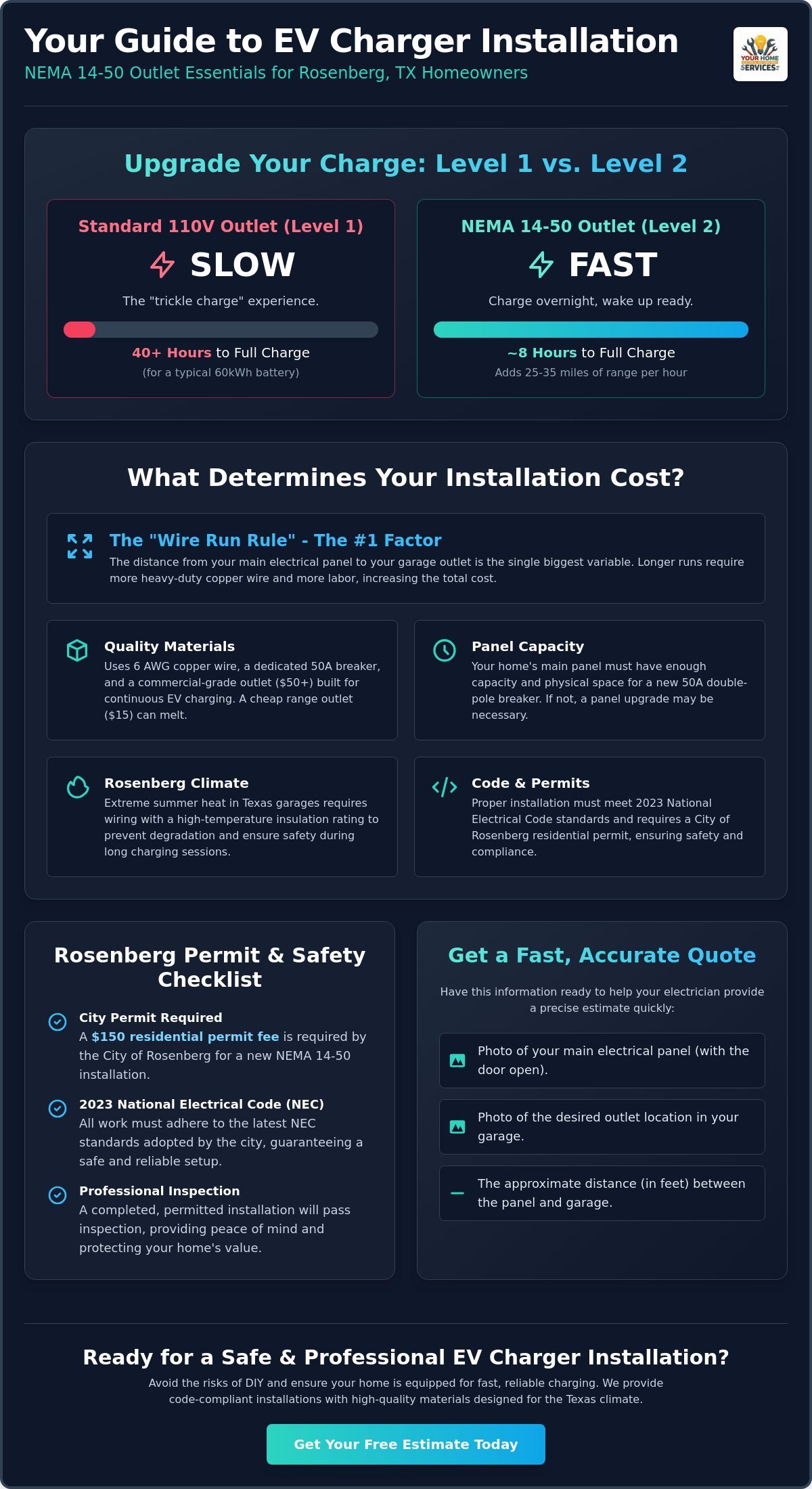
- Understand why the 240-volt NEMA 14-50 is the standard for Level 2 charging, providing significantly faster speeds than a standard household outlet.
- Learn how the “Wire Run Rule” and the distance from your breaker box impacts the total cost to install NEMA 14-50 outlet Rosenberg homeowners can expect.
- Identify if your home’s electrical panel has the necessary 50-amp capacity or if a panel upgrade is required to support your new EV charger safely.
- Navigate local Rosenberg city ordinances and permit requirements to ensure your installation is code-compliant and passes professional inspection.
- Discover the specific photos and information you should have ready to help an electrician provide a fast and accurate installation estimate.
What is a NEMA 14-50 Outlet and Why is it the EV Standard?
The NEMA 14-50 Outlet has become the industry standard for home electric vehicle charging for several practical reasons. It is a heavy-duty, 240-volt receptacle rated for 50 amps, making it significantly more powerful than the standard wall plugs found around your home. For Rosenberg homeowners, this outlet is the primary gateway to “Level 2” charging. While a standard outlet provides a slow trickle, a dedicated 50-amp circuit can add between 25 and 35 miles of range for every hour your car is plugged in. This speed ensures that even the most depleted batteries are fully topped off by morning. Safety is built into the physical design, as the 4-prong configuration includes two “hot” wires, a neutral wire, and a dedicated ground to protect your vehicle and your home’s electrical system.
NEMA 14-50 vs. Standard 110V Outlets
If you’ve tried charging your EV with a standard 110V outlet, you’ve likely experienced “trickle charge” frustration. For a typical 60kWh battery, a standard outlet might take over 40 hours to reach a full charge. That’s nearly two full days of waiting. Upgrading to a Level 2 setup changes the dynamic entirely, reducing that time to a single overnight session. Many residents find that the cost to install NEMA 14-50 outlet Rosenberg services provide pays for itself in sheer convenience. Instead of hunting for public charging stations in Fort Bend County, you simply plug in when you get home and wake up with a “full tank.” Understanding the cost to install NEMA 14-50 outlet Rosenberg homeowners face starts with recognizing this massive jump in performance.
Versatility for Rosenberg Homeowners
Beyond EV charging, this outlet offers long-term value for your property. It is highly versatile, serving as a reliable power source for heavy-duty shop tools or high-powered welding equipment in a garage workshop. If you own an RV, the NEMA 14-50 is the exact connection needed to power your rig’s systems while it’s parked in the driveway. This multipurpose nature makes it an attractive feature for future homebuyers, potentially increasing the resale value of your Rosenberg residence. Whether you use a Tesla Mobile Connector or a universal Level 2 charging station, this outlet provides the consistent, high-amperage power required for modern electric transportation.
Cost Factors: The Wire Run Rule and Labor in Rosenberg
The most significant variable in determining the cost to install NEMA 14-50 outlet Rosenberg residents require is the “Wire Run Rule.” Simply put, the further your garage outlet is from your main electrical panel, the more you’ll pay for materials and labor. Copper is a premium commodity. Since a 50-amp circuit requires heavy-duty 6 AWG copper wire, every additional foot of distance adds substantial weight to the project’s material list. In the Rosenberg and Richmond area, labor rates for licensed expertise reflect the technical demands of these high-voltage installations. A professional ensures that connections are torqued correctly to prevent the arcing or overheating common in amateur setups.
Living in Southeast Texas introduces another critical factor: the heat. Rosenberg garages often reach temperatures well over 100 degrees during the summer. This ambient heat affects how electricity flows through your wiring. We prioritize wire insulation ratings that can handle “continuous load” charging in these conditions. If your wire isn’t rated for high temperatures or the circuit isn’t sized correctly for the distance, the resistance can cause the wire to degrade over time. Following Local Permitting and Safety Standards ensures that your installation accounts for these environmental stressors.
Breaking Down the Materials Cost
A safe installation requires more than just a plug. Essential components include an industrial-grade NEMA 14-50 outlet, a dedicated 50-amp breaker, metal or PVC conduit, and 6/3 Romex or THHN wire. It’s vital to distinguish between a $15 “range” outlet designed for a stove and a $50 industrial-grade outlet built for EV charging. Cheap residential outlets often melt under the continuous, high-amperage heat generated by charging an electric vehicle for eight hours straight. Investing in high-quality components from the start prevents costly failures later. If you aren’t sure which components your home needs, a professional electrical assessment can clarify your requirements.
Labor and Distance Estimates
The complexity of the physical installation path dictates the labor hours required. A “Back-to-Back” installation, where the panel sits directly on the other side of the garage wall, is the most straightforward scenario. In contrast, a “Cross-Garage” run involves navigating around water heaters, storage shelving, or through attic spaces. Attic runs are more labor-intensive due to the heat and tight spaces involved in Rosenberg’s typical home designs. If we have to fish wire through finished walls, drywall patching and repair may become part of the project scope to restore your home’s appearance.
The Comparison: Run Length Cost Tiers
We generally categorize installations into three tiers based on distance. Short runs are under 15 feet and typically stay within the same corner of the garage. Medium runs span 15 to 50 feet and often require more complex conduit bending. Long runs exceed 50 feet and may face “voltage drop” issues. When a run nears 100 feet, we might need to upgrade the wire gauge to 4 AWG to ensure your car receives the full power it expects. In some cases, installing a sub-panel closer to the garage is more cost-effective than running a single long, heavy-gauge wire from the opposite side of the house.
Panel Capacity: When Your Rosenberg Home Needs an Upgrade
The physical outlet in your garage is only half of the equation. The real heart of your EV charging setup is the main electrical panel. A NEMA 14-50 outlet requires a dedicated 50-amp circuit, which represents a significant portion of a home’s total electrical capacity. If you live in one of the older neighborhoods in Rosenberg, your home might still be operating on a 100-amp service. Adding a 50-amp load to a 100-amp panel often pushes the system past its safe operating limits, especially when the air conditioner and kitchen appliances are running simultaneously. Understanding your panel’s health is a vital step in calculating the total cost to install NEMA 14-50 outlet Rosenberg projects require.
If your panel is physically full, you might feel tempted to look for shortcuts. Some homeowners discover “double-tapping,” where two wires are forced into a single breaker slot to make room. This is a major safety violation and a common cause of electrical fires. We never recommend this practice. Instead, a thorough assessment ensures your home remains code-compliant and safe. For a deeper look at how we handle these technical requirements, you can review our Professional Electrical Panel Upgrade Richmond TX Guide. This resource explains the long-term benefits of modernizing your home’s electrical backbone before adding high-draw devices.
Signs You Need a Panel Assessment
You can often identify your service size by looking at the main breaker, typically located at the top of your panel. A “100” or “200” stamped on the handle indicates your total amperage. However, physical space isn’t the only factor. We perform a “Load Calculation” to determine if your panel can handle the new EV circuit without overloading. If you notice your lights flickering when the refrigerator kicks on, or if you’ve experienced frequent breaker trips in the past, these are clear red flags. Your system is telling you it’s already near capacity before you even consider the cost to install NEMA 14-50 outlet Rosenberg equipment.
Solutions for Crowded Panels
A full panel doesn’t always mean a full replacement. In some cases, we can use “tandem breakers” to consolidate existing circuits and create the two slots needed for a 240V breaker. This is a cost-effective way to gain space if your panel manufacturer allows it. Another option is installing a dedicated garage sub-panel. This organizes your EV charging and workshop tools in one place while keeping your main panel clean. If your home is older and you plan on adding more smart home devices or solar panels later, a full 200-amp service upgrade is the best way to future-proof your property. It provides peace of mind that your home can handle any modern electrical demand safely.
Local Permitting and Safety Standards in Rosenberg & Fort Bend County
Rosenberg city ordinances are clear: any new 240V circuit requires a formal electrical permit. This isn’t just a bureaucratic hurdle. It’s a safety measure enforced by the Fort Bend County fire marshal and local building inspectors to ensure your home doesn’t become a fire risk. When calculating the total cost to install NEMA 14-50 outlet Rosenberg residents often overlook the “Insurance Gap.” If you choose to bypass the permitting process and an electrical fire occurs, your homeowners insurance provider may deny your claim entirely. They view unpermitted work as a breach of policy, leaving you responsible for any property damage. Skipping this step can also complicate future home sales, as inspectors will flag the lack of documentation during the escrow process.
Professional installers handle the permit paperwork on your behalf to avoid these complications. This ensures that every component, from the breaker to the conduit, meets the rigorous standards set by the 2026 National Electrical Code (NEC). If you’re ready to start your project correctly, you can schedule a code-compliant EV charger installation today. Our team understands local requirements, ensuring your installation passes the first time without costly delays or rework. We make sure the $150 residential permit fee and all necessary documentation are managed properly so you don’t have to navigate the city’s building department alone.
The Inspection Process
A Rosenberg city inspector focuses on specific technical details during the final walkthrough. They verify that the wire gauge matches the breaker size and that the conduit is secured properly every few feet. They also check for proper grounding and bonding to prevent electrical shocks. While the timeline for inspections in the Richmond and Rosenberg area varies, most are completed within three to five business days of the installation. Having a professional on-site for the inspection provides peace of mind that any minor adjustments can be handled immediately. This structured process protects your property value and ensures the long-term reliability of your charging setup.
GFCI Requirements and NEMA 14-50
The 2026 NEC includes a specific requirement for Ground Fault Circuit Interrupter (GFCI) protection on all 240V garage outlets. This safety feature is non-negotiable for a code-compliant installation. A GFCI breaker is designed to shut off power instantly if it detects a leak in the electrical current. This is critical in garage environments where damp concrete floors or high humidity can increase the risk of a dangerous shock. Because these are specialized components, a GFCI breaker alone can cost over $100 more than a standard 50-amp breaker. It’s a necessary investment in the safety of your family and your vehicle, preventing accidents before they can happen.
Getting a Professional EV Charger Installation Quote
Obtaining an accurate estimate for your home charging project requires more than a quick phone call. Most over-the-phone quotes for the cost to install NEMA 14-50 outlet Rosenberg residents receive are based on idealized conditions that rarely exist in real-world garages. Without seeing your panel’s physical condition or the exact path the wire must take, an electrician can’t account for attic obstructions or complex conduit bends. To get the most precise figure, we recommend having clear photos ready of your main electrical panel, the circuit directory label, and the specific wall where you want the outlet located. This preparation allows us to identify potential challenges before we even arrive at your property.
If your assessment reveals that your home’s electrical backbone isn’t ready for a 50-amp load, you may need to consider a more comprehensive solution. Our guide on Electrical Panel Upgrade for EV Charger in Sugar Land provides a clear roadmap for those who require a full system overhaul. Whether you’re in a newer development or a historic neighborhood, understanding the total cost to install NEMA 14-50 outlet Rosenberg equipment depends on the transparency and detail of your initial quote.
What to Look for in a Rosenberg Electrician
Not every electrician is equally equipped to handle high-amperage EV installations. Always verify that your contractor holds a valid license from the Texas Department of Licensing and Regulation (TDLR) and carries insurance specifically for residential work. You should also ask about their experience with your specific vehicle brand, such as Tesla or Rivian, as each has unique requirements for wall connectors and mobile adapters. We recommend choosing a “Flat-Rate” quote over an hourly “Time and Materials” billing structure. Flat-rate pricing ensures you know the final cost upfront, protecting you from paying extra if a run proves more difficult than expected or if the electrician needs to source specialized conduit.
Why Your Home Electrical and Handyman Services LLC is the Trusted Choice
Your Home Electrical and Handyman Services LLC takes pride in being a localized service provider deeply rooted in the Richmond and Rosenberg community. Our team understands the specific building styles of Fort Bend County, allowing us to plan wire runs that are both efficient and aesthetically pleasing. What sets us apart is our dual expertise in professional electrical work and handyman finishes. Most electricians will leave holes in your garage walls after fishing wire, leaving you to find another contractor for the cleanup. We handle the entire process, including professional drywall patching and repair, so your garage looks exactly as it did before we started. If you’re ready for a seamless experience, request your NEMA 14-50 installation quote today and let our trusted experts guide your transition to electric driving.
Power Your Home and Vehicle with Confidence
Transitioning to an electric vehicle is a significant step toward a more efficient lifestyle. As we’ve discussed, the total cost to install NEMA 14-50 outlet Rosenberg homeowners experience depends on your garage’s layout and your electrical panel’s current health. By prioritizing a code-compliant installation, you ensure your Level 2 charging setup is both fast and safe for years to come. Professional oversight is the key to navigating local Rosenberg permits and 2026 safety standards without the stress of potential hazards or insurance complications.
Our team of licensed Texas electricians is dedicated to providing reliable, Fort Bend County local service. We take pride in our thoroughness, which includes expert drywall patching to keep your home looking its best after the wiring is complete. You don’t have to manage these technical details alone. Schedule Your Professional NEMA 14-50 Installation in Rosenberg today to secure a dependable charging solution for your new EV. We look forward to helping you power your journey safely.
Frequently Asked Questions
How much does it typically cost to install a NEMA 14-50 outlet in Rosenberg?
The total cost depends primarily on the distance between your electrical panel and the outlet location. Short runs with existing panel capacity are the most straightforward, while long runs requiring conduit and heavy-gauge copper wire increase the project scope. If your home requires an electrical panel upgrade to support the new 50-amp load, this will also impact the final cost to install NEMA 14-50 outlet Rosenberg residents can expect.
Do I need a permit to install a 240V outlet in my Rosenberg garage?
Yes, the City of Rosenberg requires a residential electrical permit for all new 240-volt circuit installations. This process includes a $150 fee for homes up to 2,500 square feet and ensures the work meets the 2023 National Electrical Code standards. Obtaining this permit is a critical step for maintaining your homeowners insurance coverage and ensuring the installation is documented for future property sales.
Can I install a NEMA 14-50 outlet myself to save money?
Professional installation is the safest and most reliable option for high-voltage EV charging. Handling 240-volt, 50-amp circuits involves significant risks of electrical shock or fire if the wiring isn’t torqued and grounded correctly. Licensed electricians ensure that the wire gauge, breaker type, and outlet grade all meet modern safety standards, which protects your vehicle’s sensitive electronics and your home’s structural integrity.
What is the difference between a NEMA 14-50 and a hardwired EV charger?
A NEMA 14-50 is a heavy-duty plug-in receptacle that offers versatility for various chargers and RVs. In contrast, a hardwired charger is permanently connected to your electrical system, which often allows for higher charging speeds on a 60-amp circuit. While the outlet is convenient for those who may move their charger, hardwiring is often preferred for outdoor installations or for maximizing the charging rate of specific vehicle models.
Will adding a NEMA 14-50 outlet trip my main house breaker?
Your main breaker will only trip if the total electrical demand exceeds your panel’s rated capacity. We perform a detailed load calculation before installation to ensure your 100-amp or 200-amp service can handle the new EV circuit alongside your air conditioner and appliances. Understanding your home’s limits is a key part of determining the total cost to install NEMA 14-50 outlet Rosenberg projects require for long-term safety.
What wire size is required for a 50-amp EV outlet in Texas?
A 50-amp circuit requires 6 AWG copper wire as the standard for safe operation. In the intense heat of a Rosenberg summer, wire insulation ratings become even more important to prevent degradation under a continuous electrical load. For exceptionally long runs exceeding 100 feet, we may upgrade the wire to 4 AWG to prevent voltage drop and ensure your vehicle charges at its maximum efficiency.
How long does the actual installation take?
A standard installation typically takes between two and four hours to complete. This timeframe includes mounting the outlet box, running the conduit, and installing the new 50-amp breaker in your panel. If your project involves complex attic runs, drywall patching, or a full panel upgrade, the process can extend to a full day. We provide a clear timeline during the quoting process so you can plan accordingly.
Does a NEMA 14-50 outlet work with a Tesla Wall Connector?
A Tesla Wall Connector is designed to be hardwired directly into your home’s electrical system for the best performance. However, Tesla’s Mobile Connector comes with a NEMA 14-50 adapter that allows you to plug directly into the outlet. If you prefer the Wall Connector but want to use an outlet, you would need to purchase a specific plug-in version of the device, though hardwiring remains the manufacturer’s recommended standard.