

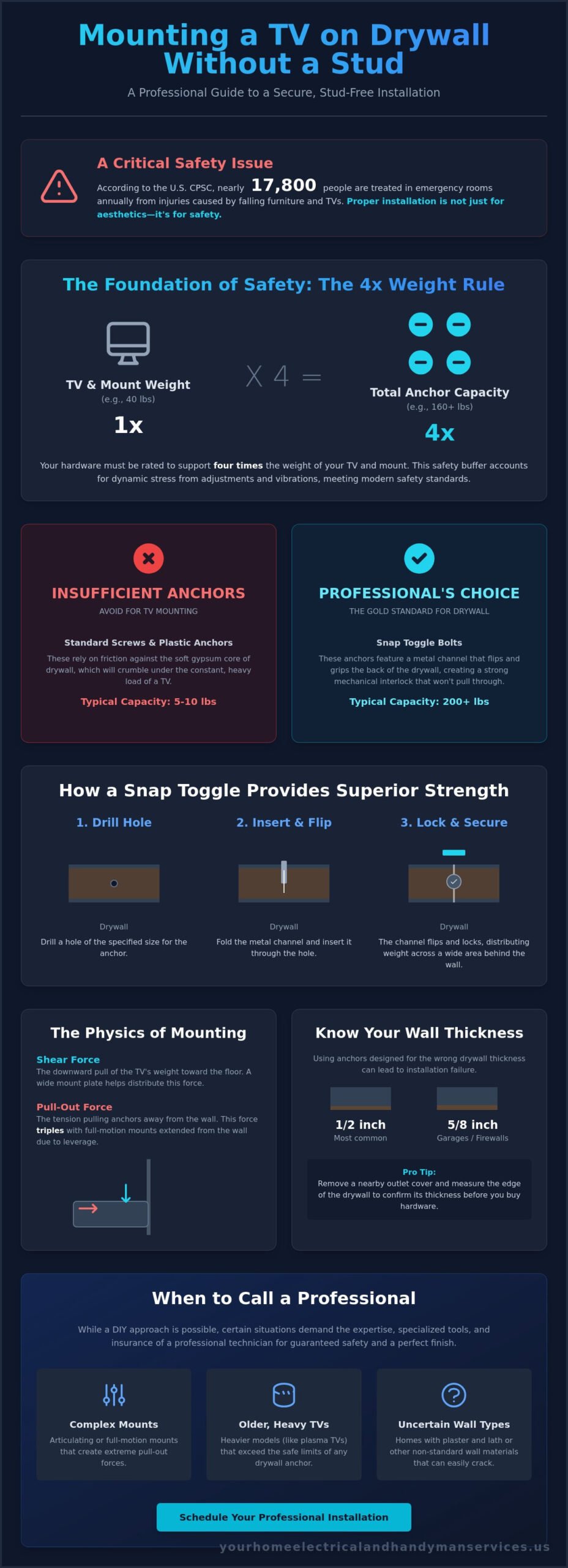
Did you know that according to the U.S. Consumer Product Safety Commission, nearly 17,800 people are treated in emergency rooms every year for injuries caused by falling furniture and TVs? It is a sobering reality that highlights why getting your installation right is about much more than just aesthetics. Safety is the foundation of any successful home project.
You likely feel a familiar knot of anxiety when you consider how to mount TV on drywall without a stud nearby. It’s completely normal to worry about your expensive screen crashing to the floor or accidentally drilling into a hidden electrical wire. With so many different anchors on the market, choosing the wrong hardware can lead to a disaster you would rather avoid. You want a solution that is permanent and professional.
This guide provides the professional clarity you need to move forward with confidence. You will learn the exact steps, specialized tools, and modern heavy-duty anchors like the Toggler Snaptoggle that make a studless installation both permanent and safe. We will walk through the physics of weight distribution and the latest 2026 safety standards to ensure your TV stays level and secure for years to come.
Key Takeaways
- Understand the “4x Weight Rule” to ensure your selected hardware can support four times the actual weight of your television for maximum safety.
- Identify why Snap Toggle bolts are the professional gold standard to securely mount TV on drywall when wood studs are not accessible.
- Learn a clean installation workflow using painter’s tape and specific drilling depths to prevent wall scuffs and unsightly structural damage.
- Master reliable detection techniques to locate hidden electrical wires and plumbing lines before you begin drilling into your living room walls.
- Recognize when complex setups, such as articulating full-motion mounts, require the specialized tools and insurance of a professional technician.
Can You Safely Mount a TV on Drywall Without a Stud?
The short answer is yes; you can safely mount TV on drywall without a stud, but success depends entirely on engineering rather than luck. Drywall is essentially a core of gypsum plaster pressed between two thick sheets of paper. While it is excellent for finishing rooms, it lacks the structural integrity of a wood stud. To ensure your screen stays on the wall, you must respect the material’s limits. Standard drywall screws might support 5 to 10 pounds, which is far below what even a modern LED screen weighs.
Professional installers follow the “4x Weight Rule.” This standard requires that your chosen hardware supports four times the total weight of the television and its mount. If your 55-inch LED TV weighs 40 pounds, your anchors must be rated for at least 160 pounds of total capacity. This buffer accounts for the dynamic stress placed on the wall when you adjust the screen or plug in cables. Standard plastic expansion anchors are never sufficient for this task. They rely on friction against the soft gypsum core, which eventually crumbles under a heavy, constant load. Choosing the Right Anchors for Drywall involves selecting hardware that mechanicaly grips the back of the wall board itself.
Weight limits vary significantly between generations of technology. Modern flat screens are lighter than ever, but they still pose a risk. A 2026-era 75-inch TV might weigh 70 pounds, while an older plasma unit of the same size could easily exceed 120 pounds. If you are dealing with an older, heavier model, mounting to a stud is always the safer choice for permanent peace of mind.
Understanding Drywall Thickness in Texas Homes
In many newer developments across Richmond and Katy, builders often use different drywall thicknesses depending on the room’s purpose. Most interior walls use 1/2-inch board, but you might find 5/8-inch thickness in garages or shared walls for fire protection. You can check the thickness by removing a nearby outlet cover and measuring the edge of the board. This measurement is critical. If you use a toggle bolt designed for 1/2-inch board on a 5/8-inch wall, the anchor may not have enough clearance to “flip” and lock into place behind the wall. Older properties in the region might even feature plaster and lath, which feels solid but is prone to cracking if you don’t use the correct pilot bits.
The Physics of Weight Distribution
When you mount TV on drywall, two forces are at play: shear force and pull-out force. Shear force is the downward weight of the TV pulling toward the floor. Pull-out force is the tension pulling the anchors away from the wall. A wide wall plate is your best friend here. It distributes the shear force over a larger surface area, preventing the mount from “sinking” into the drywall. Be aware that tilting or full-motion mounts increase the pull-out force significantly. When you extend a TV 20 inches away from the wall, the leverage can triple the stress on your anchors compared to a flat, fixed mount.
Choosing the Right Anchors for Drywall TV Mounting
Selecting the correct hardware is the most important decision you’ll make when you mount TV on drywall. Standard screws are designed to grip wood studs, not the crumbly gypsum core of a wallboard. To create a secure connection, you need anchors that provide a mechanical interlock behind the wall. This hardware must be strong enough to meet the “4x weight rule” discussed earlier, ensuring your installation handles both the static weight of the screen and any accidental bumps or cable adjustments.
There is a massive difference between light-duty anchors and professional-grade fasteners. While self-drilling threaded anchors like the Fischer DuoBlade are excellent for hanging pictures or light shelving, they often lack the pull-out resistance required for a 65-inch television. For a permanent installation, you should focus on hardware that expands or flips to grip a wide area of the drywall’s rear surface. If you’re ever in doubt about which hardware suits your specific wall type, a professional TV wall mounting service can provide the specialized tools and expertise needed for a flawless setup.
Snap Toggles: The Professional Handyman’s Choice
Snap toggles, such as the Toggler Snaptoggle BA, are widely considered the gold standard for studless mounting. Unlike traditional wing toggles that fall behind the wall if you remove the bolt, snap toggles use a solid metal channel held in place by plastic straps. This allows you to remove and reinstall the bolt as needed without losing the anchor. In standard 1/2-inch drywall, a single 1/4-inch snap toggle can often support over 200 pounds of shear force. When you use four or more of these across a wide wall plate, you create a rock-solid foundation that easily exceeds safety requirements for modern flat screens.
Molly Bolts and Heavy-Duty Metal Anchors
Molly bolts are another reliable option, especially for medium-sized screens ranging from 32 to 50 inches. These anchors use an “umbrella” expansion mechanism. As you tighten the bolt, the metal sleeve collapses and expands into four legs that grip the back of the drywall. They offer excellent stability because the sleeve stays permanently crimped to the wall even if the bolt is removed. However, they’re more difficult to remove than snap toggles. You’ll need to carefully tap the flange into the wall and patch over it if you ever decide to move your TV. Before you start drilling for these heavy-duty fasteners, it’s vital to perform Critical Safety Checks: Avoiding Wires to ensure you don’t strike a power line hidden behind the gypsum.
You must avoid “winged” plastic expansion anchors at all costs. These are frequently included in the box with cheap wall mounts, but they’re only intended for concrete or masonry. On drywall, they’ll simply pull through the wall under the weight of a television. Stick to all-metal toggles or molly bolts to ensure your screen stays safely mount TV on drywall for years to come.
How to Mount Your TV on Drywall: A Step-by-Step Guide
Mounting a television is a methodical process that rewards patience and precision. While some online tutorials claim you can finish in ten minutes, a professional-grade installation requires a more deliberate approach. Before you begin, gather your toolkit. You will need a power drill, a high-quality bubble level, painters tape, a pencil, and a vacuum. Having a vacuum on hand is a professional secret; it allows you to catch gypsum dust as you drill, keeping your living room clean and protecting your electronics from fine particles.
To mount TV on drywall successfully, you must start with a clean workspace. Apply a wide strip of painters tape to the general area where the mount will sit. This simple step allows you to mark your drill points clearly without leaving permanent pencil lead on your paint. It also provides a small amount of surface tension that helps prevent the drywall’s paper face from tearing or scuffing when the drill bit first enters the wall.
Preparation and Precise Marking
Start by measuring the VESA pattern on the back of your television. This is the standard measurement between the four threaded mounting holes. You need to ensure your wall bracket is centered and aligned based on these specific dimensions. Hold the bracket against the taped wall and place your level across the top. Once the bubble is perfectly centered, mark the exact spots for your anchors through the bracket’s mounting slots. Always measure twice. A crooked mount is difficult to fix once the anchors are set, and precise marking ensures your viewing experience isn’t ruined by a slanted screen.
Installing the Anchors and Bracket
Most heavy-duty snap toggles, which we identified as the gold standard in previous sections, require a 1/2-inch pilot hole. Use a sharp bit to ensure a clean, circular cut through the gypsum core. Insert the metal channel of the snap toggle through the hole. Pull the plastic straps toward you until the channel sits flat against the back of the drywall. Slide the plastic cap down the straps until it sits flush against the wall surface, then snap off the excess plastic. This creates a permanent, threaded metal point behind the wall board.
Align your bracket with these new anchor points. Thread the bolts through the bracket and into the metal channels by hand first. This “hand-tighten” rule is vital because it prevents cross-threading, which could ruin the anchor. Once all bolts are started, tighten them firmly. Before you lift the screen, perform a “Stress Test.” Apply firm, downward pressure to the bracket with your hands. It should feel completely immobile. If there is any movement or clicking, stop and inspect the anchors. Only when the bracket feels like a solid part of the wall should you proceed to hang the television. This careful verification is what separates a DIY attempt from a professional mount TV on drywall installation.
Critical Safety Checks: Avoiding Wires and Structural Damage
The biggest risk when you mount TV on drywall isn’t just the weight of the screen. It’s the hidden infrastructure living behind the gypsum. Many homeowners rely on the “Knock Test” to find solid ground, but this method is dangerously incomplete. While a hollow sound indicates a lack of studs, it tells you nothing about the electrical conduits, gas lines, or plumbing pipes that might be inches away from your drill bit. Modern electronic stud finders with built-in AC detection are the professional standard for a reason. They provide a visual warning if live wires are present, allowing you to adjust your placement before a dangerous mistake occurs.
In many Texas living rooms, electrical wiring follows predictable paths, but there are always exceptions. Standard practice dictates that wires run horizontally about 12 to 24 inches from the floor or vertically alongside the studs. If your desired mounting height sits directly above a light switch or a power outlet, there is a high probability of a vertical wire run in that exact cavity. If you feel any sudden resistance while drilling, stop immediately. Drill bits should move through drywall and wood with a consistent, smooth feel. If the bit hits something hard or “springy,” you may have struck a metal safety plate designed to protect electrical lines. For absolute peace of mind, our team provides professional TV wall mounting to ensure your home’s wiring remains untouched.
Detecting Hidden Electrical Hazards
Before you commit to a hole, use a non-contact voltage tester against the wall surface. This tool can often detect the electromagnetic field of live wires through the drywall. Remember that wires are frequently stapled to the sides of studs. Even if you aren’t drilling into the stud itself, a wide toggle anchor could potentially pinch or nick a wire as it expands in the wall cavity. Never drill directly in line with any electrical fixture. If you must mount in a crowded wall, consider a “shallow” drilling approach where you only penetrate the thickness of the drywall board itself.
Protecting Your Drywall from Cracking
Structural damage can also occur if you over-tighten your mounting bolts. It’s a common mistake to think that tighter is always better. In reality, cranking down on a bolt can crush the gypsum core of the drywall, effectively turning the area around the anchor into powder. This significantly reduces the anchor’s load-bearing capacity. If you are mounting an extra-large display over 85 inches, a plywood backer board can help distribute the weight across a much larger surface area. Additionally, inspect the wall for signs of moisture damage, such as yellowing or soft spots. If the drywall is compromised by humidity, it will not safely mount TV on drywall regardless of the anchors you choose.
Special caution is required for mounting above a fireplace. While this is a popular design choice, it introduces two major risks: excessive heat and complex internal venting. Heat can degrade the adhesive in your TV’s internal components and make the drywall behind it more brittle over time. Always measure the temperature of the wall while the fireplace is active before proceeding with an installation.
When to Hire a Professional Handyman in Richmond or Katy
Deciding whether to tackle this project yourself or call a professional often comes down to the value of your equipment and the complexity of your wall. While you now have the technical blueprint to mount TV on drywall, the physical reality of lifting an 85-inch OLED screen is a different matter. These larger displays are awkward and fragile. One slip can lead to a cracked panel that costs more to replace than the original installation. Professional technicians bring the strength and specialized hardware needed to handle these high-end electronics with care.
Specialized wall types also present unique challenges. Many modern apartments and commercial spaces in the Houston area use light-gauge metal studs rather than traditional wood. Standard lag bolts won’t work in these structures; they require specific toggle systems and a delicate touch to avoid stripping the metal. Similarly, older homes in Richmond might have brittle drywall that requires careful reinforcement. If your project involves a full-motion articulating mount, the stress on the wall is significantly higher. A professional ensures that the anchors are positioned to handle the leverage of a screen extended 20 inches from the wall.
Many homeowners choose to bundle their installation with other technical needs. We often coordinate mounting with a smart home device setup Houston residents rely on for a fully integrated entertainment system. This ensures your soundbar, streaming devices, and smart lighting all work in harmony from the moment the TV is powered on.
The Benefits of Professional Installation
The most visible benefit of hiring a pro is the “floating” look. We use code-compliant in-wall power relocation kits to hide every cable behind the drywall. This eliminates the clutter of hanging wires without violating the National Electrical Code. Precision is another factor. We use laser levels to ensure the bracket is perfectly straight, even if your floors or ceilings are slightly uneven. Perhaps most importantly, a local business provides a labor guarantee. This gives you peace of mind that your mount TV on drywall installation is permanent and secure.
Local Expertise in Fort Bend County
Homeowners throughout Sugar Land and Katy trust us because we understand the specific building standards of our local developments. Whether you need TV mounting Sugar Land TX or help with furniture assembly Sugar Land TX, we arrive with the right tools for the job. If you are also planning to update your living space with new modular pieces, our expert furniture assembly Katy TX service ensures every component is built correctly and safely alongside your new TV setup. We take pride in being a dependable partner for residential needs across the region. Contact Your Home Electrical and Handyman Services LLC today for a 2026 quote on your next home improvement project.
Secure Your Home Entertainment with Confidence
Achieving a professional-grade installation is a matter of following the right engineering principles. You now understand that using high-quality snap toggles and respecting the 4x weight rule are the most reliable ways to mount TV on drywall. By performing thorough safety checks for hidden wires and choosing a location away from heat sources, you ensure your setup is both functional and safe for everyone in your household.
If the physical weight of a large screen or the complexity of hidden electrical lines feels like too much to handle alone, expert assistance is available. Our team has served homeowners in Richmond, Katy, and Sugar Land since 2021. With licensed and insured technicians who specialize in both electrical upgrades and handyman repairs, we provide the stability and precision your home deserves. Get a Professional TV Mounting Quote in Richmond & Katy to ensure your project is completed to the highest standards.
Transforming your living space should be an exciting experience, not a source of anxiety. With the right tools and professional guidance, you can enjoy a perfectly level, secure television that serves as the centerpiece of your home for years to come.
Frequently Asked Questions
Can I mount a 65-inch TV on drywall without a stud?
Yes, you can mount a 65-inch TV on drywall without a stud if you use professional-grade toggle anchors. Modern 65-inch LED screens typically weigh between 45 and 60 pounds, which is well within the safe load-bearing capacity of multiple snap toggles. You must verify the weight of your specific model and ensure your chosen anchors are rated for at least four times that amount to maintain a permanent installation.
What are the best drywall anchors for mounting a TV?
Snap toggles, also known as Elephant bolts, are the best choice for this project because they provide a solid metal channel behind the wall. Unlike standard plastic anchors that rely on friction, these fasteners create a mechanical interlock that won’t pull through the gypsum. Molly bolts are a reliable secondary option for medium-sized displays, as they expand into an “umbrella” shape to grip a large surface area of the wall board.
Will mounting a TV on drywall ruin my wall?
Mounting a TV won’t ruin your wall. Just use the correct drill bits and avoid over-tightening the hardware. When it’s time to move, you’ll simply be left with a few 1/2-inch holes that are easy to fill with a standard patching compound. However, using the wrong anchors can cause the drywall to crumble or crack. This leads to more extensive and expensive structural repairs later.
How many toggle bolts do I need for a TV mount?
You should use a minimum of four toggle bolts to mount TV on drywall securely. Most professional wall plates have multiple slots, and distributing the weight across at least four points reduces the stress on any single section of the gypsum. For extra-large screens or heavy articulating mounts, increasing this to six anchors provides an additional layer of stability and peace of mind for your installation.
Can I mount a full-motion (swivel) TV bracket on just drywall?
It’s generally not recommended to mount a full-motion bracket on drywall alone because of the increased leverage. When an articulating arm is fully extended, it can exert three to five times the TV’s static weight in pull-out force. This extreme tension can easily cause anchors to pull through the drywall core. If you must use a swivel mount, finding at least one stud is a critical safety requirement for a stable setup.
Is it safe to drill into drywall if I don’t know where the wires are?
No, it’s never safe to drill into a wall cavity without first identifying the location of electrical wires and plumbing. Striking a live power line can cause a fire or a dangerous electrical shock. You should always use a stud finder with AC detection or a non-contact voltage tester to scan the area. This ensures your drill bit doesn’t make contact with hidden hazards behind the surface.
How much weight can 1/2-inch drywall actually hold?
A single 1/2-inch sheet of drywall can typically support 50 to 100 pounds of shear weight when paired with a high-quality toggle bolt. However, the cumulative weight of the TV and mount must be distributed across several anchors to prevent the board from warping. It’s important to remember that drywall is brittle. Its strength relies entirely on the surface area of the anchor’s backplate rather than the hole itself.
Should I use a plywood backer if I can’t find a stud?
Using a plywood backer is an excellent strategy when you can’t find a stud in the ideal viewing position. By securing a piece of 3/4-inch plywood across a larger section of the wall first, you create a much stronger foundation for the TV bracket. This method allows you to mount TV on drywall with significantly more security. The plywood effectively distributes the load across a wider area of the gypsum board.
One Response