

You walk into the garage at 6:00 AM, coffee in hand, only to find your car still sitting at a 10% charge while the wallbox flashes a cryptic red light. That immediate spike of range anxiety is something many local drivers face, but effective EV charger troubleshooting Rosenberg homeowners can perform often starts with understanding the difference between a minor software glitch and a serious hardware fault. It’s stressful to worry about whether a failed charge might damage your battery or, worse, pose a fire risk to your property.
We understand that you just want your vehicle ready for the road by tomorrow morning without the guesswork. This guide will help you diagnose common charging interruptions, explain what those blinking error codes actually mean, and clarify when the Texas heat or your home’s electrical panel requires a professional’s touch. You’ll learn how to safely navigate these technical hurdles so you can maintain a reliable home charging setup and keep your daily commute on schedule.
Key Takeaways
- Learn how to distinguish between simple software glitches and hardware faults using effective EV charger troubleshooting Rosenberg techniques to get your vehicle back on the road quickly.
- Identify common fault codes, such as solid or flashing red lights, to determine if your charger is experiencing a temporary error or a major internal failure.
- Understand how the local climate, including high humidity and intense summer heat, can cause thermal throttling or impact the longevity of your outdoor equipment.
- Recognize critical warning signs like burning smells or buzzing sounds that indicate when it’s time to stop DIY fixes and consider professional repairs or necessary electrical panel upgrades.
- Establish a routine maintenance schedule with torque checks and thermal imaging to prevent future charging failures and ensure your home’s electrical system remains safe.
Why Your EV Charger Stopped Working: First Steps for Rosenberg Homeowners
When your vehicle fails to charge overnight, the problem usually lies in a breakdown of communication or a physical power interruption. Effective EV charger troubleshooting Rosenberg homeowners can perform begins with a systematic approach to isolating the fault. This process involves checking the three main components of your setup: the home’s power supply, the charging unit itself, and the vehicle’s intake system. In technical terms, this is often referred to as electric vehicle supply equipment (EVSE) troubleshooting.
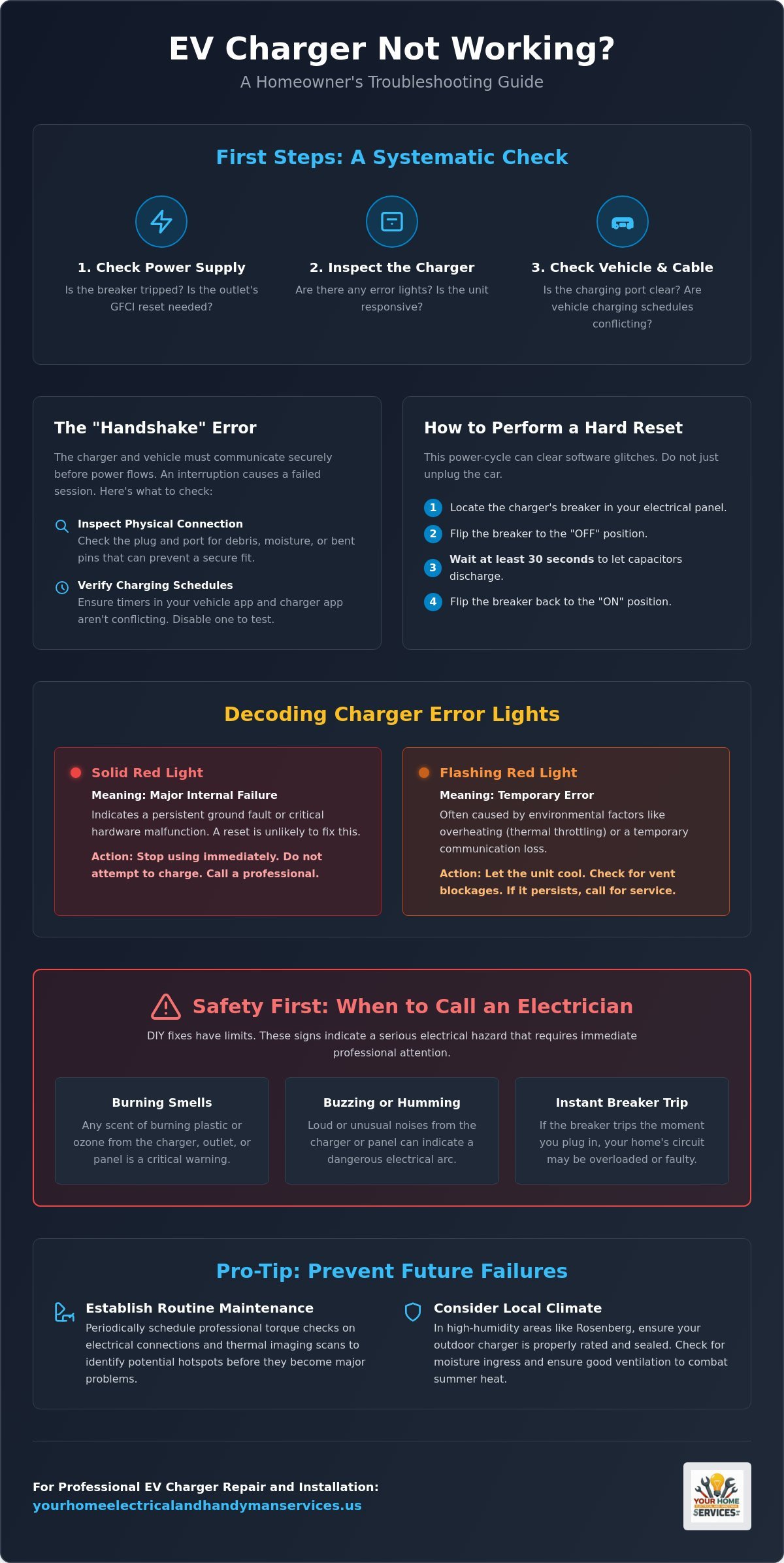
One of the most common reasons for a failed charging session is a “handshake” error. Modern electric vehicles and chargers don’t simply transfer power the moment they’re plugged in. Instead, they engage in a digital protocol where the car and the charger must confirm a secure, safe connection before any high-voltage current flows. If this handshake is interrupted by a software lag or a loose connection, the charger will remain idle to prevent electrical damage. Before you assume the hardware has failed, you should perform two quick checks:
- Inspect the physical connection: Our humid Texas climate can lead to dust or moisture buildup inside the connector. Check for debris, cobwebs, or slightly bent pins inside the charging handle. Even a small obstruction can prevent the plug from seating deeply enough to initiate the handshake.
- Verify charging schedules: It’s easy to overlook conflicting timers. If your vehicle app is set to charge at midnight but your charger’s internal app is set for 2:00 AM, the two systems may fail to sync correctly. Ensure both apps are aligned or disable one to see if the session starts immediately.
The Simple Hard Reset: How and When to Do It
If your charger is unresponsive or displaying a generic error light, a hard reset is often the best first step for EV charger troubleshooting Rosenberg residents can try. You shouldn’t just unplug the car; you need to power-cycle the entire unit. Locate the dedicated double-pole breaker in your main electrical panel and flip it to the “off” position. Wait at least 30 seconds before flipping it back on. This duration is critical because it allows the capacitors on the charger’s internal logic board to fully discharge, which clears out “frozen” software states. While this often resolves minor glitches, be cautious. If you have to reset the breaker frequently, it’s a sign of a deeper electrical fault rather than a simple software hiccup.
Verifying Power at the Source
When the charging unit shows no lights or signs of life, the issue is likely upstream. Check your electrical panel for a tripped breaker. A breaker that has tripped due to an overload will usually sit in a middle position between “on” and “off.” If you’re using a plug-in Level 2 setup, also check the GFCI reset button on your NEMA 14-50 outlet. If the breaker trips the moment you start a charging session, your home’s electrical infrastructure might be overtaxed. This is a common occurrence in older homes where the existing circuitry wasn’t designed for the continuous, high-amperage draw of an EV. In these scenarios, an electrical panel upgrade for EV charger in Sugar Land or Rosenberg is the safest way to ensure your home can handle the load without risking a fire or equipment damage.
Decoding Common EV Charger Error Lights and Fault Codes
Most modern charging units use a standardized system of LED indicator lights to communicate their status. While the specific patterns can vary slightly between brands, understanding the general color language is a core part of EV charger troubleshooting Rosenberg homeowners can do themselves. These lights act as the first line of diagnostic data, telling you whether the problem is a simple delay or a critical hardware failure. Interpreting these signals correctly prevents you from repeatedly attempting to charge a system that has safely shut itself down.
- Solid Red Light: This is generally the most serious indicator. It typically points to a major internal hardware failure or a persistent ground fault. If a hard reset doesn’t clear a solid red light, do not continue trying to use the charger.
- Flashing Red Light: A blinking red signal often signifies a temporary environmental error. This could be caused by over-voltage from the local grid or the unit overheating due to high ambient temperatures in your garage.
- Yellow or Amber Lights: These colors usually indicate a communication hang-up. The charger is often “waiting for the vehicle” to respond. It suggests the physical connection is made, but the digital handshake hasn’t been completed.
- Blue or Green Pulsing: These are your “all clear” signals. A pulsing light usually means power is actively flowing into the battery, while a solid light typically means the vehicle is fully charged or the unit is in a standby “ready” state.
If you find yourself stuck with a persistent red light that won’t go away after a power cycle, it may indicate a deeper wiring issue that requires a professional eye. You can always reach out to a local electrical specialist to verify your circuit integrity and get your system back online safely.
Ground Fault Errors (GFCI)
Your charger is designed with highly sensitive Ground Fault Circuit Interrupter (GFCI) technology that monitors the flow of electricity. A ground fault is an unintended path between a power source and a grounded surface. When the charger detects even a tiny amount of “leaking” current, it shuts down instantly to prevent electric shock. In Rosenberg, these faults are frequently caused by high humidity or condensation forming inside the charging handle. A failing ground wire in your home’s electrical system can also trigger this safety shutdown, especially in older detached garages where the wiring may have degraded over time.
Connectivity and Software Glitches
Many “smart” chargers require a stable Wi-Fi connection to process charging schedules or verify user permissions. If your charger is located in a detached garage, signal drops can cause the unit to default to a “fault” state or ignore your mobile app commands. Furthermore, newer 2026 EV models may require specific firmware updates to maintain compatibility with older charging hardware. If your car won’t start a session, check your charger’s app for pending updates or RFID lockout settings. Sometimes, simply re-authorizing your “Charge at Home” permissions in the manufacturer’s portal can resolve a frustrating handshake failure.
Rosenberg Specific Challenges: Heat, Humidity, and Grid Issues
Living in Fort Bend County means dealing with environmental factors that most generic guides ignore. When you’re performing EV charger troubleshooting Rosenberg homeowners must account for the local climate. High temperatures and intense humidity don’t just make you uncomfortable; they directly impact how your charging equipment performs and how long it lasts. Understanding these local variables helps you distinguish between a broken charger and one that is simply reacting to the Texas elements.
Thermal throttling is a common occurrence during our peak summer months. Most Level 2 chargers include internal temperature sensors. When the ambient temperature in an uninsulated garage exceeds 100 degrees, the charger may automatically reduce its power output to prevent internal components from melting. You might notice your car is only gaining half the usual range per hour. This isn’t necessarily a hardware failure; it’s a safety feature designed to protect both the charger and your vehicle’s battery from heat-related degradation.
Humidity also presents a unique challenge for local installations. While most quality chargers are housed in NEMA 3R enclosures, these are primarily designed to keep out falling rain and ice. In our coastal-adjacent climate, persistent high humidity can lead to condensation inside the unit or around the charging port. This moisture can trigger the ground fault errors mentioned earlier, causing the unit to shut down as a precaution against short circuits. Additionally, the Fort Bend grid can experience fluctuations during peak demand periods, leading to brownouts or voltage spikes that confuse sensitive EVSE electronics.
Managing Heat-Induced Charging Delays
The best way to combat thermal throttling is to shift your charging window. Aim to charge your vehicle between 10:00 PM and 6:00 AM when ambient temperatures are at their lowest. Improving the airflow in your garage also makes a significant difference. Installing high-quality lighting installation services and industrial-grade ceiling fans can help circulate air and lower the stagnant heat around your wall-mounted unit. If your garage lacks insulation, even a small portable fan directed at the charger during operation can prevent it from reaching the throttling threshold.
Surge Protection for Your EV
Texas thunderstorms are notorious for sudden power surges and lightning strikes. It’s a common misconception that a standard breaker in your panel provides enough protection. While a breaker prevents your wires from overheating, it doesn’t stop a high-voltage surge from reaching your car’s expensive onboard charger. We recommend whole-home surge protection for Rosenberg properties to create a secondary line of defense. After a major storm, you should always check the status indicator on your surge protector. If the light has changed color or gone out, the device has likely sacrificed itself to save your electronics and needs to be replaced immediately to maintain safety.
Safe Troubleshooting vs. When to Call a Rosenberg Electrician
Knowing where your expertise ends and professional danger begins is the most important part of EV charger troubleshooting Rosenberg homeowners must master. While previous sections covered software resets and cleaning pins, these tasks represent the limit of safe DIY intervention. Most charging systems operate on a 240-volt circuit, which carries enough current to be lethal if handled improperly. Distinguishing between a minor glitch and a structural electrical failure ensures you don’t turn a simple repair into a hazardous situation.
One helpful diagnostic tool is the “warm to the touch” test. It’s perfectly normal for your charging cable and the unit’s casing to feel slightly warm during a high-speed session. However, if the handle is too hot to hold or if you notice the wall outlet feels scorched, you must stop the session immediately. Some homeowners attempt to “jiggle the wire” to maintain a connection when a charger is acting up. This is a recipe for an electrical fire. A loose connection creates resistance, which generates intense heat that can melt internal components long before a breaker ever trips.
You should move into the “danger zone” mindset if you experience any of the following sensory warnings:
- Smelling Ozone: A distinct metallic or “electrical” burning smell usually indicates arcing wires.
- Hearing Buzzing: A persistent humming or crackling sound near the charger or the main panel suggests a failing connection or a struggling breaker.
- Visible Melting: Any warping of the plastic casing or discoloration on the plug is a sign of extreme overheating.
Signs of Professional Electrical Failure
If your charger causes persistent nuisance tripping, the problem is likely not the charger itself but the circuit feeding it. This often happens when the wire gauge is insufficient for the 40 or 50-amp load required by modern vehicles. If you see discoloration on your NEMA 14-50 outlet or the hardwire junction box, the internal wiring has likely been compromised. In many older Fort Bend County homes, these issues signal that you need a professional electrical panel upgrade in Richmond TX or Rosenberg to safely accommodate the continuous draw of an EV.
The Risk of DIY High-Voltage Repair
Modern EVSE units are not designed to be user-serviceable inside the casing. Opening the unit usually voids your warranty and exposes you to high-voltage capacitors that can hold a charge even after the power is turned off. Many homeowners waste money on what we call the “parts cannon,” where they guess and buy expensive replacement cables or units without knowing if the house wiring is actually the culprit. If your basic resets haven’t worked, it’s time to schedule a professional inspection. Expert diagnostics identify the exact point of failure, saving you money and ensuring your garage remains a safe place to park your vehicle.
Expert EV Charger Repair and Maintenance in Fort Bend County
When basic resets fail and the warning signs of electrical distress appear, professional intervention becomes the only safe path forward. Specialized EV charger troubleshooting Rosenberg homeowners rely on involves more than just checking a voltmeter. At Your Home Electrical and Handyman Services, we approach every repair with a focus on long term reliability and home safety. We understand that your charging station isn’t just an appliance; it’s a critical piece of infrastructure that powers your daily life and protects your vehicle’s battery health.
Preventative maintenance is the best way to avoid the range anxiety that comes with a failed overnight charge. For Rosenberg residents, we recommend an annual maintenance check to combat the effects of our local climate. This process includes torque checks on all internal terminal blocks, as the natural expansion and contraction caused by the Texas heat can loosen connections over time. We also utilize thermal imaging to identify “hot spots” within your electrical panel or the charger’s junction box. These invisible heat signatures often reveal a failing component months before it actually breaks or causes a safety hazard.
Our Professional Diagnostic Process
We don’t believe in guessing with your high-voltage equipment. Our team utilizes specialized EVSE testers that simulate the digital handshake of a vehicle. This allows us to determine if the fault lies within the charger’s internal logic board or if the vehicle itself is rejecting the power flow. We verify circuit integrity from the main breaker all the way to the nozzle pins, ensuring that the wire gauge and insulation are still up to the task of a continuous 50-amp draw. After the diagnosis, we provide a clear, flat-rate quote for the necessary repairs so you can make an informed decision without any surprises.
Beyond the Charger: Total Home Electrical Health
Your EV charger is likely the largest electrical load in your home. If its operation coincides with flickering lights or tripped breakers in other rooms, it’s a sign that your overall electrical system is struggling to keep up. As we move through 2026, many families are adding second vehicles and considering multi-EV charging setups. We help you plan for this growth by integrating smart home monitoring tools that track your real-time energy usage. This data ensures you aren’t overtaxing your panel while also helping you take advantage of off-peak utility rates.
Reliability comes from using local experts who understand the specific demands of Fort Bend County properties. Don’t let a minor glitch turn into a major repair. Book your Rosenberg EV charger inspection today to ensure your system remains safe, efficient, and ready for the road tomorrow morning.
Secure Your Home’s Electric Future
Maintaining a reliable home charging station requires a balance between smart DIY habits and knowing when to call in a specialist. You now understand how to handle simple resets, interpret flashing error codes, and protect your equipment from the intense Texas heat. Professional EV charger troubleshooting Rosenberg services ensure that your home’s electrical infrastructure remains resilient against the demands of modern electric vehicles. By addressing small faults today, you prevent costly panel damage and hazardous wiring failures tomorrow.
Your Home Electrical and Handyman Services is locally owned and operated right here in Richmond and Rosenberg. Our licensed and insured Texas technicians provide expert diagnostics for Tesla, ChargePoint, and JuiceBox systems. We prioritize your property’s safety and your vehicle’s performance with every inspection. Schedule Your Professional EV Charger Diagnostic in Rosenberg to keep your commute stress-free. Your car is a major investment; let’s make sure it stays powered and ready for the road.
Frequently Asked Questions
Why is my Tesla Wall Connector flashing red in Rosenberg?
A flashing red light on a Tesla Wall Connector usually indicates a ground fault or an internal hardware error. In our local area, this is frequently caused by a loose wire in the wall box or a thermal issue triggered by high ambient temperatures in the garage. You should count the number of flashes and consult your manual to identify the specific fault code, as this helps determine if you need a simple reset or a professional repair.
Can high Texas humidity cause my EV charger to fail?
Yes, persistent high humidity can lead to moisture buildup inside the charging handle or the vehicle’s port. When this condensation occurs, the charger’s sensitive Ground Fault Circuit Interrupter (GFCI) sensors may detect “leakage” and shut the system down for safety. Keeping your charger in a sheltered, well-ventilated area helps reduce these moisture-related interruptions during the humid summer months.
How much does it cost for an electrician to troubleshoot an EV charger?
Professional diagnostic costs depend on the complexity of the fault and whether the issue lies within the unit or your home’s main electrical panel. Most reputable electricians charge a standard service fee to perform a comprehensive inspection and use specialized testing equipment. Once the technician identifies the exact point of failure, they will provide a detailed quote for the necessary repairs or parts replacement.
Is it safe to use my EV charger if the cord feels hot?
It’s not safe to continue charging if the cord is painfully hot to the touch or shows any signs of discoloration. While a moderate amount of warmth is normal during a high-amperage Level 2 session, excessive heat indicates high electrical resistance. This is often caused by a damaged internal wire or a failing connection at the plug, which can lead to a garage fire if left unaddressed.
Why does my charger only work at night?
Your charger likely has a “Time of Use” schedule enabled in either the vehicle’s settings or the charger’s mobile app. Many homeowners set these schedules to take advantage of lower overnight electricity rates. If you haven’t set a schedule, the unit might be experiencing thermal throttling during the day, where it refuses to operate until the Rosenberg afternoon heat subsides to a safe level.
Do I need to replace my whole charger if the cable is damaged?
You don’t always need a full replacement because many popular brands offer replaceable tethered cables. However, if your specific model is a sealed unit or if the damage occurred where the cable meets the internal circuit board, a full replacement is usually the only safe option. Attempting to splice a high-voltage EV cable yourself is extremely dangerous and will void your equipment warranty.
How do I know if the problem is my car or my home charger?
The easiest way to isolate the problem is to take your vehicle to a public Level 2 charging station. If the car charges normally at a public station, the issue is almost certainly with your home equipment or your garage’s dedicated circuit. If the car fails to charge at multiple locations, the fault likely lies within the vehicle’s onboard charger or its battery management software.
What should I do if my EV charger keeps tripping the circuit breaker?
You should stop using the charger immediately and contact a professional to inspect your electrical panel. Frequent tripping is a primary focus of EV charger troubleshooting Rosenberg experts because it often indicates an overloaded circuit or a loose breaker connection. Continuing to reset the breaker can cause the internal components to overheat, eventually leading to a total failure of your home’s electrical bus bar.