

What if the 30 percent discount you were counting on for your home’s power upgrade has already reached its expiration date? Many homeowners are currently looking for the federal tax credit for electrical panel upgrade 2026 to help offset the cost of a 200-amp service or a new EV charger. It’s stressful to manage technical home improvements when IRS definitions seem to change every year. You deserve clear, professional guidance to ensure your property is safe, code-compliant, and efficient without any expensive surprises during tax season.
This guide will clarify the current status of energy incentives, including the critical expiration of the 25C credit on December 31, 2025. You’ll learn exactly how this affects your 2026 filing and what specific panel requirements were necessary for prior qualifying installations. We’ll also provide a roadmap for successfully upgrading your electrical system to support modern high-load appliances while maintaining the highest standards of professional safety. We will walk you through the technical details of the 30 percent credit and explain how to prepare your home for the next generation of energy efficiency.
Key Takeaways
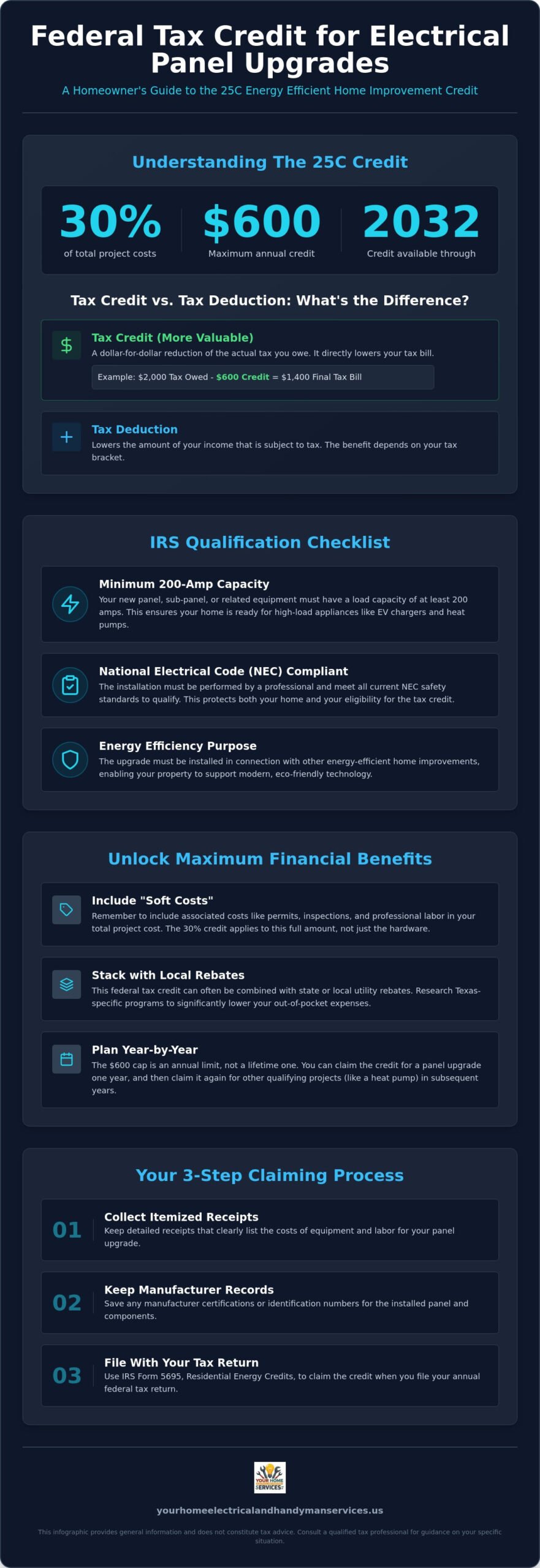
- Understand the 30% credit rate and the $600 annual cap defined under the 25C Energy Efficient Home Improvement Credit.
- Learn how to meet the IRS 200-amp load capacity threshold to qualify for the federal tax credit for electrical panel upgrade 2026.
- Discover how to include “soft costs” like permits and inspections in your financial breakdown to maximize your total tax savings.
- Follow a simple checklist to collect itemized receipts and manufacturer identification numbers required for your tax return.
- See why it’s critical to use local experts in Richmond and Sugar Land to ensure your upgrade is code-compliant and ready for an EV charger.
Understanding the Federal Tax Credit for Electrical Panel Upgrades in 2026
The 25C Energy Efficient Home Improvement Credit is a federal incentive designed to help you modernize your home’s infrastructure. It provides a credit equal to 30 percent of the cost for certain projects, including an electrical panel upgrade. For most homeowners, this specific incentive is capped at $600 per year. It’s a central component of the Inflation Reduction Act, which aims to reduce energy consumption across the country by making high-efficiency upgrades more affordable for the average household.
The government prioritizes these upgrades because older panels often can’t handle the electrical load required by modern, eco-friendly technology. If you’re planning to install a heat pump, high-efficiency solar panels from nipponenergy.co, or a residential EV charger, your existing system might need a boost to remain safe and functional. By offering the federal tax credit for electrical panel upgrade 2026, the IRS helps you bridge the gap between traditional power and a fully electrified home while ensuring your system meets modern safety standards.
It’s helpful to understand the distinction between a tax credit and a tax deduction. A deduction lowers the amount of income you’re taxed on, which provides a smaller benefit based on your tax bracket. A credit, however, is a dollar-for-dollar reduction of the actual tax you owe. If you owe the IRS $2,000 and qualify for the full $600 credit, your bill drops directly to $1,400. This makes credits significantly more valuable for homeowners in Richmond, Katy, and Sugar Land who want to see an immediate impact on their liability.
Is the Credit Still Available in 2026?
The 25C credit remains a viable option for your 2026 home improvements. The legislative framework extended these benefits through 2032, providing a long-term window for residents to phase in their upgrades. This is especially useful because the $600 cap is an annual limit rather than a lifetime one. You can strategically upgrade your panel in 2026 and claim the credit, then pursue other energy-efficient projects in subsequent years to maximize your total savings over time.
Tax Credit vs. Utility Rebate
While the federal tax credit for electrical panel upgrade 2026 is a nationwide program, you should also look at local Texas incentives. Federal credits are claimed on your annual tax return, but utility rebates are often distributed as direct checks or bill credits from providers like CenterPoint or local electric cooperatives. In many cases, you can “stack” these incentives. Using a federal credit alongside a local rebate can significantly lower your total out-of-pocket investment, resulting in a much higher ROI for your property. This principle of maximizing returns through incentives also applies to business energy projects, where Texas Engineered Solar LLC provides expert guidance on navigating commercial solar tax benefits.
IRS Requirements: What Makes Your Panel Upgrade Tax-Credit Eligible?
Qualifying for a tax incentive involves more than just swapping out an old breaker box. To successfully claim the federal tax credit for electrical panel upgrade 2026, your project must meet three primary criteria regarding capacity, safety, and purpose. The IRS is specific about what hardware qualifies, covering panelboards, sub-panels, branch circuits, and feeders. Feeders are the heavy-duty wires that carry power to different parts of your home, while branch circuits are the individual lines powering your outlets and lights. All these components must work together to support a more energy-efficient household.
The IRS defines the technical boundaries clearly. According to the IRS Energy Efficient Home Improvement Credit rules, any eligible upgrade must have a load capacity of at least 200 amps. It’s a high bar, but it ensures your home is ready for the future. Additionally, every installation must be consistent with the National Electrical Code (NEC). This means the work must be performed by a professional who understands current safety standards, ensuring you don’t miss out on the federal tax credit for electrical panel upgrade 2026 due to technical oversights.
The 200-Amp Standard for Modern Homes
In Texas, the 200-amp threshold is quickly becoming the baseline for modern living. With our intense summer heat, air conditioning systems place a massive load on a home’s electrical system. If you’re still using a 100 or 150-amp panel, you’re likely at capacity already. You can check your current capacity by looking at the number printed on your main breaker switch, usually located at the very top of your panel. Upgrading to 200 amps isn’t just about the credit; it’s about preventing tripped breakers and ensuring your home can handle modern lifestyle demands safely.
Qualifying “In Conjunction With” Upgrades
Another critical layer is the “Enabling Rule.” The IRS requires that your panel upgrade be performed in conjunction with the installation of qualified energy property. For example, if you are installing a heat pump water heater or central air unit, the panel upgrade needed to support that equipment qualifies for the credit. Similarly, preparing your home for an EV charger installation Sugar Land often triggers eligibility. This connection demonstrates that the upgrade is a necessary step toward a high-efficiency home. If you’re unsure if your planned improvements qualify, a professional panel upgrade assessment can help align your project with federal requirements.
The Financial Breakdown: Costs, Credits, and Long-Term Savings
Understanding the math behind your home investment helps you maximize the available incentives. When you apply the federal tax credit for electrical panel upgrade 2026, you’re looking at a credit of 30 percent of the total project cost. Because the IRS caps this specific credit at $600, a project totaling $2,000 or more will typically reach that maximum limit. This is a significant offset for a necessary infrastructure project, especially when you consider that the IRS allows you to include “soft costs” in your calculation. These costs often include labor, local permitting fees, and required inspections, making the credit more accessible than many homeowners realize.
You should be aware that this is a non-refundable tax credit. This means the credit can reduce the amount of tax you owe to zero, but the government won’t issue a refund check for any leftover credit amount. For example, if you owe $400 in federal taxes and qualify for the $600 panel credit, your tax liability drops to zero, but you don’t receive the remaining $200. Planning your upgrades during a year when you have sufficient tax liability ensures you receive the full financial benefit of the federal tax credit for electrical panel upgrade 2026.
Beyond the immediate tax savings, a modern electrical system is a major asset in the Richmond and Katy real estate markets. Local buyers are increasingly tech-savvy and prioritize homes that are “EV-ready” or capable of handling heavy AC loads without flickering lights. A 200-amp panel acts as a seal of quality, suggesting the home’s vital systems are updated and safe. This can lead to a faster sale and a higher asking price compared to homes with outdated 100-amp service.
Avoiding the Cost of Electrical Failure
Proactive upgrades help you avoid the high costs associated with electrical emergencies. Outdated panels are more than just an inconvenience; they’re a primary cause of residential fires and can lead to expensive damage to sensitive electronics. Waiting until a breaker melts or a circuit fails often results in higher labor costs for emergency repairs. Additionally, many Texas insurance carriers look favorably upon modernized electrical systems. You may find that updating your panel leads to lower premiums or prevents a denial of coverage based on the age of your home’s wiring.
Preparing for Future Electrification
Upgrading your panel once is far more cost-efficient than doing it in small, piecemeal stages. As electricity rates in the Houston metro area continue to fluctuate, having a robust system allows you to adopt energy-saving technologies more easily. A high-capacity panel provides the necessary foundation for a comprehensive smart home device setup Houston, ensuring your automation hubs and security systems have stable power. By investing in a 200-amp panel now, you’re building a bridge to a more efficient and controllable energy future for your household.
How to Claim the 25C Credit on Your 2026 Tax Return
Claiming the federal tax credit for electrical panel upgrade 2026 requires a methodical approach to your annual paperwork. Accuracy matters. It’s not a process you want to rush during the busy tax season. By following a structured path, you ensure that every dollar you’re entitled to remains in your pocket. The process begins with your contractor and ends with a specific set of IRS forms that translate your home improvement into a direct reduction of your tax liability.
- Step 1: Collect your itemized receipt from Your Home Electrical and Handyman Services LLC. This document is the foundation of your entire claim.
- Step 2: Verify the Qualified Manufacturer Identification Number (QMID) if it’s provided for your specific equipment. While not always required for panels, having it adds a layer of audit protection.
- Step 3: Complete IRS Form 5695, Part II. This is the section dedicated to the Energy Efficient Home Improvement Credit.
- Step 4: Carry the final credit amount over to your Form 1040. This is where the actual reduction of your tax bill occurs.
- Step 5: Retain all documentation, including the invoice and proof of payment, for at least three years. The IRS may request these records to verify your eligibility later.
Documentation You Need from Your Electrician
A generic invoice that simply lists “electrical work” won’t satisfy the IRS if you’re audited. Your paperwork must be specific to the requirements of the 25C credit. When we provide your documentation, we ensure that the 200-amp capacity and NEC compliance are explicitly stated. It’s also vital to have separate line items for labor and materials. Since the credit covers 30 percent of the total project, including permitting and inspections, having these broken down clearly helps your tax professional maximize your return without guesswork. Clarity in your records prevents delays.
Common Filing Mistakes to Avoid
Many homeowners mistakenly try to claim this credit for a new construction home. The IRS rules specify that the 25C credit is for existing homes that serve as your primary residence. Another frequent error involves the annual limits. While there’s a $1,200 total annual limit for general home improvements, the panel upgrade itself is specifically capped at $600. However, if you’re also installing a heat pump, that project carries a separate $2,000 limit. Understanding these distinct buckets prevents you from under-claiming or accidentally exceeding the allowable amounts on your return. If you’re ready to start your project, you can schedule your panel upgrade with a team that provides the precise documentation you need for a successful claim.
Professional Panel Upgrades in Richmond, Katy, and Sugar Land
Navigating local building codes in Richmond and Sugar Land can be a complex task for any homeowner. Each municipality has distinct permitting requirements that must be satisfied to ensure your work is legal and safe. At Your Home Electrical and Handyman Services LLC, we handle the entire permitting process on your behalf. This professional management is vital because the IRS requires your installation to be code-compliant to qualify for the federal tax credit for electrical panel upgrade 2026. We provide the peace of mind that comes from knowing your home’s infrastructure is handled by specialists who understand both the technical requirements and the administrative hurdles.
Many of our clients choose to combine their panel modernization with other improvements to maximize their home’s potential. It is an ideal time to consider lighting installation services while your system is being accessed. Whether you are adding recessed lighting or upgrading your home’s exterior fixtures, having a high-capacity panel ensures your new lighting has a stable and reliable power source. Our team maintains a strict commitment to licensed, insured, and code-compliant workmanship, protecting your property’s value and your family’s safety at every stage of the project.
Serving the Fort Bend County Community
Our team has extensive experience with the unique electrical profiles of homes across Fort Bend County. We understand the specific demands placed on systems in Katy and Sugar Land, where large floor plans and high-efficiency cooling are standard. We manage the “heavy up” process, which involves coordinating with local utility providers to increase the amperage coming into your home from the grid. This coordination is essential for a seamless transition to a 200-amp service. Timing is everything when it comes to tax season. We work diligently to schedule your 2026 inspections early, ensuring all work is finalized and documented well before the year-end deadline for the federal tax credit for electrical panel upgrade 2026.
Ready to Upgrade Your Home’s Power?
Upgrading to a 200-amp service provides a level of reliability that older systems simply cannot match. You won’t have to worry about whether your panel can handle a new EV charger or a modern kitchen suite. We provide every client with a detailed, itemized quote that breaks down labor and materials. This transparency doesn’t just build trust; it makes your tax filing process straightforward and stress-free. Our goal is to make your home improvement journey as smooth as possible, from the initial site visit to the final inspection. When you are ready to secure your home’s energy future, Schedule your electrical panel consultation with Your Home Electrical and Handyman Services LLC today.
Secure Your Home’s Energy Future Today
Modernizing your home’s electrical system is a strategic move that pays dividends in safety, resale value, and immediate tax savings. By meeting the 200-amp capacity threshold and ensuring your installation follows NEC standards, you position yourself to successfully claim the federal tax credit for electrical panel upgrade 2026. Accurate documentation remains the most important factor in securing your $600 credit, so keeping detailed, itemized records from your contractor is essential for a smooth filing process next year.
Our team has been serving Richmond, Katy, and Sugar Land since 2021. We provide the specialized expertise in 200-amp service upgrades needed to power modern lifestyles and high-load appliances. Our licensed and insured technicians ensure that every project is code-compliant and ready for future electrification, from EV chargers to smart home hubs. We’re here to help you manage these technical steps with professional assurance and local pride.
Get Your Itemized Quote for a Tax-Credit Eligible Panel Upgrade
Taking this step today ensures your property is prepared for tomorrow’s technology while lowering your upcoming tax liability. We look forward to helping you build a safer, more efficient home for your family.
Frequently Asked Questions
Can I claim the electrical panel tax credit for a rental property?
No, you cannot claim the 25C credit for a rental property. IRS guidelines specify that the Energy Efficient Home Improvement Credit is only available for existing homes that serve as your primary residence. If you own a property that you lease to others, the costs for electrical upgrades do not qualify for this specific federal incentive. You must live in the home where the upgrade is performed to be eligible.
What is the maximum amount I can claim for a panel upgrade in 2026?
The maximum amount you can claim for a panel upgrade is $600 per year. While the federal tax credit for electrical panel upgrade 2026 covers 30 percent of the project costs, this specific category is capped. You should also keep in mind that the total annual limit for all general energy property and home improvements is $1,200. Certain items like heat pumps have separate, higher limits that don’t count toward this specific cap.
Do I need to install a heat pump to get the electrical panel tax credit?
Yes, the IRS requires that your panel upgrade be installed in conjunction with other qualified energy-efficient property. This means you must be upgrading your system to support a specific improvement like a heat pump, central air unit, or heat pump water heater. A standalone panel replacement without a connection to qualified energy-efficient equipment typically doesn’t meet the “Enabling Rule” requirements for the credit.
Is a sub-panel upgrade eligible for the federal tax credit?
Yes, a sub-panel upgrade is eligible if it meets the same technical requirements as a main panel. The equipment must have a load capacity of at least 200 amps and be installed according to National Electrical Code standards. If the sub-panel is a necessary component to enable the use of qualified energy property, it can be included in your 30 percent calculation up to the $600 limit.
Can I claim the credit if I do the electrical work myself?
No, you generally cannot claim the credit for DIY electrical work. The IRS requires that the installation be consistent with the National Electrical Code, which almost always necessitates a licensed professional and local permits. While the federal tax credit for electrical panel upgrade 2026 covers labor costs, these must be paid to a contractor. You cannot claim a credit for the value of your own labor.
Does the 2026 tax credit apply to smart electrical panels?
Yes, the 2026 tax credit applies to smart electrical panels provided they meet the standard IRS criteria. The hardware must maintain a load capacity of at least 200 amps and comply with all local and national electrical codes. Because smart panels are often more expensive than traditional models, you will easily reach the 30 percent threshold to claim the maximum $600 credit available for that tax year.
What happens if 30% of my project cost is more than $600?
If 30 percent of your project cost exceeds $600, your credit is still limited to the $600 maximum for that year. For example, if your upgrade costs $3,000, 30 percent would be $900, but you can only claim $600 on your return. Understanding these specific caps is important before finalizing your budget. You cannot carry over the excess credit to future tax years under the current 25C rules.
Can I combine the panel tax credit with the EV charger tax credit?
Yes, you can combine the panel credit with the EV charger tax credit, but they are handled under different sections of the tax code. The panel upgrade falls under the 25C Energy Efficient Home Improvement Credit, while residential EV chargers are covered by the 30C Alternative Fuel Vehicle Refueling Property Credit. Using both allows you to maximize your total tax reduction for a comprehensive home electrification project.