
Does your home have the hidden strength to fuel your new electric vehicle, or are you risking an electrical fire every time you plug in? Many homeowners in established Sugar Land neighborhoods are discovering that their existing infrastructure isn’t quite ready for the high-speed demands of modern driving. You’ve likely felt the excitement of a new EV purchase quickly turn to frustration when faced with slow charging times and confusing permit requirements in Fort Bend County. It’s a common concern, especially with the 30% federal tax credit set to expire on June 30, 2026.
This guide explains exactly how an electrical panel upgrade for EV charger Sugar Land provides the foundation for a safe, high-speed Level 2 charging station. You’ll learn how to follow the 2023 and upcoming 2026 National Electrical Code standards while maximizing local rebates from CenterPoint Energy. We’ll walk you through the necessary steps to ensure your setup is code-compliant, increases your home’s resale value, and delivers the reliable performance you need to stay on the road. By understanding the 80% rule and local load calculations, you can make an informed investment that keeps your property safe and efficient.
Key Takeaways
- Understand why your home’s original electrical system might be reaching its limits and how to identify capacity warning signs before installing a charger.
- Discover why an electrical panel upgrade for EV charger Sugar Land is often necessary to meet the NEC 80% rule for continuous electrical loads.
- Compare the differences between 100-amp and 200-amp service to ensure your Level 2 charging station operates at peak efficiency without tripping breakers.
- Learn how to navigate specific Sugar Land permit processes and Fort Bend County codes to keep your installation safe and fully insurance-compliant.
- Find out how choosing a provider with both electrical and handyman expertise ensures a seamless finish with professional drywall patching after the upgrade.
Why Your Sugar Land Home May Need a Panel Upgrade for an EV Charger
Sugar Land homes built in the late 20th century, particularly in established neighborhoods like First Colony, Greatwood, or New Territory, were designed for a different era of energy consumption. Back then, a 100-amp or 125-amp electrical panel (distribution board) was more than enough to handle a central air conditioner, a few kitchen appliances, and basic lighting. Today, the demands of a high-speed Level 2 charging station change that equation entirely. Adding this equipment to an aging system often requires an electrical panel upgrade for EV charger Sugar Land to ensure your home remains safe during the sweltering Texas summers.
Texas homeowners already push their electrical systems to the limit when the heat index climbs above 100 degrees. Your HVAC system works overtime to keep the house cool, consuming a large portion of your available amperage. If you plug in an electric vehicle during these peak hours, an undersized panel will struggle to keep up. This often leads to “nuisance tripping,” where the main breaker shuts off the entire home’s power to prevent wires from melting or catching fire. Upgrading your service ensures your infrastructure can support both your family’s comfort and your vehicle’s range simultaneously.
Signs Your Current Panel is Overloaded
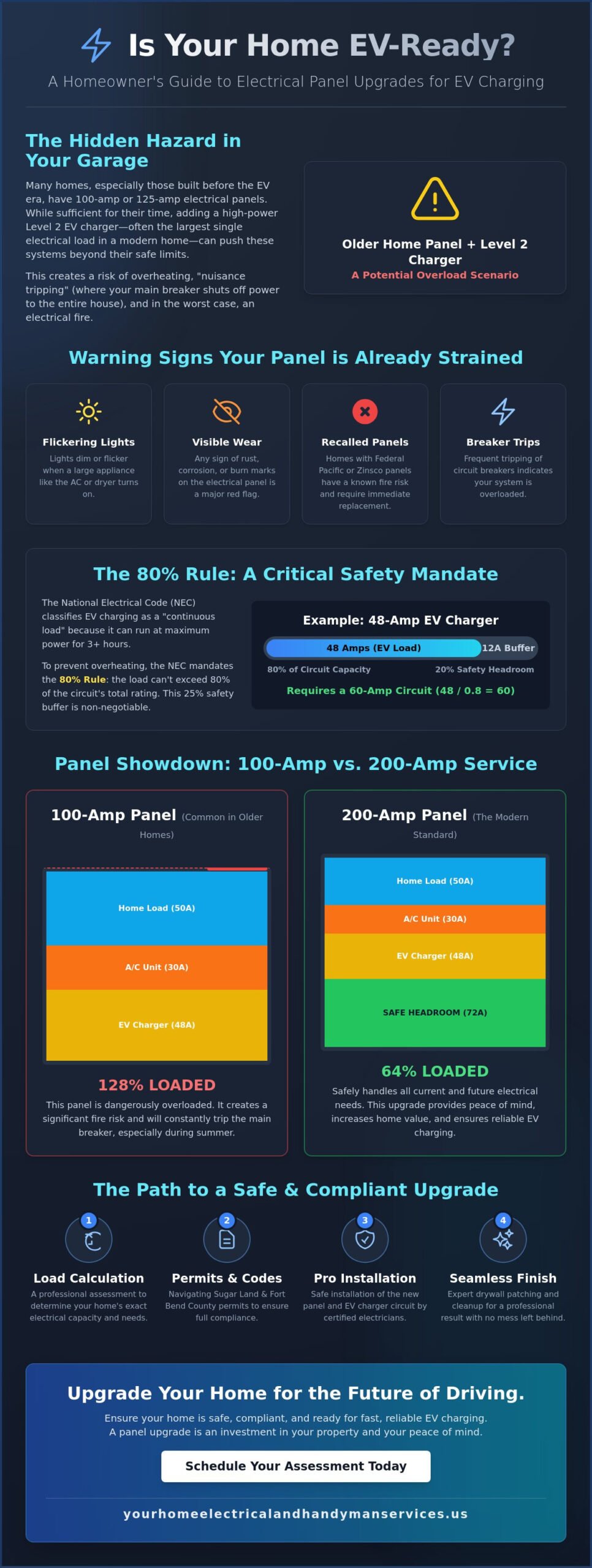
Before you purchase a charger, take a close look at how your home handles its current electrical load. If your lights flicker when the AC compressor kicks on or when you start the clothes dryer, your panel is already struggling to manage the demand. You should also inspect the physical condition of the box. Any visible corrosion, rust, or breakers that feel warm to the touch are immediate red flags. Additionally, many older Sugar Land homes still contain recalled panel brands like Federal Pacific or Zinsco. These specific models are notorious for failing to trip during a surge, which creates a significant fire risk when you add a high-draw appliance like an EV charger.
The EV Charger ‘Power Tax’ on Your Home
A Level 2 charger is not a standard appliance. Because it draws a high amount of electricity for several hours at a time, the National Electrical Code classifies it as a continuous load. This classification requires a 125% safety buffer for the circuit. For example, a 48-amp charger requires a dedicated 60-amp circuit breaker. An EV charger is often the largest single load in a modern home. If you only have a 100-amp panel, that single charger could claim 60% of your home’s total capacity. Investing in an electrical panel upgrade for EV charger Sugar Land allows you to expand your home’s electrical “headroom,” preventing the system from running at its absolute limit every night while you sleep.
Calculating Your Home’s Electrical Load: The 80% Rule and EV Charging
Determining if your home can handle a new charger requires more than just looking at the main breaker’s number. It involves a detailed load calculation that accounts for every major appliance in your household. Professional technicians perform these assessments to decide if an electrical panel upgrade for EV charger Sugar Land is truly necessary or if your current system has enough “headroom” to safely operate. Skipping this step often leads to overheated wires and melted insulation, which are primary causes of residential electrical fires. It’s a technical process, but it’s the only way to guarantee long-term safety.
What is a Continuous Load?
The National Electrical Code defines a continuous load as any electrical draw that runs at maximum current for three hours or more. While a microwave or a toaster runs for only a few minutes, charging a Tesla or a Ford F-150 Lightning overnight fits this definition perfectly. Because the heat builds up in the circuit over those long hours, the system must follow the 80% rule. The 80% rule is the mandatory safety margin that requires a circuit to be sized 25% larger than the load it serves. This ensures that the wires and breakers don’t reach dangerous temperatures during a long charging session.
A Sample Load Calculation for a Sugar Land Home
In Fort Bend County, our homes face unique electrical demands that differ from other parts of the country. A typical 3,000-square-foot home in Sugar Land often relies on large 5-ton AC units that draw significant power during the afternoon. When you factor in an electric water heater, a double oven, and perhaps a pool pump, your available capacity disappears quickly. Following Fort Bend County electrical codes ensures that your new EV circuit won’t cause a total system failure when the AC kicks on. If your total calculated load exceeds 80% of your panel’s rating, an electrical panel upgrade for EV charger Sugar Land becomes the only safe path forward.
DIY load assessments are risky because they often ignore “hidden” loads or fail to apply the correct demand factors. A professional technician uses specialized formulas to ensure every variable is captured, from your recessed lighting to your laundry room. This thoroughness prevents the frustration of a project that fails city inspection or leaves your home vulnerable to frequent power outages. If you’re unsure where your home stands, you can request a professional evaluation to get a clear picture of your system’s health. This proactive approach saves time and ensures your Level 2 charger provides the fast, reliable power you expect without compromising your home’s stability.
100-Amp vs. 200-Amp Service: Which is Right for Your Level 2 Charger?
Choosing between a 100-amp and a 200-amp panel is one of the most significant decisions you will make during your home electrification journey. While a 100-amp panel was the standard for decades, it often lacks the capacity to support a high-speed charger alongside modern climate control systems. For most homeowners, an electrical panel upgrade for EV charger Sugar Land to 200-amp service provides the necessary power to charge quickly without sacrificing daily convenience. This upgrade ensures your home can handle the heavy draw of a vehicle without the risk of overheating your main service lines.
The Limitations of 100-Amp Charging
If you choose to stay with a 100-amp panel, you may be forced to “throttle” your charger to lower amperages, such as 16A or 24A. This significantly increases your charging time, which can be frustrating for high-mileage drivers who need a full battery every morning. You might also face operational conflicts where you cannot run your dishwasher or electric dryer while your car is plugged in. These limitations often lead to “range anxiety” at home, as the slow recovery speeds fail to keep up with a busy Sugar Land commute. In these cases, staying with a lower-capacity panel often costs more in lost time and daily frustration than the upgrade itself.
Future-Proofing with a 200-Amp Upgrade
A 200-amp panel is the gold standard for a professional Level 2 charging station installation. It provides the flexibility to support a NEMA 14-50 outlet installation or a hardwired charger at its maximum 48-amp or 50-amp output. Beyond your current vehicle, this capacity prepares your home for a future where your household might have two or more electric cars. It also allows for other high-draw improvements like induction stoves or heat pump water heaters. As Forbes points out when discussing upgrading your home for EV charging, investing in infrastructure now prevents expensive rework later as technology evolves.
In the competitive Sugar Land real estate market, having an “EV-ready” home with 200-amp service is a major selling point. Buyers increasingly look for properties that don’t require immediate electrical work to support their lifestyle. Before committing to a specific service level, reviewing a detailed EV charger installation quote that breaks down every cost factor for your specific property will help you make the most informed decision. If your home falls into a specific category where 200 amps isn’t feasible, a 150-amp “middle ground” upgrade might be an appropriate alternative. However, for most residents, the electrical panel upgrade for EV charger Sugar Land to 200 amps offers the best return on investment and total peace of mind for years to come.
Navigating Sugar Land Permits and Fort Bend County Electrical Codes
Sugar Land local ordinances are strict for a reason. An electrical panel upgrade for EV charger Sugar Land isn’t just a hardware swap; it’s a regulated modification to your home’s primary infrastructure. The City of Sugar Land currently follows the 2023 National Electrical Code (NEC) to ensure every installation meets modern safety benchmarks. Skipping the permit process might seem like a way to save time, but it creates significant legal and safety liabilities. If an electrical issue occurs and the cause is traced to unpermitted work, your homeowner’s insurance provider may have grounds to deny your claim entirely. This financial risk far outweighs the effort required to follow local regulations.
The Fort Bend County fire marshal plays a silent but vital role in residential safety. Their standards influence how city inspectors evaluate high-draw continuous loads like EV chargers. During a final inspection, a city official will visit your property to verify that the work matches the submitted plans. They check for proper wire sizing, correct breaker labeling, and overall workmanship. This walkthrough is the final layer of protection for your family, confirming that your new charging setup won’t compromise the integrity of your home’s electrical system.
The Permit Process for Sugar Land Homeowners
Filing for an electrical permit in Sugar Land typically involves using the Sugar Land Citizen Self Service (CSS) portal. This digital system allows for the submission of plans and the payment of fees, which generally range from $350 to $800 depending on the project’s valuation. While the process is transparent, the technical requirements for load calculations and wiring diagrams can be overwhelming for most residents. We handle all the red tape for our clients, from the initial application to scheduling the final inspection. This ensures that the timeline stays on track and your project doesn’t get bogged down in administrative delays.
Code Compliance and Safety Standards
Modern codes require specific safety features that weren’t standard in older Sugar Land homes. This includes proper grounding and bonding to prevent electric shocks and the installation of Arc Fault Circuit Interrupter (AFCI) protection for new circuits. As Texas prepares to adopt the 2026 National Electrical Code on September 1, 2026, staying ahead of these changes is essential for maintaining your home’s value. Many homeowners find it beneficial to address all their electrical upgrades at once, including professional lighting installation services that also need to comply with the incoming 2026 NEC standards. Hiring a licensed EV charger installer Cypress or Sugar Land specialist is non-negotiable for meeting these rigorous standards. Professional installation guarantees that your electrical panel upgrade for EV charger Sugar Land is fully compliant with both current and upcoming state laws.
Safe, code-compliant charging starts with a professional assessment of your home’s specific needs. You can book your permit-ready consultation to ensure your installation is handled with the precision and integrity required by Fort Bend County authorities.
Choosing Your Home Electrical for Your Sugar Land EV Infrastructure
Your home’s electrical system is the heartbeat of your daily commute. Since 2021, we have served residents in Greatwood, New Territory, and First Colony, providing the technical expertise needed for modern energy demands. Choosing the right partner for an electrical panel upgrade for EV charger Sugar Land means looking for more than just a wire-puller. You need a team that understands the specific infrastructure of Fort Bend County homes and offers transparent, flat-rate pricing so you aren’t surprised by hidden fees at the end of the project. We prioritize clear communication and professional standards to ensure your property remains safe and efficient.
One common oversight in many home charger installations is the failure to plan for a multi-EV future. Many Sugar Land households eventually add a second electric vehicle, which can double the strain on your system. We focus on future-proofing your home by assessing your total capacity now, rather than just meeting the minimum requirements for today. Whether you are installing a Tesla Wall Connector, a ChargePoint Home Flex, or a universal Level 2 station, we ensure your electrical panel upgrade for EV charger Sugar Land integrates seamlessly with your specific hardware. Our goal is to provide a reliable setup that scales with your family’s needs.
A unique advantage of working with our team is our dual expertise in electrical work and professional handyman services. Most electricians will cut into your garage walls to run new conduit or upgrade your panel and leave the drywall repair to you. We provide a complete solution that includes professional drywall patching and repair. If you have experienced wall damage in other areas of your home from previous projects, our professional drywall repair Katy TX service can restore those surfaces to a flawless finish as well. This “one-stop” approach means you won’t have to spend weeks looking for another contractor to fix the holes left behind. We treat your garage with the same care as your living room, leaving the workspace clean and fully restored.
Our Comprehensive Installation Process
The journey begins with a thorough evaluation of your existing service. This often mirrors the detailed steps we take during an electrical panel upgrade Richmond TX, where we verify that the main breaker and bus bars can handle the new continuous load. Once the upgrade is complete, we perform rigorous testing on your charger to confirm it is pulling the correct amperage. Our post-installation support ensures you understand how to monitor your system, and we provide clear warranty coverage to protect your investment for the long term.
Ready to Power Your New EV?
Scheduling a professional load calculation and quote is the first step toward a faster, safer charge. Some Sugar Land properties feature detached garages or unique layouts that require long cable runs, which can impact the overall design of the circuit. We specialize in navigating these challenges to find the most efficient path for your wiring. Don’t wait until the 2026 driving season is in full swing to find out your panel is overloaded. Request your professional quote today to ensure your home is ready to support your transition to electric driving with total confidence.
Secure Your Home’s Power for the 2026 Driving Season
Transitioning to an electric vehicle is a major milestone for any household, but the success of that transition depends on the strength of your home’s infrastructure. Prioritizing an electrical panel upgrade for EV charger Sugar Land ensures your property remains code-compliant and safe while delivering the high-speed Level 2 performance you expect. You’ve seen how professional load calculations prevent dangerous overloads and why a 200-amp service provides the necessary headroom for modern Texas living.
Since 2021, we’ve provided reliable electrical solutions to homeowners in Sugar Land, Richmond, and Katy. Our licensed and insured Texas technicians handle every technical detail, from permit coordination to the final safety test. We also understand that aesthetics matter. That’s why we include expert drywall patching with our installations, ensuring your garage looks as good as it functions. Many of our clients also take this opportunity to modernize their garage and home interiors with updated lighting installation services that meet the same 2026 NEC standards, completing their home’s electrical transformation in a single project. We’re committed to providing the stability and competence you need to feel confident in your home’s electrical health.
Ready to build a faster, safer charging setup? Request Your Sugar Land EV Charger & Panel Upgrade Quote today to get started. We look forward to helping you power your new vehicle with a professional, worry-free installation.
Frequently Asked Questions
Do I really need a permit for an EV charger installation in Sugar Land?
Yes, the City of Sugar Land requires a permit for all new 240V circuits and panel modifications. This mandatory process ensures the work meets the 2023 National Electrical Code and protects your homeowner’s insurance coverage. A city official must inspect the final installation to verify that the grounding and wiring are safe for the high-draw demands of a vehicle charger. Skipping this step won’t save you money in the long run if a safety issue arises.
How much does a 200-amp panel upgrade typically cost in Fort Bend County?
The total investment for an electrical panel upgrade for EV charger Sugar Land depends on the complexity of your home’s wiring and the distance between the panel and the garage. While market rates in Texas fluctuate based on material costs, the most reliable way to determine your project’s scope is to request a professional load calculation. Understanding what goes into an accurate EV charger installation quote helps you compare estimates fairly and avoid unexpected costs once the project begins. This assessment ensures your quote reflects the specific capacity your property needs for safe operation. You aren’t just paying for hardware; you’re investing in safety.
Can I install a Tesla Wall Connector on a 100-amp panel?
You can technically install a Tesla Wall Connector on a 100-amp panel, but you will likely need to “throttle” the charger’s output to a lower amperage. This results in significantly slower charging speeds compared to the full 48-amp performance the hardware is capable of delivering. For most high-mileage drivers, upgrading the panel is the only way to achieve a full charge overnight without tripping the main breaker. It’s the difference between a four-hour and a twelve-hour charging window.
What is the difference between a panel upgrade and a panel ‘heavy-up’?
These terms are used interchangeably by technicians to describe the process of increasing your home’s total electrical capacity. Whether you call it a “heavy-up” or an upgrade, the goal is to replace your existing panel and service wires with higher-rated equipment. This allows your home to safely draw more power from the utility grid to support modern, high-demand devices like Level 2 charging stations. It’s a standard procedure for homes built before the widespread adoption of electric vehicles.
How long does it take to complete an electrical panel upgrade?
A standard panel upgrade typically takes between eight and ten hours of active work to complete. During this window, your power will be temporarily disconnected while the new equipment is installed and wired. Once the physical installation is finished, we coordinate with the city to schedule the required safety inspection, which usually occurs within a few business days based on local department availability. We aim to minimize the disruption to your daily routine while ensuring every connection is perfect.
Will a panel upgrade increase my home’s resale value in Sugar Land?
Modernizing your electrical infrastructure is a strong selling point in the competitive Fort Bend County real estate market. An “EV-ready” home with a 200-amp panel is an attractive asset for the growing number of buyers who already own or plan to purchase an electric vehicle. It demonstrates that the property is prepared for future energy demands without requiring immediate, costly renovations. Smart buyers don’t want to worry about power limitations when they move into a new neighborhood.
Do I need to replace my entire panel or just the breakers?
Replacing individual breakers does not increase the total amount of power your home can safely handle. If your main bus bars or service entrance wires are only rated for 100 amps, adding more breakers will eventually lead to a system failure. A full electrical panel upgrade for EV charger Sugar Land is necessary when your total household demand exceeds the physical capacity of the original distribution board. This comprehensive approach is the only way to guarantee the system won’t overheat during peak summer use.
What happens if I install an EV charger without upgrading my overloaded panel?
Installing a high-draw charger on an undersized panel leads to frequent “nuisance tripping” and dangerous heat buildup within your electrical components. Over time, this heat can melt wire insulation and significantly increase the risk of a house fire. Unpermitted and overloaded systems also give insurance providers a reason to deny claims if an electrical issue occurs on your property. Professional installation protects both your home and your financial liability. It won’t be a problem until the moment it becomes a dangerous emergency.
29 Responses